Home / Travel / Spain · Day trips
Day trips from Barcelona: Montserrat, Girona, Sitges and more
The best day trips from Barcelona, compared by travel time and who they suit: Montserrat's monastery, medieval Girona, Dalí's Figueres, Sitges and Roman Tarragona.
This guide contains affiliate links, marked as such. If you book through them, Bloiq may earn a commission at no extra cost to you.
Barcelona has enough to fill a week, but some of Catalonia's best sights lie just beyond it: a monastery wedged into a serrated mountain, a medieval city on a river, Roman ruins above the sea and beaches that feel a world away from the city's crowded sands. Good suburban and high-speed trains put most of them within about an hour. Here's how the main options compare, how to reach each one and how long it really needs.
The quick comparison
- Montserrat: about 1 to 1.5 hours by train plus a rack railway or cable car. Best for mountain scenery, the monastery and walking. A full day, or a long half day.
- Girona: under an hour by high-speed train, longer by regional train. Best for a walkable medieval old town. A full day.
- Figueres: about an hour by high-speed train. Best for the Dalí Theatre-Museum. Half a day, or combine with Girona.
- Sitges: about 40 minutes by train. Best for beaches and a relaxed seaside town. Half a day to a full day.
- Tarragona: about an hour or a little more by train. Best for Roman history by the sea. A full day.
- The Costa Brava: about 1.5 hours or more by bus or car. Best for coves, coastal paths and whitewashed villages. A full day.
- The Penedès and Colònia Güell: 20 minutes to an hour by train. Best for cava cellars or a lesser-known Gaudí work. Half a day each.
Montserrat: the mountain monastery
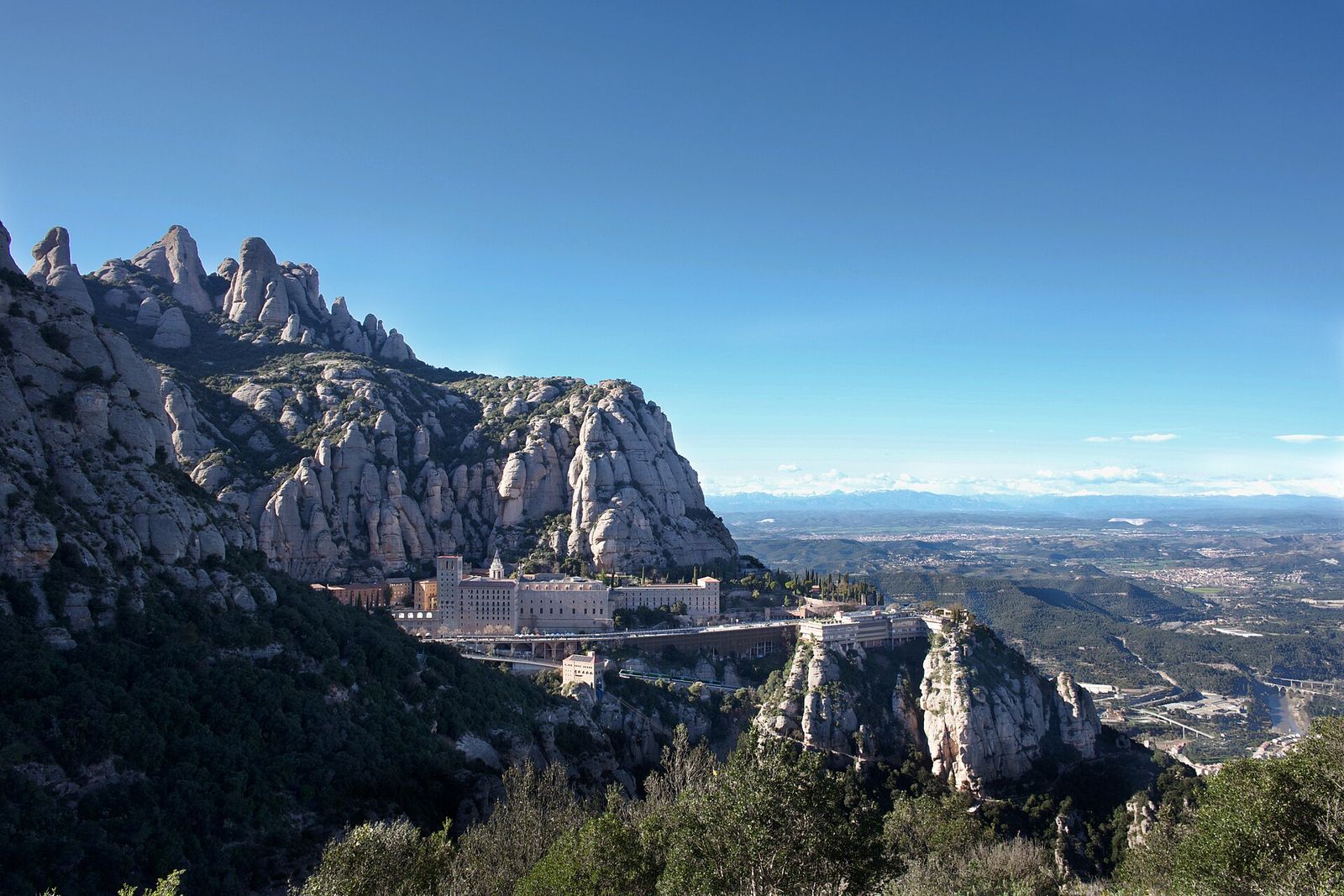
Montserrat, "the serrated mountain", rises abruptly from the plain north-west of Barcelona in a wall of rounded rock pinnacles. Halfway up sits the Benedictine monastery of Santa Maria de Montserrat, still home to a community of monks and one of Catalonia's most important places of pilgrimage.
Getting there: suburban trains run from Plaça d'Espanya. Get off at Monistrol de Montserrat for the rack railway or at Montserrat-Aeri for the cable car, so decide which you want before you set off; combined tickets cover the train and the ascent. You can also drive up a winding road.
What to see: - The basilica, where visitors queue to see the Virgin of Montserrat, a dark wooden statue known as La Moreneta. According to tradition, it was found in a cave on the mountainside. - The Escolania, one of the oldest boys' choirs in Europe, sings in the basilica at set times on many days. Check the schedule, as it doesn't sing every day. - The funiculars: one climbs to trails along the upper ridges; another descends towards the Santa Cova, the chapel at the site of the legend. - Walking trails: the path to Sant Jeroni, the highest point at around 1,236 metres, has wide views; allow several hours for the round trip from the monastery, less if you take the funicular up first. Shorter paths lead to viewpoints and old hermitages.
How long: a full day lets you combine the basilica with a walk. Dress respectfully for the basilica; it's a working monastery, so services take priority.
Girona: a medieval city on the river
Girona's compact old town climbs a hillside above the River Onyar, whose banks are lined with houses painted in ochre, red and yellow.
Getting there: high-speed trains from Sants take well under an hour; regional trains take roughly 1.5 hours and need no reservation. The station is a short walk from the old town.
What to see: - The cathedral, reached by a long flight of baroque steps, with one of the widest Gothic naves in the world. - El Call, the medieval Jewish quarter, a maze of narrow stepped lanes and one of the best-preserved in Europe, with a museum of Jewish history. - The city walls, with a walkway along the top and views over the rooftops. - The Arab Baths, despite the name a Romanesque bathhouse, and the Basilica of Sant Feliu. - The bridges over the Onyar, especially the red iron footbridge, for the classic view of the painted houses.
How long: a full day at an easy pace, or a half day if you're adding Figueres.
Figueres: Dalí's own museum
Salvador Dalí was born in Figueres and designed the Dalí Theatre-Museum himself, in the shell of the town's old theatre. It's crowned with giant eggs and filled with his paintings, installations and visual tricks, and the artist is buried in a crypt beneath it.
Getting there: high-speed trains reach Figueres Vilafant station in about an hour, a walk or short bus ride from the centre. Regional trains to the central station take longer. Girona and Figueres are only minutes apart by high-speed train, so they pair well.
How long: two to three hours for the museum. Timed tickets are strongly recommended in busy months. Dalí fans with a car can add his house at Portlligat near Cadaqués, visited in small groups that must be booked ahead, or the castle at Púbol that he gave to his wife, Gala.
Sitges: the seaside town
Sitges is a whitewashed resort town with a string of beaches, a palm-lined promenade and a church on a small headland. It's known for its lively carnival and an international film festival in autumn, and has long attracted artists.
Getting there: trains run along the coast from Sants and Passeig de Gràcia in about 40 minutes.
What to see: the old town around the Church of Sant Bartomeu i Santa Tecla, the Cau Ferrat museum in the former home and studio of the modernista painter Santiago Rusiñol, and the beaches, which get quieter the farther you walk from the centre.
How long: half a day for the town, a full day with time on the beach.
Tarragona: Roman Tarraco
Tarragona was Tarraco, one of the most important cities of Roman Hispania. Its remains are inscribed by UNESCO as the Archaeological Ensemble of Tárraco (2000).
Getting there: regional trains run down the coast to the central station, near the sea, in about an hour or a little more. High-speed trains use Camp de Tarragona, a station well outside the city, so check which station your ticket is for.
What to see: the amphitheatre on the shore, the remains of the Roman circus and the Praetorium tower, the Roman walls along the Passeig Arqueològic, and the cathedral at the top of the old town. With a car, add the Pont del Diable, a Roman aqueduct in the woods just outside the city.
How long: a full day. Families sometimes pair a Tarragona stay with the theme park at nearby Salou.
The Costa Brava
North of Barcelona, the Costa Brava ("wild coast") is a run of pine-backed coves, rocky headlands and small resort towns, linked by old coastal paths called camins de ronda. The best-known day trip is Tossa de Mar, whose walled medieval old town, the Vila Vella, stands on a headland above the beach.
Getting there: direct buses reach Tossa in roughly 1.5 hours, longer in summer traffic. Farther north, the coves around Calella de Palafrugell, Llafranc and Begur, and medieval inland villages such as Pals and Peratallada, are far easier with a car.
How long: a full day; a night or two lets you explore far more.
The Penedès and Colònia Güell
Two shorter trips leave from the city's suburban lines:
- The Penedès wine region: Sant Sadurní d'Anoia is the heart of cava production, with large and small cellars offering tours, and Vilafranca del Penedès has a wine museum. Trains take under an hour, which means nobody has to drive after a tasting. Book cellar tours ahead.
- Colònia Güell: a former textile workers' village where Antoni Gaudí designed the church. Only the crypt was completed, but it's an extraordinary building, listed by UNESCO among the Works of Antoni Gaudí. Trains from Plaça d'Espanya take around 20 minutes.
Practical tips for day trips from Barcelona
- Know your station. High-speed trains leave from Sants; Montserrat and Colònia Güell trains leave from Plaça d'Espanya; coastal trains to Sitges stop at Sants and Passeig de Gràcia.
- Book high-speed trains ahead. Seats on popular routes go early in busy months. Suburban and regional trains don't need reservations.
- Check the service on the day. Suburban lines are sometimes affected by engineering works or disruption, so check before you leave.
- Start early. An early train leaves time for a long lunch, which is when much of Catalonia slows down, and still gets you back for dinner.
- Watch the opening days. Many museums close one day a week, often Monday, and hours change with the seasons; check the official sites.
- Pick a convenient base. Staying near Sants or Plaça d'Espanya saves time on travel days; our guide to where to stay in Barcelona compares the neighbourhoods. If you're planning the city itself, our three-day Barcelona itinerary shows how to fit a day trip around it.
Bloiq is reader-supported. Some links may earn us a commission; it never affects what we write. How we make money.
Cover photo: Imaginepascal, CC BY-SA 4.0, via Wikimedia Commons
.jpg)