Home / Travel / Universities / Hong Kong
HKUST campus tour: the university above Clear Water Bay
A guide to the Hong Kong University of Science and Technology: the Red Bird sundial, the Atrium, the sea-view library, halls on the shore, transport and where to stay.
This guide contains affiliate links, marked as such. If you book through them, Bloiq may earn a commission at no extra cost to you.
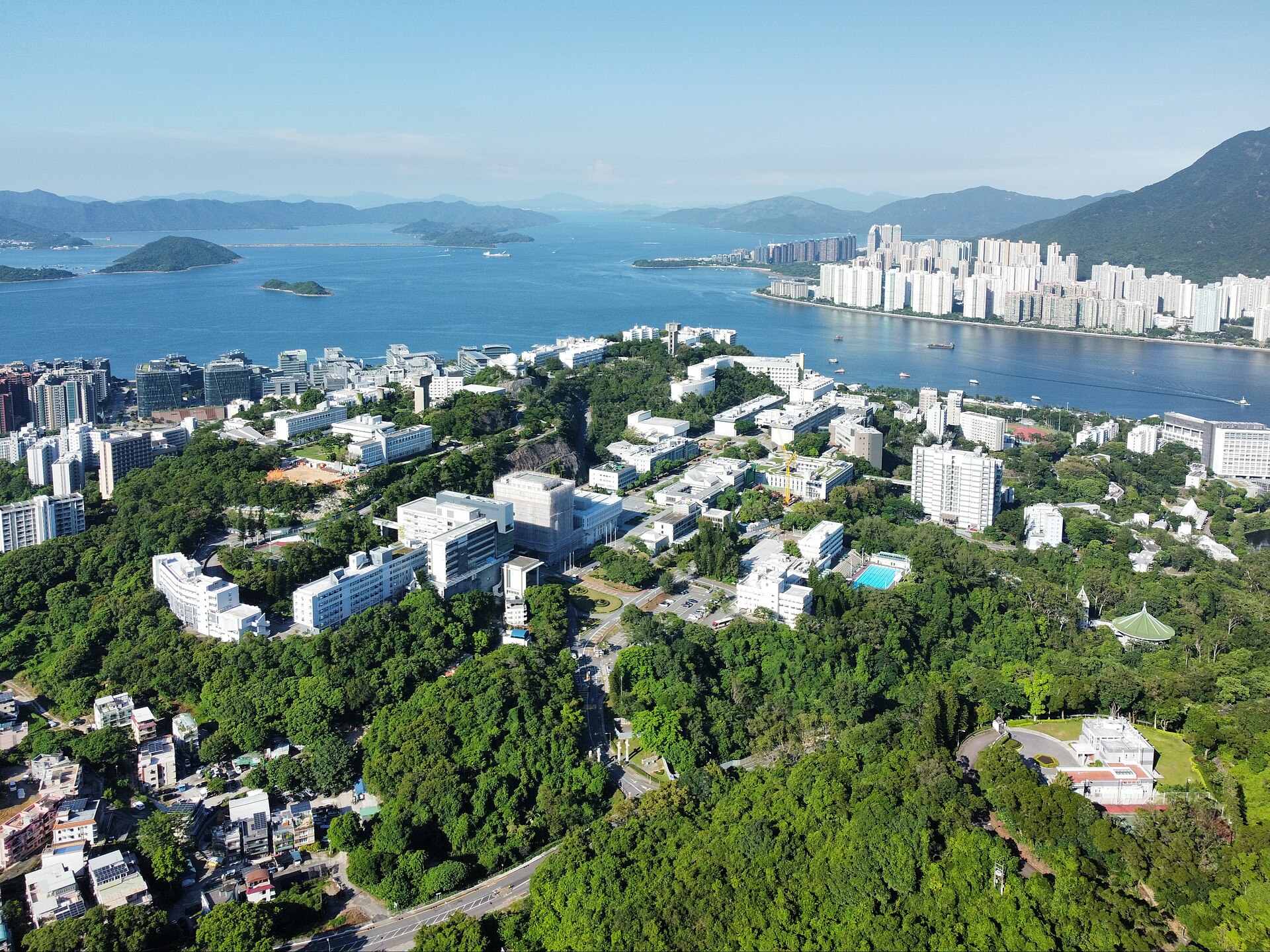
The Hong Kong University of Science and Technology, known everywhere as HKUST or simply UST, has one of the most dramatic university settings in Asia. Its white buildings step down a steep green slope on the Clear Water Bay peninsula, in the east of the New Territories, to a rocky shore and a wide bay dotted with islands. It is also young: the university opened in 1991, and almost everything you see was planned as a single campus. This guide explains the layout, the main sights and how to reach a campus that is not on a railway line.
A university built in one go
HKUST was created to give Hong Kong a research university focused on science, technology and business, and it admitted its first students in 1991. It has schools of science, engineering, business and management, and humanities and social science, and all teaching is in English. The student body is notably international, with exchange students and degree students from across Asia and beyond.
Because it was built all at once, the campus is unusually coherent. Most of the academic life happens inside one enormous linked building, and the rest of the campus, housing, sports and the newer blocks, is arranged down the slope below it.
The piazza and the Red Bird
Buses and taxis stop at a circular piazza at the top of the campus. In the middle stands the Red Bird sundial, a tall, curved red sculpture that is the university's emblem and appears on its souvenirs and in most graduation photos. Students have nicknamed it the "fire chicken", and a campus superstition holds that anyone who walks through the centre of the circle before graduating is asking for trouble with their grades. You'll notice people walking around the edge.
The Atrium and the Academic Building
Behind the piazza is the Atrium, a hall several storeys high under a glass roof, used for fairs, exhibitions and student society stalls. It is the front door to the Academic Building, a single complex that stretches along the hillside and contains most lecture theatres, laboratories and offices.
Finding your way inside takes practice. Rooms are identified partly by the nearest lift, so directions tend to sound like "take lifts 25 and 26", and the floors run down the hill as well as up, with several "lower ground" levels below the entrance. Signposting is good; allow extra time on a first visit.
A library with a sea view
The Lee Shau Kee Library occupies a curved, glass-fronted block beside the Atrium. Its reading floors face the bay, and the terrace outside is one of the best viewpoints on campus. Access to the library itself is generally for members of the university.
Down to the water
From the Academic Building the campus drops in terraces. Lifts, escalators and covered walkways lead down past canteens and student amenities to the undergraduate halls, and finally to the seafront, where there are a running track, a football pitch, a swimming pool and a short stretch of shore. On a clear day the walk down is the highlight of a visit; remember that you have to come back up.
Newer buildings have filled in the edges of the campus. The business school has its own glass building on the southern side, and a large white auditorium, opened in the 2020s, hosts concerts and ceremonies.
Student life
Many undergraduates live in the halls for at least part of their degree, which gives the campus a residential feel that is unusual in Hong Kong. Daily life revolves around the canteens, the sports facilities, the societies that set up in the Atrium and, inevitably, the library.
The location shapes weekends. Sai Kung, a short bus or minibus ride north, is known for its seafood restaurants, its harbour-front promenade and boats to nearby islands and beaches. To the south are the beaches of Clear Water Bay and well-marked hiking trails along the peninsula. The shopping centres of Tseung Kwan O are the nearest urban area, and Kowloon is within easy reach for an evening out.
Visiting
HKUST is a working campus, and arrangements for visitors have changed more than once in recent years. The university has offered guided tours led by student ambassadors and publishes information for prospective students through its admissions office; some of this needs to be requested in advance. Check the university's official website for what is currently possible before you go.
Getting there
There is no MTR station at the campus. The usual approach is by rail to one of two stations, then a short road journey:
- Hang Hau station (Tseung Kwan O Line): the closest. Buses, green minibuses and taxis run from the station to the campus in roughly ten minutes.
- Choi Hung station (Kwun Tong Line): buses and minibuses run along Clear Water Bay Road to the campus, taking a little longer.
- From the airport: take the Airport Express or a bus into the city and continue by MTR, or use a taxi for the whole journey.
Route numbers and stops change from time to time, so check a current transport app on the day.
Where families usually stay
- Tseung Kwan O: the nearest district with hotels, modern and residential, a few minutes from Hang Hau.
- East Kowloon (Kwun Tong, Kowloon Bay): business hotels with good MTR links to both Choi Hung and Hang Hau.
- Tsim Sha Tsui: the classic visitor area, with the widest choice; allow 45 minutes or more to the campus. Our page on The Peninsula Hong Kong covers that waterfront.
- Hong Kong Island (North Point, Quarry Bay): on the eastern side of the Island, with a direct MTR line to Tseung Kwan O.
Practical tips
- Pick a clear day if you can; the views are half the experience.
- Autumn and early winter are the most comfortable months. Summer is hot and humid, with a risk of typhoons.
- An Octopus card works on the MTR, buses and minibuses.
- Combine the campus with Sai Kung for lunch by the harbour.
- Comparing Hong Kong universities? See our University of Hong Kong campus tour and our Chinese University of Hong Kong campus tour.
Bloiq is reader-supported. Some links may earn us a commission; it never affects what we write. How we make money.
Cover photo: Hkust pao, CC BY-SA 3.0, via Wikimedia Commons