Home / Travel / Universities / Hong Kong
Chinese University of Hong Kong campus tour: colleges on a hill
A guide to CUHK's hillside campus in Sha Tin: the nine colleges, the University Mall, the Pavilion of Harmony, Chung Chi's lake, transport and where to stay.
This guide contains affiliate links, marked as such. If you book through them, Bloiq may earn a commission at no extra cost to you.
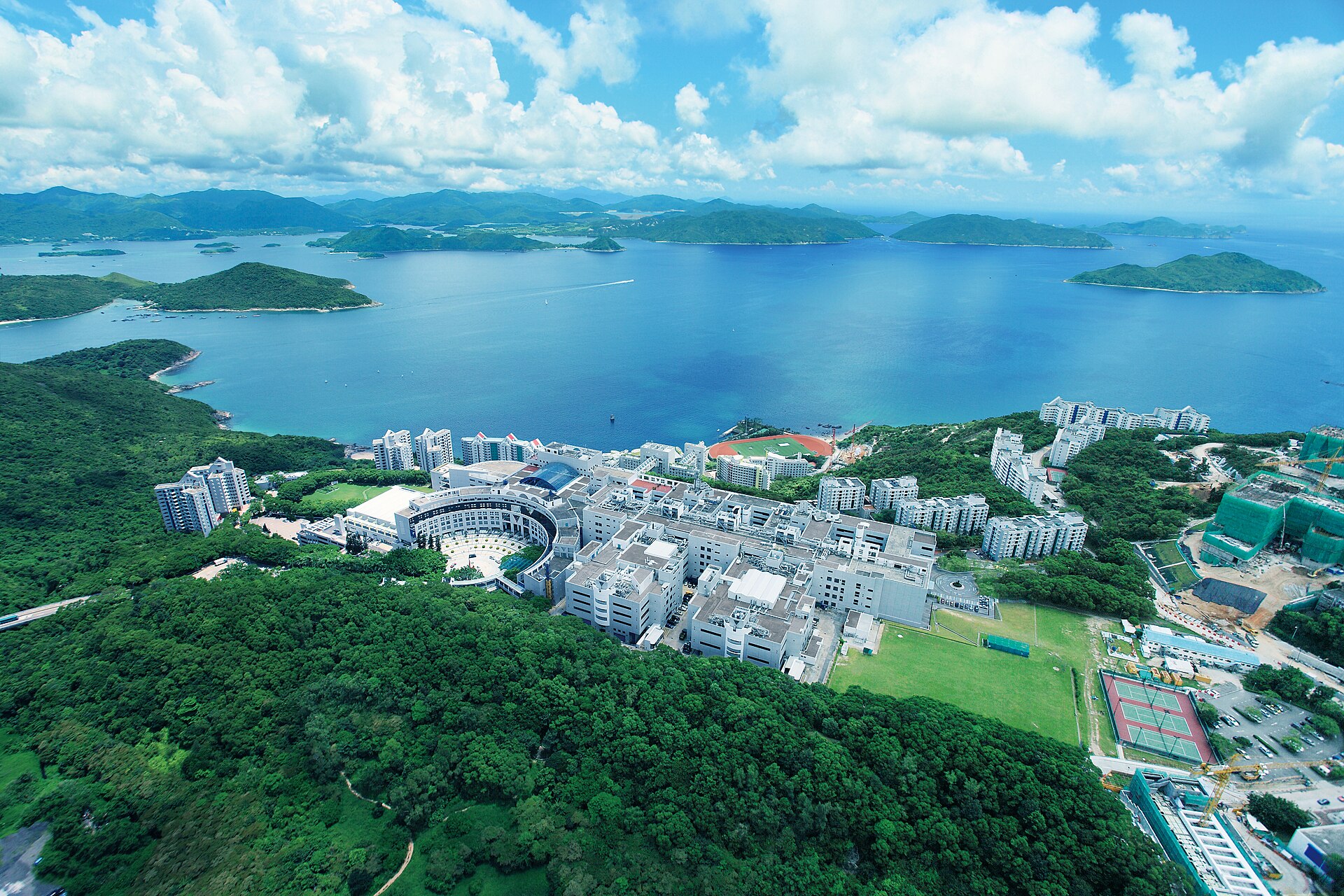
The Chinese University of Hong Kong, CUHK for short, does not look like the Hong Kong of postcards. Its campus is a forested hillside in the New Territories, north of the Kowloon hills, with white buildings stepping up from a railway station at sea level to two colleges on the summit, and Tolo Harbour spread out below. It is the largest campus in Hong Kong and the only one organised around colleges. This guide explains how the place fits together and how to see it without exhausting yourself on the slopes.
Three colleges become a university
CUHK was founded in 1963 as a federation of three existing colleges, each with its own story:
- New Asia College (1949) was started by scholars who had left mainland China, led by the historian Ch'ien Mu, to keep Chinese humanist learning alive.
- Chung Chi College (1951) was founded by Protestant churches in the Christian college tradition.
- United College (1956) brought several smaller colleges together.
The name "Chinese University" refers to language and culture: from the start, the university has taught in both Chinese and English, and it still does.
How the college system works
There are nine colleges today. Shaw College joined the first three in the 1980s, and five smaller ones (Morningside, S.H. Ho, C.W. Chu, Wu Yee Sun and Lee Woo Sing) were added from 2006. Every undergraduate belongs to one. The colleges don't teach degree subjects; they provide hostels, dining halls, general education, sports teams, scholarships and a smaller community within a big university. Some of the newer colleges are fully residential, with communal dining.
For a prospective student, the choice of college shapes daily life more than almost anything else, so it's worth seeing at least two.
The campus in three levels
Think of the campus as three terraces.
The lower level is Chung Chi College, right beside University Station. Its heart is Lake Ad Excellentiam, a quiet pond ringed by willows and footbridges, with the college chapel close by.
The middle level is the central campus. The University Mall, a long ceremonial avenue, runs between the main library and the Science Centre. In front of the library stands the Gate of Wisdom, a rough-hewn bronze by the Taiwanese sculptor Ju Ming, and the administration building and the main concert hall are alongside. The Art Museum, in the Institute of Chinese Studies, is generally open to the public and shows Chinese painting, calligraphy and ceramics.
The upper level holds New Asia and United colleges, side by side on the summit. At New Asia, the Pavilion of Harmony has a shallow pool whose far edge seems to merge with Tolo Harbour, a reference to Ch'ien Mu's idea of the unity of humanity and nature. It is the view everyone comes for; go on a clear day. United College's water tower, next door, is a landmark visible from across the harbour.
Shaw College and the newer colleges sit on the ridges to the north and west.
Getting around the slopes
Walking from the station to the summit is a real climb, especially in the humid months. Shuttle buses run fixed routes between the station, the central campus and the colleges; check on arrival which routes visitors may use. Students also know a network of shortcuts: lifts inside teaching buildings, covered staircases and footbridges that link one level to the next.
Student life
Much of life is lived in the colleges: hostel floors, dining halls, college assemblies and inter-college sport. Societies and clubs are numerous, and the long harbour-side cycle track that passes the foot of the campus is popular for running and cycling. The Hong Kong Science Park, a cluster of technology companies and laboratories, is just along the shore.
The setting is quieter than the urban universities, but the railway makes the city easy to reach, and the new town of Sha Tin, with its large shopping centres and restaurants, is two stops away.
Visiting
The campus is in daily use, and access for the public has varied in recent years, so don't assume the gates are open to all at all times. The university has offered guided tours for groups by arrangement and publishes information for prospective students through its admissions office. Check CUHK's official website for the current position before you go.
Getting there
- MTR East Rail Line: University Station is at the foot of the campus. Trains run north from Admiralty on Hong Kong Island through Kowloon and Sha Tin; allow about half an hour from Admiralty and less from Kowloon.
- From the airport: take the Airport Express or a bus into Kowloon and change to the East Rail Line, or use an airport bus to Sha Tin.
- From mainland China: the East Rail Line continues north to the border crossings, which makes CUHK the closest of Hong Kong's universities to Shenzhen.
- By taxi: useful for reaching the upper colleges directly.
Where families usually stay
- Sha Tin: the nearest town centre, on the same railway line, with hotels, shopping and the riverside park. There is also a hotel beside University Station itself.
- Kowloon (Tsim Sha Tsui, Mong Kok): more choice and the classic harbour views, with a direct or one-change train ride. Our page on The Peninsula Hong Kong describes the Tsim Sha Tsui waterfront.
- Hong Kong Island (Admiralty, Wan Chai): convenient since the East Rail Line was extended across the harbour, and best for combining with other sights.
Practical tips
- October to December is the most comfortable time, with clear, dry days. Summer is hot, humid and prone to typhoons.
- Start at the top and walk down: ride up to New Asia College, then descend through the central campus to Chung Chi and the station.
- Bring water and wear shoes with grip; some paths and staircases are steep.
- An Octopus card covers trains and buses.
- Comparing Hong Kong universities? See our University of Hong Kong campus tour and our HKUST campus tour.
Bloiq is reader-supported. Some links may earn us a commission; it never affects what we write. How we make money.
Cover photo: 建園春秋, CC BY-SA 4.0, via Wikimedia Commons