Home / Travel / United States · Campus tours
University of Chicago campus tour: Hyde Park, Gothic quads and the lake
Plan a visit to UChicago: Hull Gate and the Main Quadrangle, Harper Library, Rockefeller Chapel, Mansueto Library, the Midway, Robie House and where to stay.
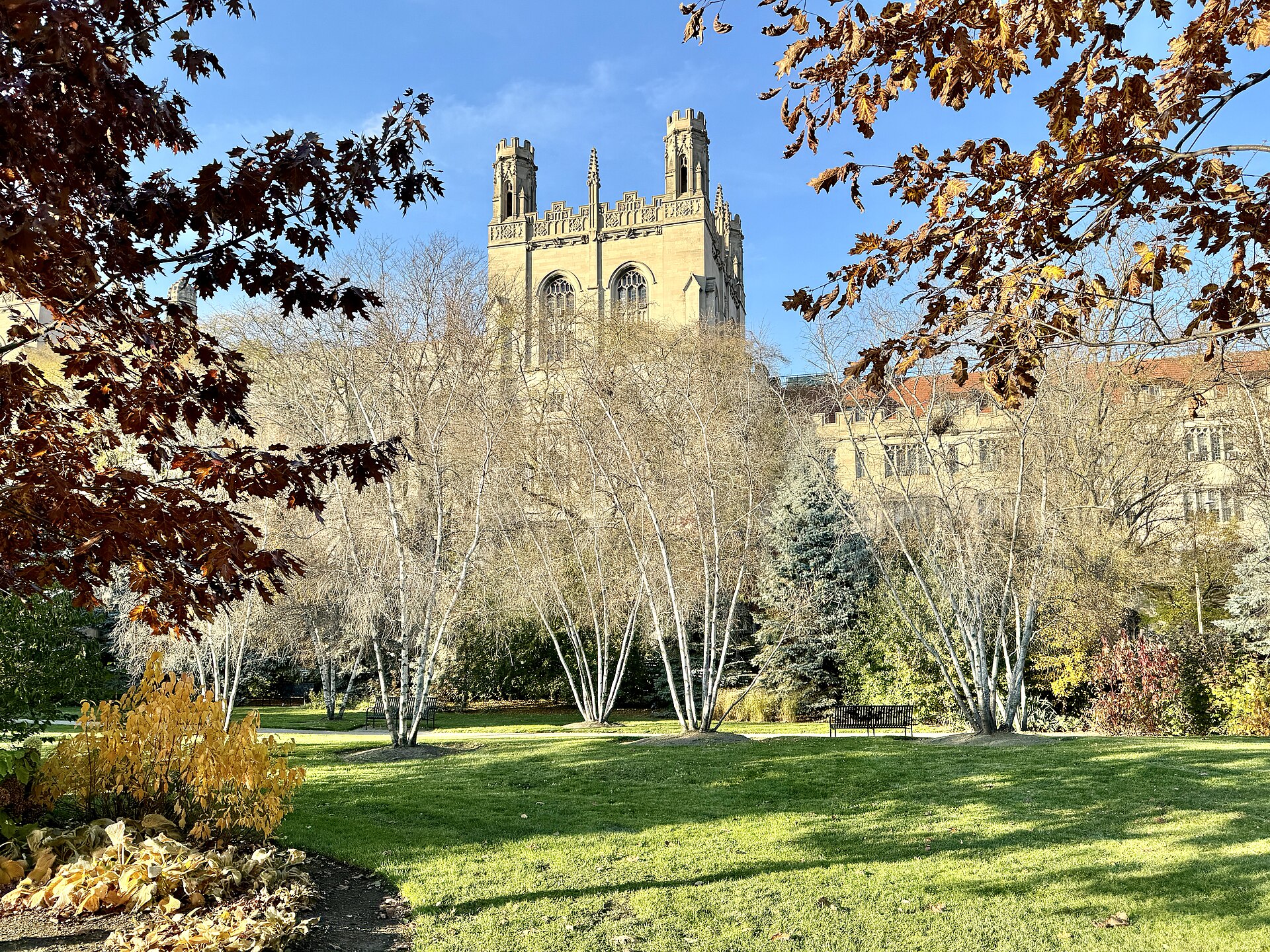
The University of Chicago was founded in 1890 with support from John D. Rockefeller and opened its doors two years later. Its campus fills a large part of Hyde Park, a leafy neighbourhood on Chicago's South Side, a few blocks from Lake Michigan and a short train ride from downtown. The look is unmistakable: grey limestone, pointed arches, towers and gargoyles, arranged around enclosed quadrangles. This guide suggests a walking route, explains how campus life works and covers the practical side of visiting.
Before you arrive: how the campus fits together
The historic core is the Main Quadrangle, a cluster of connected quads between 57th and 59th Streets. South of it runs the Midway Plaisance, a long, wide strip of park that divides the northern campus from newer buildings on the south side. Rockefeller Chapel stands at the eastern end of the main campus, the big modern Regenstein and Mansueto libraries lie to the north-west, and the residential streets of Hyde Park wrap around it all. Most of what visitors want to see is within a 15-minute walk.
Hull Gate and the Main Quad
Start at Hull Gate, the arched entrance on 57th Street that leads into the Main Quadrangle. Inside, paths cross lawns shaded by old trees, surrounded by Gothic limestone buildings covered in carved detail. It's a quiet, enclosed space that feels far from the city, and in autumn, when the ivy turns red, it's especially photogenic. Walk slowly and look up: the gargoyles and grotesques are part of the fun.
Two very different libraries
On the south side of the quads, Harper Memorial Library has a long reading room with high arched windows and a vaulted ceiling. It's one of the most atmospheric study spaces anywhere, and students use it every day, so keep your voice down if you step inside.
For contrast, walk north to the Joe and Rika Mansueto Library, a glass dome beside the Regenstein Library. Under the reading room, millions of volumes are stored in a deep underground vault and fetched by robotic cranes when requested. The combination of these two buildings says a lot about the university: old traditions and a deep investment in research.
Rockefeller Chapel
Rockefeller Chapel, at the eastern end of campus on the edge of the Midway, is a huge Gothic building with a carillon in its tower. When the bells are played, they ring out over the whole neighbourhood. The chapel hosts services, concerts and university ceremonies, and it's often open to visitors outside events.
The Midway and Robie House
The Midway Plaisance was the setting for amusements at the 1893 World's Columbian Exposition, and today it's a broad green space used for walking, sports and, in winter, an ice rink. A few minutes' walk from the chapel, Frank Lloyd Wright's Robie House is one of the best-known Prairie School houses and part of a UNESCO World Heritage Site covering Wright's 20th-century architecture. Guided tours of the house are usually available; check its official site for times.
Also on campus, a Henry Moore sculpture marks the site where the first self-sustaining nuclear chain reaction took place in 1942.
Living and studying here
First-year students live in residence halls divided into smaller houses, each with its own community, events and traditions, which helps a large university feel smaller. Student life centres on the quads, the libraries and the streets of Hyde Park, with bookshops such as the Seminary Co-op and 57th Street Books, cafés and casual restaurants within easy reach. The Smart Museum of Art and the Court Theatre add art and drama on campus.
Lake Michigan and the neighbourhood
Promontory Point, a short walk east along 55th Street, juts into Lake Michigan and gives wide views back to the downtown skyline. It's popular for picnics, running and watching the sunset. Jackson Park, just south-east of campus, is home to the Museum of Science and Industry, housed in a building from the 1893 fair. The lakefront trail runs north all the way to downtown.
Tours and information sessions
The university typically offers admissions information sessions and student-led campus tours for prospective students. Places are limited and usually need to be booked in advance, so check the university's official visitor pages for current dates and times. Term time gives the truest picture of campus life; summer and the winter break are much quieter.
Getting there
- From the airports: O'Hare and Midway both serve Chicago; Midway is closer to Hyde Park. Allow extra time for traffic.
- By train from downtown: Metra Electric trains run from downtown stations to Hyde Park, stopping at 55th–56th–57th Street and 59th Street, both close to campus.
- By bus: several CTA bus routes link Hyde Park with downtown and nearby train lines.
- Around campus: walking works well; the university also runs shuttle buses around the area.
Where families usually stay
- Hyde Park: a handful of hotels within walking distance of campus; convenient but limited, so book early.
- Downtown (the Loop and South Loop): far more choice, with easy Metra or bus links to Hyde Park, and the city's museums and architecture to explore after your visit.
- Near the lakefront: some families base themselves close to Museum Campus or Streeterville for sightseeing.
Practical tips
- Chicago winters are cold and windy; dress in layers from November to March.
- Plan half a day for the campus, the chapel and the libraries, and add time for Robie House and the lakefront.
- Check the university's official visitor pages again shortly before your trip, as schedules and access rules change.
- Trains from Chicago towards Detroit stop in Ann Arbor, so the University of Michigan fits well as a second visit on the same trip.
Bloiq is reader-supported. Some links may earn us a commission; it never affects what we write. How we make money.
Cover photo: Warren LeMay from Chicago, IL, United States, CC BY-SA 2.0, via Wikimedia Commons
.jpg)