Home / Travel / United Kingdom · Campus tours
University of Manchester campus tour: Oxford Road, libraries and labs
A visitor's guide to the University of Manchester: the Old Quad, the Oxford Road campus, the John Rylands Library, student areas like Fallowfield, transport and where to stay.
The University of Manchester is a big, city-centre university with a record of scientific firsts that few can match. Its main campus stretches along Oxford Road, a long, busy corridor of universities, hospitals and cultural venues, from the edge of the city centre south towards Rusholme and Fallowfield. For future students, the draw is the combination of a major research university and one of Britain's liveliest cities. This guide walks you down the campus, explains where students actually live, and covers the practical side of a visit.
One university, several histories
Today's university was created in 2004, when the Victoria University of Manchester merged with UMIST, a neighbouring institute of science and technology. Its roots go back much further, to a mechanics' institute of the 1820s and Owens College, founded in 1851. The merger explains the campus's shape: the former UMIST buildings sit at the northern end near Piccadilly, while the older Victorian core lies further south along Oxford Road.
Walking Oxford Road, north to south
A walk from Oxford Road station southwards takes in most of the main campus in about half an hour.
The northern end. Around Sackville Street and the former UMIST area, you'll find engineering and science buildings, and in nearby Sackville Gardens, a statue of Alan Turing sitting on a bench. Turing worked at the university in the years after the Second World War.
The Alan Turing Building and the science quarter. Further south, modern buildings house mathematics, physics, computer science and the National Graphene Institute. Graphene, the one-atom-thick form of carbon, was first isolated here in 2004 by Andre Geim and Konstantin Novoselov, who received the Nobel Prize in Physics for it in 2010.
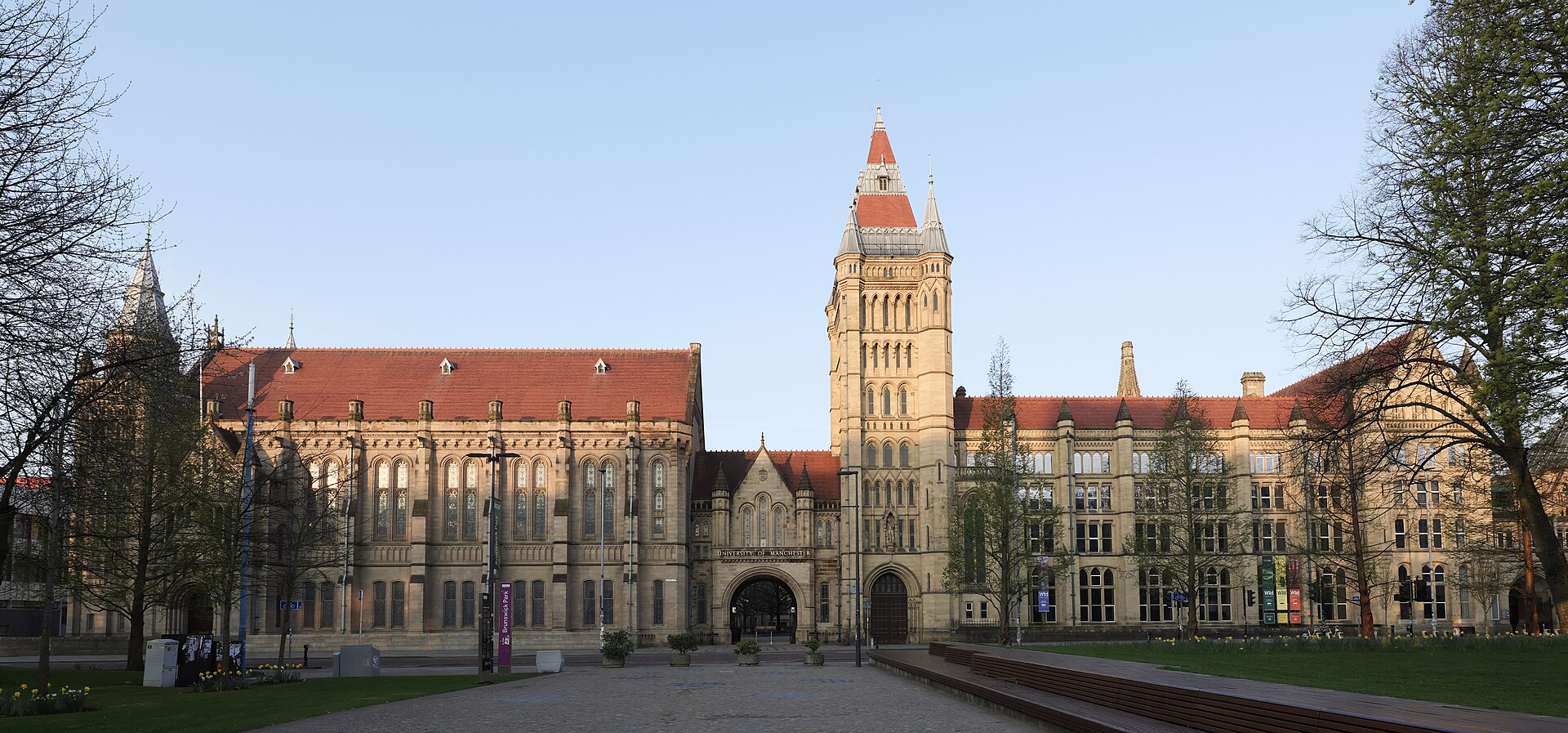
The Old Quad. The heart of the historic campus is the Victorian Gothic Whitworth Building designed by Alfred Waterhouse, with its tall tower and archway on Oxford Road. Pass through to the Old Quad, a quiet lawn surrounded by the oldest buildings, including Whitworth Hall, where graduation ceremonies are held.
Manchester Museum. Next door, in another Waterhouse building, the university's museum covers natural history, archaeology and world cultures, with dinosaur casts and Egyptian collections. It reopened after a major redevelopment in 2023.
The student hub. Opposite, the Students' Union building, the Main Library and the Alan Gilbert Learning Commons, a modern study building open around the clock during term, form the busiest part of campus. Further south still is The Whitworth, the university's art gallery, set in Whitworth Park.
Scientific firsts to know about
Manchester students are often reminded of the work done here before them. Ernest Rutherford developed the nuclear model of the atom in Manchester and later carried out the first artificial transformation of one element into another, often described as splitting the atom. In 1948 the Manchester Baby became the first computer to run a program stored in its own electronic memory. The university also runs Jodrell Bank Observatory in Cheshire, home of the giant Lovell Telescope and a UNESCO World Heritage Site, which has a visitor centre worth a separate trip.
A detour to Deansgate
In the city centre, about 20 minutes' walk from the Old Quad, the John Rylands Research Institute and Library on Deansgate is part of the university. Opened in 1900 and built in a dramatic neo-Gothic style, it looks more like a cathedral than a library. Its reading room is one of the most striking interiors in the city, and its collections include some of the earliest surviving fragments of the New Testament.
Where students live and spend their time
Most first-year undergraduates live in university accommodation, spread across three main areas: residences in and around the city centre and the campus, Victoria Park, and Fallowfield, a large student district a few kilometres south along Wilmslow Road. Buses run along the Oxford Road and Wilmslow Road corridor at very short intervals day and night, passing the Curry Mile in Rusholme, a stretch lined with South Asian and Middle Eastern restaurants.
Sports facilities include a large sports centre on campus shared with Manchester Metropolitan University, facilities in Fallowfield and the Manchester Aquatics Centre on Oxford Road, built for the 2002 Commonwealth Games. The union's live music venues, the city's gig scene, two famous football clubs and neighbourhoods such as the Northern Quarter and Didsbury give the city its student reputation.
Open days and tours
The university holds undergraduate open days, typically in early summer and in the autumn, with subject talks, accommodation visits and campus tours led by current students; self-guided options are usually available at other times. Registration is generally required. Check the official open-day pages for dates and formats before planning your journey.
Reaching campus
- By train: Manchester Piccadilly has direct trains from London Euston, taking a little over two hours, and from most major UK cities. Oxford Road station sits at the northern edge of the campus. Euston is a short walk from UCL, so a London visit pairs easily: see the UCL campus tour.
- From the airport: trains run frequently from Manchester Airport to Piccadilly and Oxford Road, taking around 20 minutes.
- Around the city: walk or take the very frequent buses along Oxford Road. The Metrolink tram network covers the city centre and suburbs, but not the campus itself.
Picking a neighbourhood for your stay
- The city centre, around St Peter's Square, Deansgate and Piccadilly, within walking distance of the northern end of campus and the John Rylands Library.
- The Oxford Road corridor, for the shortest walk to the Old Quad on open days.
- The Northern Quarter, for independent cafés and a livelier evening scene.
- Didsbury, a leafy southern suburb with good bus links along Wilmslow Road.
Tips for the day
- Start at Oxford Road station and walk south so the campus unfolds in order.
- Take a bus to Fallowfield to see where many first-years actually live.
- Make time for the John Rylands Library, even if only for half an hour.
- Bring an umbrella: Manchester's reputation for rain is not entirely unfair.
Bloiq is reader-supported. Some links may earn us a commission; it never affects what we write. How we make money.
Cover photo: MichaelDavidBeckwith, CC0, via Wikimedia Commons