Home / Travel / United Kingdom · Campus tours
UCL campus tour: Bloomsbury, the Portico and student London
A guide to visiting University College London: the Wilkins Building and Portico, Bloomsbury's squares, UCL's museums, student life, UCL East, transport and where to stay.
University College London sits in Bloomsbury, the leafy academic quarter just north of the West End, where its buildings mix with garden squares, publishers, hospitals and the British Museum. There's no gate or fence: the university simply fills block after block around Gower Street. That makes UCL easy to reach and fascinating to walk around, but it helps to know what you're looking at. This guide is for future students and parents planning a visit.
A radical beginning
UCL was founded in 1826, as London's first university. It was set up to be open to students regardless of religion, at a time when Oxford and Cambridge were restricted to members of the Church of England, and it later became one of the first universities in England to admit women on equal terms with men. The philosopher Jeremy Bentham is often called its spiritual father. His preserved skeleton, dressed in his own clothes and topped with a wax head, sits on public display on campus in a glass case, the famous "auto-icon", and has become an unofficial mascot.
The main quad and the Portico
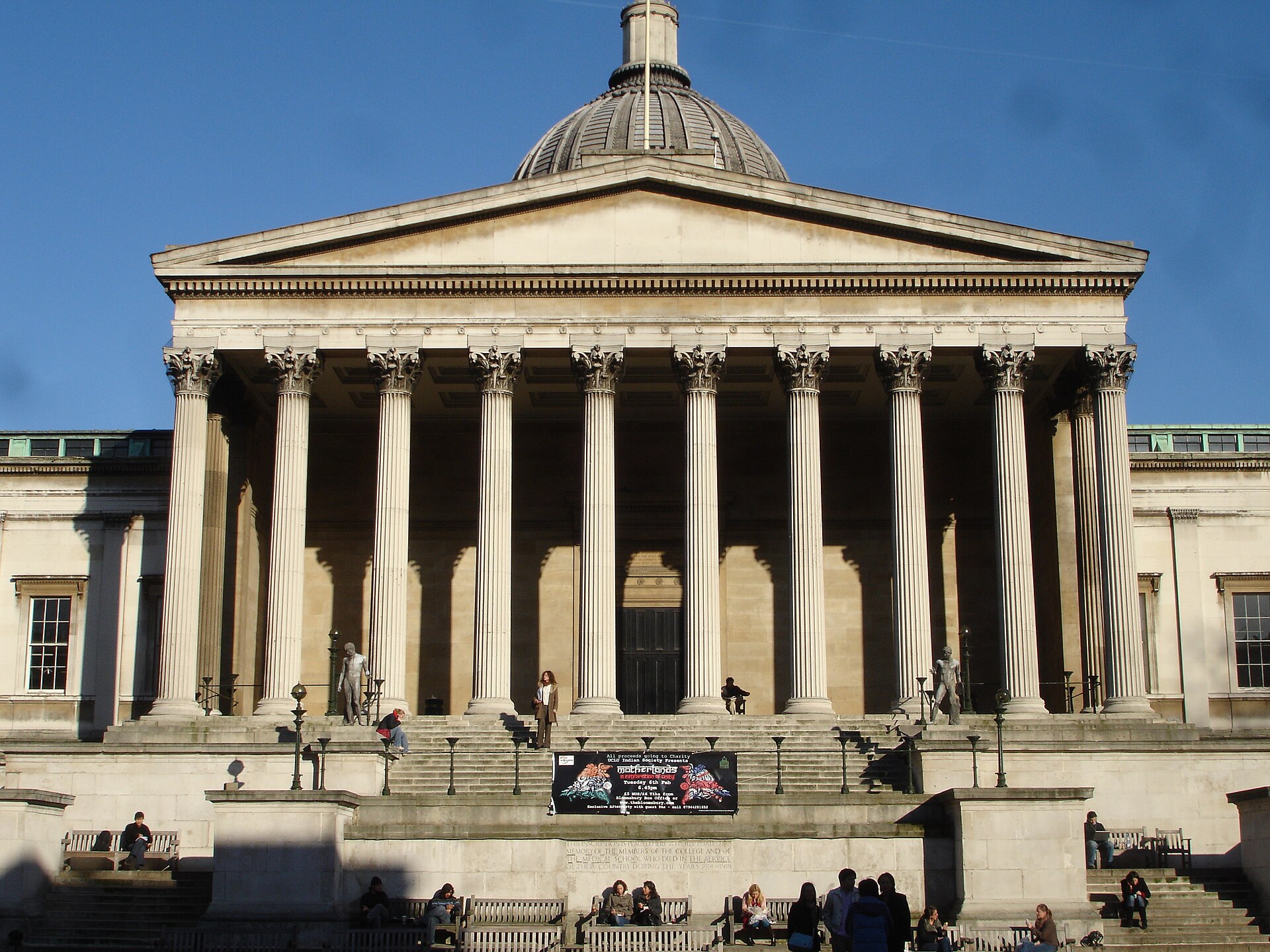
Enter from Gower Street into the main quadrangle, facing the Wilkins Building. Its broad steps, tall Corinthian portico and dome, designed by William Wilkins, who also designed the National Gallery, make it UCL's defining image and a favourite meeting place. Graduation photos, club recruitment and summer lunches on the steps all happen here.
Inside the dome, the Flaxman Gallery displays plaster models by the sculptor John Flaxman. The UCL Main Library, with its historic reading rooms, occupies much of the building, and the South and North Cloisters lead off the quad.
Around Gower Street
UCL's buildings spread out from the quad in every direction:
- The Student Centre on Gordon Street, a modern building with study spaces across several floors, is where many students spend their long library days.
- The Science Library and many engineering and science departments cluster along Gower Street and Malet Place.
- Senate House, the tall Art Deco tower on Malet Street, belongs to the University of London, the federation that UCL is part of, and houses its library.
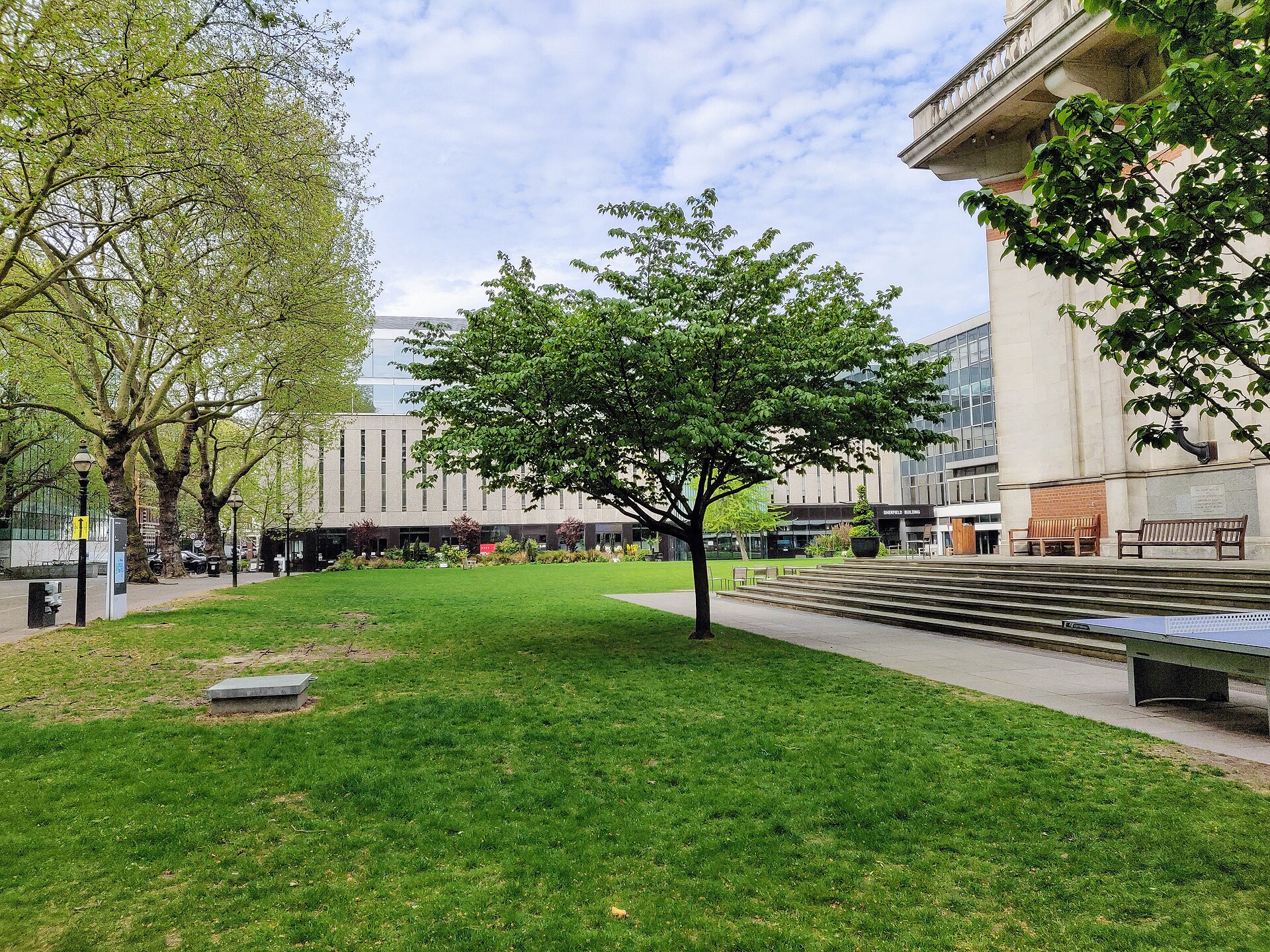
- Garden squares such as Gordon Square, Tavistock Square and Russell Square are the campus's lawns in practice, with benches and big trees.
UCL's collections are open to the public and make a good add-on to a visit:
- The Grant Museum of Zoology, a single crowded room of skeletons and specimens in jars.
- The Petrie Museum of Egyptian Archaeology, one of the largest collections of Egyptian and Sudanese archaeology in the world.
- UCL Art Museum, with prints and drawings shown in changing displays.
Check their opening days before you go; they are smaller than the national museums and keep shorter hours. The British Museum is a five-minute walk away.
UCL East and other sites
In recent years UCL has opened a second campus, UCL East, on Queen Elizabeth Olympic Park in Stratford, east London, with modern buildings for engineering, design, the environment and other newer programmes. Some courses are taught partly or wholly there. Medical students also spend time at teaching hospitals in the area, including University College Hospital on Euston Road.
What student life is like
UCL is large and international, and it feels like a university inside a capital city rather than a closed campus. Most first-year undergraduates live in university halls around Bloomsbury, King's Cross, Camden and other parts of central and north London, often within walking or cycling distance of the main site.
The students' union runs hundreds of clubs and societies, from sport and debating to music and film, and the Bloomsbury Theatre on Gordon Street hosts student productions. Sports teams train at UCL's facilities and at grounds outside central London. Much of the social life happens in the surrounding neighbourhood: the cafés and bookshops of Bloomsbury, the restaurants of Fitzrovia and Charlotte Street to the west, the canal and Granary Square at King's Cross, and Regent's Park to the north-west.
How visits work
UCL holds undergraduate open days, typically in the summer, when departments give talks, show their facilities and answer questions, and current students lead tours. At other times you can explore the public spaces and museums on your own. Some events require registration and places can fill up, so check UCL's official open-day and visitor pages for current dates and details before planning a trip.
How to get there
- Nearest stations: Euston Square (Circle, Hammersmith & City and Metropolitan lines) is next to the campus; Warren Street, Goodge Street, Russell Square and Euston are all within a few minutes' walk.
- By rail: Euston station is a few minutes' walk north, and King's Cross St Pancras, with Eurostar trains to Paris and Brussels, is about 15 minutes on foot.
- From Heathrow: the Piccadilly line runs direct to Russell Square; the Elizabeth line reaches Tottenham Court Road, a short walk south.
- To UCL East: allow around half an hour by Tube or Overground to Stratford.
Where families usually stay
Bloomsbury itself is the obvious base: central, calmer than the West End and full of hotels of every size. King's Cross works well if you arrive by train, and Fitzrovia and Covent Garden are both walkable. Our where to stay in London guide compares these areas in detail.
Tips for a good visit
- Start at the Portico, then walk the squares to get a feel for how UCL fits into the neighbourhood.
- If your course is at UCL East, make time to see Stratford too.
- Combine the day with the British Museum or a walk to King's Cross.
- Comparing London options? Our Imperial College London campus tour covers South Kensington, about half an hour away by Tube, and three days in London helps fill the rest of the trip.
Bloiq is reader-supported. Some links may earn us a commission; it never affects what we write. How we make money.
Cover photo: LordHarris at English Wikipedia, CC BY-SA 3.0, via Wikimedia Commons