Home / Travel · Campus tours
KU Leuven campus tour: a day in Belgium's great university town
What to see on a KU Leuven visit: University Hall, the library tower, the Great Beguinage, Arenberg Castle, student life in Leuven, open days and where to stay.
In Leuven the university isn't a place in the city; it very nearly is the city. KU Leuven, founded in 1425 and the oldest university in the Low Countries, owns historic buildings on almost every central street, and students make up a large share of the people you'll pass. The town is small enough to cover on foot in a day, just 25 minutes or so by train from Brussels. This guide follows a walking route from the old centre to the science campus and adds what families need to plan a visit.
A quick orientation
Leuven's centre sits inside a ring road that follows the old city walls. The station is on the east side of the ring; from there, Bondgenotenlaan runs straight to the Grote Markt, the main square. The university's humanities, law and social sciences occupy buildings in and around the centre, while science and engineering are on the Arenberg campus in Heverlee, just south, and medicine on the Gasthuisberg hospital campus to the west.
One historical note explains a lot: in 1968 the university split along language lines. The Dutch-speaking KU Leuven stayed here, and the French-speaking UCLouvain built a new town, Louvain-la-Neuve, south of Brussels. Make sure you're looking at the right one.
The Grote Markt and University Hall
Start at the Grote Markt, dominated by the Gothic Town Hall, whose facade is covered with statues, and St Peter's Church opposite. A few steps south along Naamsestraat is University Hall (Universiteitshal), built in the 14th century as the city's cloth hall and home to the university since its early years. Today it holds the central administration and ceremonial rooms. Its interior is not generally open to casual visitors, but the facade and the street around it are the university's historic front door.
Ladeuzeplein and the library tower
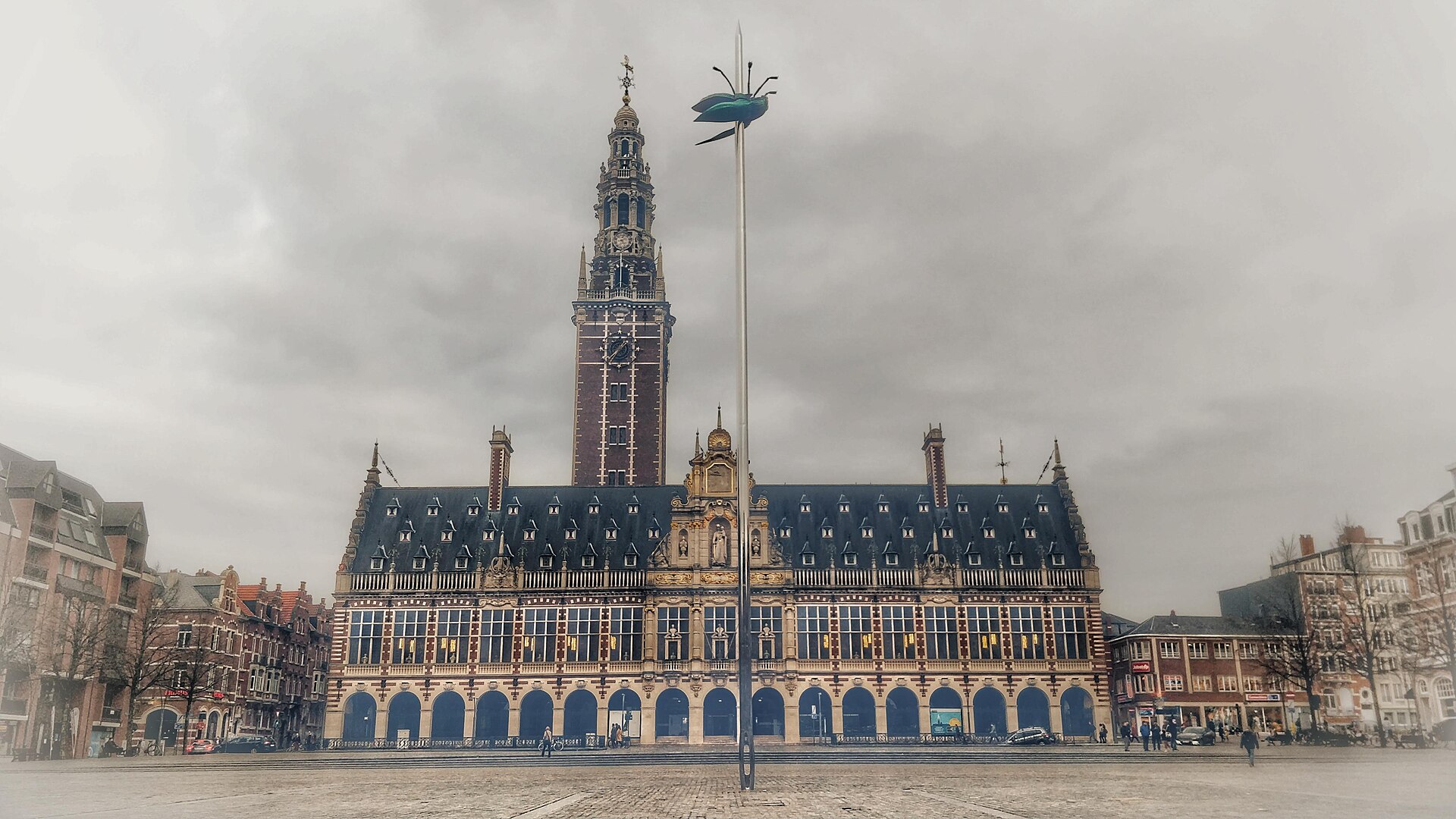
Walk east to Ladeuzeplein, a broad square dominated by the University Library, a monumental Flemish Renaissance-style building with a tall bell tower. Its story is part of the city's: the old library was burned by German troops in 1914, rebuilt in the 1920s with large donations from the United States, and badly damaged again in 1940. The tower has a carillon, and visitors can usually climb it for one of the best views over Leuven; check current opening before you go.
In the middle of the square, the tall needle with a jewel beetle skewered at its top is Totem, a sculpture by the Belgian artist Jan Fabre.
The Great Beguinage
Head south along Naamsestraat to the Groot Begijnhof, one of the most beautiful corners of Belgium. It's a walled neighbourhood of brick houses, cobbled lanes and small bridges over the Dijle, built from the 13th century onwards for the beguines, lay religious women. The university bought and restored it in the 1960s, and it now houses students and visiting academics. It's part of the UNESCO World Heritage listing of Flemish beguinages. Respect the residents: it's a place where people live.
Arenberg Castle and the science campus
Continue south into Heverlee and the Arenberg campus, a green park with the turreted Arenberg Castle at its centre and modern faculty buildings around it. Engineering and science students spend much of their time here. It's a pleasant 20 to 30 minutes' walk from the centre, or a short bus ride.
Life as a Leuven student
Most students live in a kot, the local word for a student room, rented in private houses or university residences across the centre. The Oude Markt, a square packed end to end with bars and terraces, is the social heart of the town, nicknamed the longest bar in Europe. Student associations organise events for each faculty and region, and the university sports centre offers a big programme. Plenty of Belgian students go home at weekends, so Leuven is liveliest from Monday to Thursday.
Most bachelor's programmes are taught in Dutch, with a small number in English; many master's programmes are taught in English. KU Leuven also has campuses in other Flemish cities and in Brussels, so check where a programme is based.
How to visit
KU Leuven holds information days for future students, with presentations for each programme, taster lectures and campus walks, and runs online sessions for international applicants. Outside events, you can explore the public streets, squares and the Beguinage freely. Check the university's official pages for future students for current dates.
Getting there and getting around
- From Brussels Airport: direct trains reach Leuven in roughly 15 minutes.
- From Brussels: frequent trains take about 25 minutes from Brussels Central.
- In town: everything in the centre is walkable, and buses link the station, Arenberg and Gasthuisberg. Leuven is a cycling town; watch for bikes on every street.
Staying overnight
- The old centre around the Grote Markt and Oude Markt: walkable to everything, though lively at night.
- Near the station: practical for trains to Brussels and the airport.
- Heverlee: quieter and green, close to the Arenberg campus.
- Brussels: a larger choice of hotels and an easy daily train commute.
Practical tips
- Visit on a weekday in term: the city is noticeably quieter at weekends and in summer.
- Combine the visit with Brussels, Ghent or Antwerp, all within easy train range. Direct international trains from Brussels also make Paris and Amsterdam practical next stops; see the Sorbonne and University of Amsterdam campus tours.
- Plan the library tower climb around its visiting times, and save it for a clear day.
Bloiq is reader-supported. Some links may earn us a commission; it never affects what we write. How we make money.
Cover photo: Socket0, CC BY-SA 3.0, via Wikimedia Commons