Home / Travel / South Korea · Day trips
Day trips from Seoul: Suwon, Incheon, Nami Island, Jeonju and the DMZ
How to reach Suwon's Hwaseong Fortress, Incheon, Nami Island, Jeonju and the DMZ from Seoul, what to see at each and how long to allow for the trip.
Seoul is big enough to fill a week, but a day outside it shows a different side of Korea: an 18th-century fortress city, a historic port, a tree-lined river island and a southern town of tiled-roof houses famous for its food. Korea's rail network makes most of them easy, from an hour on the subway to under two hours by high-speed train. Here's how the main options compare, how to get there and how long each one needs.
The quick comparison
| Trip | Typical travel time | Best for |
|---|---|---|
| Suwon (Hwaseong Fortress) | 30 minutes to 1 hour | A UNESCO-listed fortress wall walk |
| Incheon | About 1 hour | Chinatown, the old port, the waterfront |
| Namhansanseong | About 1 hour | A mountain fortress and forest walks |
| Nami Island | 1–1.5 hours | Tree-lined avenues, autumn colour, a river setting |
| Jeonju | 1.5–2 hours by KTX | A hanok village and some of Korea's best-known food |
| The DMZ | 1 hour or more by road, on a tour | The border and the history of the Korean War |
Suwon: Hwaseong Fortress
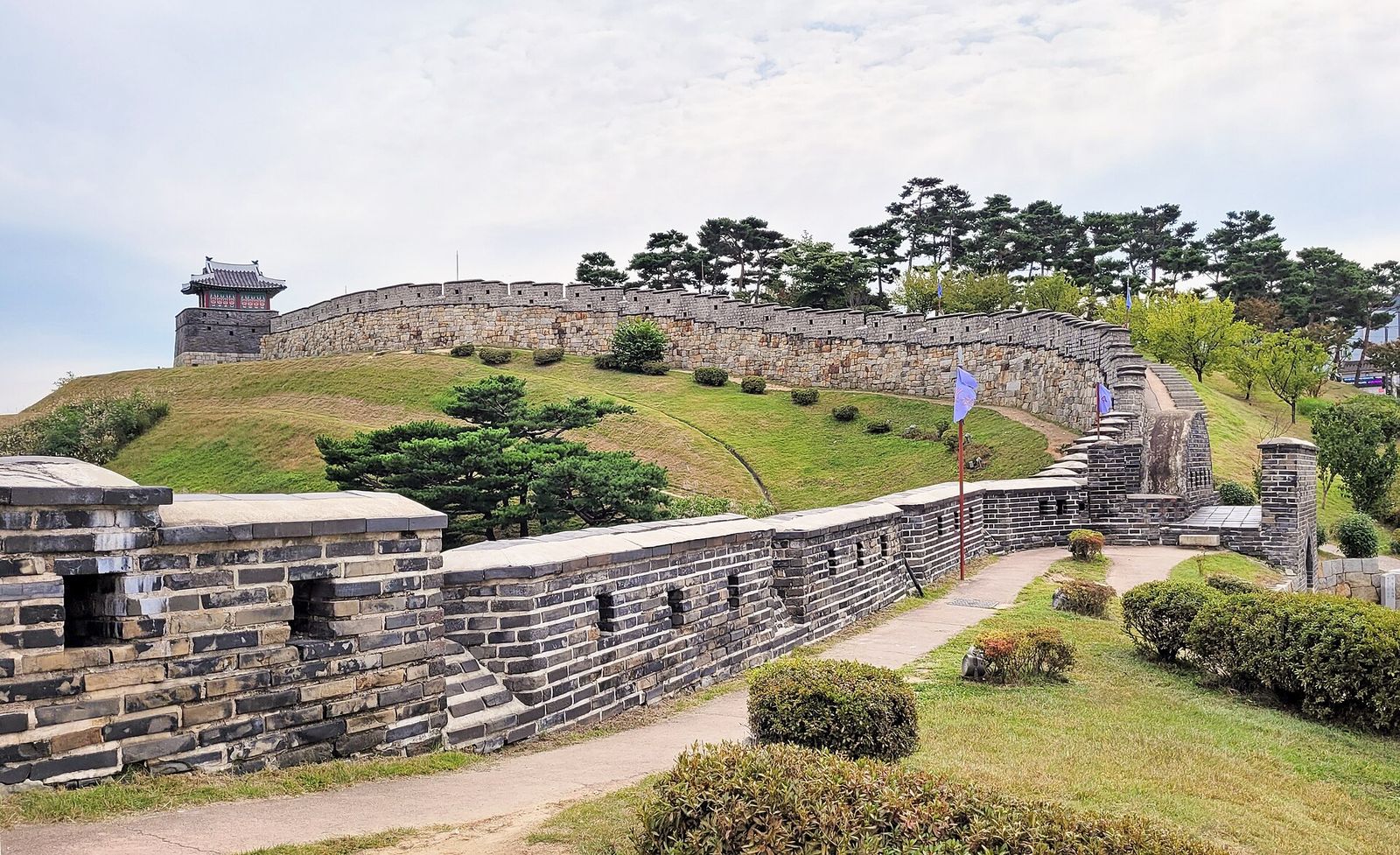
Hwaseong was built between 1794 and 1796 by King Jeongjo of the Joseon dynasty, partly to honour his father, whose tomb he moved to the area. The walls run for nearly 6 km around the old city centre, with gates, watchtowers, command posts and a graceful water gate. It's a UNESCO World Heritage Site, and much of it was carefully restored after damage in the 20th century using the detailed records kept when it was built.
How to get there: Suwon is south of Seoul on subway Line 1, which takes around an hour from central Seoul, or about half an hour by regular Korail train from Seoul Station. From Suwon Station, local buses and taxis reach the fortress in 10–20 minutes.
What to see: walk the wall, or as much of it as you like; the full circuit takes roughly two to three hours with stops and some steep sections on Paldalsan hill, where the western command post gives views over the city. Don't miss Hwahongmun, the arched floodgate over the stream, and the great Paldalmun and Janganmun gates. Inside the walls, Hwaseong Haenggung, the king's temporary palace, has been rebuilt and often hosts reenactments and cultural events.
How long to allow: half a day for the wall and palace, a full day at a slower pace. Suwon is known for marinated beef ribs (galbi), so stay for a meal.
Incheon: Chinatown and the old port
Incheon is best known for its international airport, but its old port district is one of the most interesting places near Seoul. It opened to foreign trade in the 1880s, and Chinese, Japanese and Western merchants all left their mark.
How to get there: subway Line 1 runs to Incheon Station, at the end of the line, in around an hour or more from central Seoul. Chinatown is directly across the road from the station.
What to see: Chinatown, with its gates, red-lanterned streets and restaurants, is said to be where jajangmyeon (noodles in black bean sauce) was adapted for Korean tastes, and a small museum on the dish is housed in a historic restaurant building. Next door, the Open Port area has former bank and trading buildings from the early 20th century, some now museums and galleries. Jayu Park, on the hill above, is one of Korea's first Western-style parks and looks out over the harbour. The colourful Songwol-dong Fairy Tale Village is a short walk away, and Wolmido, a former island now joined to the mainland, has a waterfront promenade and seafood restaurants.
How long to allow: half a day to a full day. Incheon also works well on your last day if you're flying out, as long as you leave plenty of time to reach the airport.
Namhansanseong: a fortress in the forest
If you'd like hills and trees without a long journey, Namhansanseong is a mountain fortress south-east of Seoul that served as an emergency capital during the Joseon dynasty. It's a UNESCO World Heritage Site with walls winding through pine forest, gates, temples and a rebuilt royal retreat. Take the subway to Sanseong Station and a local bus up the mountain, roughly an hour in total. Walking trails follow the walls; allow half a day, and wear proper shoes.
Nami Island: avenues of trees on the river
Nami Island (Namiseom) is a small, half-moon-shaped island in the Bukhan River, about 60 km north-east of Seoul. It's landscaped with avenues of tall metasequoia, ginkgo and pine trees, and became famous across Asia after it was used as a location in the 2002 television drama Winter Sonata. According to tradition, General Nam I, a 15th-century military leader after whom it's named, is buried on the island.
How to get there: take the ITX-Cheongchun train or the Gyeongchun subway line to Gapyeong, about an hour from Yongsan or Cheongnyangni stations, then a short taxi or tourist bus ride to the wharf. A ferry crosses to the island in a few minutes, and a zip-wire offers a faster way across for the adventurous. Entry is by ticket, which includes the ferry.
What to see: walk or cycle the tree-lined avenues, the riverbank paths and the small gardens and cafés. Autumn, usually from late October into early November, is the peak season for colour. Gapyeong's tourist bus also serves the Garden of Morning Calm, a large garden known for its seasonal flowers and winter lights.
How long to allow: a full day if you add other Gapyeong sights, or about half a day for the island alone. Autumn and weekend crowds are very large; go early on a weekday if you can.
Jeonju: hanok village and Korean food
Jeonju, in the south-west of the country, was the ancestral home of the Joseon royal family and is one of Korea's most traditional cities. It's a UNESCO Creative City of Gastronomy and the city most closely associated with bibimbap.
How to get there: KTX high-speed trains run from Yongsan Station to Jeonju in roughly an hour and a half to two hours. Jeonju Station is outside the old town, so allow 20–30 minutes by bus or taxi to the hanok village. What to see: Jeonju Hanok Village has hundreds of traditional tiled-roof houses, many now guesthouses, tea houses, craft workshops and restaurants. Gyeonggijeon is a shrine built in the early 15th century to house a portrait of King Taejo, the founder of the Joseon dynasty. Across the road, Jeondong Cathedral, completed in the early 20th century, is one of Korea's most beautiful brick churches and an active place of worship, so be respectful. Climb Omokdae for a view over the rooftops, walk along the river, and see Pungnammun, the old south gate. Eat Jeonju bibimbap and the local bean-sprout soup (kongnamul gukbap), and look out for the evening food stalls at Nambu Market, which run on some nights only.
How long to allow: a long day. Jeonju is better with a night in a hanok guesthouse, which also lets you see the village after the crowds leave.
The DMZ, in general terms
The Demilitarized Zone between North and South Korea is about an hour or more north of Seoul by road. Most visitors go on an organised tour, because several sites lie in a civilian-control area that requires an escort, and passports are usually needed. Typical tours visit Imjingak park and its memorials, the Third Tunnel, and Dora Observatory, which looks across the border on clear days. Visits to the Joint Security Area at Panmunjom have been suspended for long periods. Access to all these sites can change at short notice, so check the current rules with official sources and your tour operator before you go. Our Seoul three-day itinerary describes the main stops in more detail.
Practical tips for day trips
- Use a transit card. A rechargeable card such as T-money works on the subway, local buses and many taxis, including on Line 1 to Suwon and Incheon.
- Reserve KTX and ITX seats for Jeonju and Gapyeong, especially at weekends, holidays and in autumn. Seoul has several main stations, so check which one your train leaves from.
- Use Korean map apps such as Naver Map or KakaoMap for transit and walking directions; they're usually more reliable in Korea than international ones.
- Avoid major holidays. Seollal (Lunar New Year) and Chuseok (the autumn harvest festival) bring very busy roads and trains.
- Base yourself near a good station. Our guide to where to stay in Seoul compares the main areas.
For the city itself, start with our Seoul in three days plan, then add one or two of these trips. If Japan is next, see our guide to day trips from Tokyo.
Bloiq is reader-supported. Some links may earn us a commission; it never affects what we write. How we make money.
Cover photo: Bernard Gagnon, CC0, via Wikimedia Commons