Home / Travel / South Korea · Where to stay
Where to stay in Seoul: Myeongdong, Jongno, Hongdae and more
Seoul is vast, so your base decides how much time you spend on the subway. Compare Myeongdong, Jongno, Hongdae, Gangnam, Itaewon, Dongdaemun and Seoul Station.
This guide contains affiliate links, marked as such. If you book through them, Bloiq may earn a commission at no extra cost to you.
Seoul is a sprawling city of more than nine million people, split by the Han River into an older northern half and a newer, business-heavy south. The subway is excellent, but distances are real: getting from a hotel in Gangnam to the palaces can easily take 40 minutes. For most visitors, the smart choice is a base north of the river, close to a station on a line that serves the places you care about. Here's how the main areas compare.
The quick answer
- First visit, shopping and street food: Myeongdong.
- Palaces, traditional streets and hanok stays: Jongno and Insadong.
- Nightlife, live music and a young crowd: Hongdae.
- Business, upscale shopping and modern Seoul: Gangnam.
- International food and bars: Itaewon.
- Late-night markets and good value: Dongdaemun.
- Airport trains and day trips by rail: Seoul Station.
Myeongdong: central and busy
Myeongdong is Seoul's best-known shopping district, a grid of pedestrian streets lined with cosmetics shops and fashion stores. In the evening, food stalls fill the main lanes. Namsan, with its cable car and tower, rises just to the south, and the palaces are a short subway ride or a 20–30 minute walk away.
Good for: first-time visitors, shoppers and anyone who wants plenty of hotel choice in a central spot. Many airport buses stop here. Consider: it's crowded and commercial, and it feels more like a tourist shopping zone than a neighbourhood, especially at night.
Jongno and Insadong: history and tradition
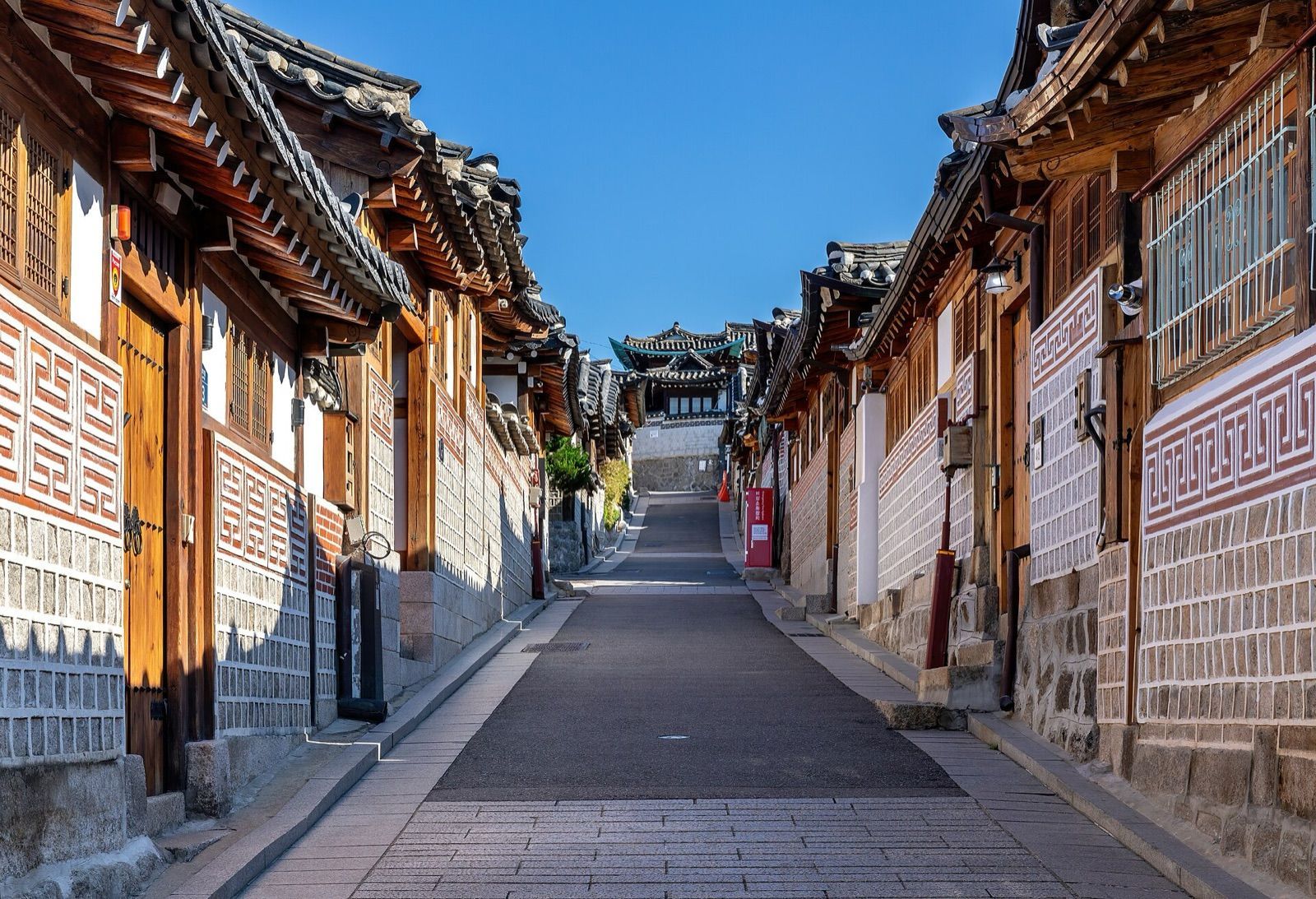
Jongno is the old heart of the city. Gyeongbokgung and Changdeokgung palaces, Gwanghwamun Square and the traditional houses of Bukchon Hanok Village are all here. Insadong is a lane of tea houses, galleries and craft shops, and nearby Ikseon-dong has restored hanok alleys full of cafés. Some traditional houses operate as guesthouses.
Good for: culture lovers, first-time visitors who want to walk to the palaces, and anyone curious about staying in a hanok. Consider: a hanok stay usually means sleeping on a mattress on a heated floor, thin walls and shared or compact bathrooms, so read the details. Bukchon is a residential area, so keep noise down, and check the current visiting rules for its lanes before you go.
Hongdae: youthful and energetic
The area around Hongik University is Seoul's centre for indie music, street performers, clubs, cafés and independent shops. Neighbouring Yeonnam-dong, along a linear park built on an old railway line, is calmer and full of small restaurants. Hongik University station is on the direct airport rail line.
Good for: younger travellers, nightlife, music fans and anyone arriving from Incheon who wants an easy first journey. Consider: weekend nights are loud and crowded near the main streets, and the palaces and the old city are 25–35 minutes away by subway.
Gangnam: modern and upscale
South of the river, Gangnam is a district of office towers, wide avenues, department stores and high-end boutiques in Apgujeong and Cheongdam. The large COEX complex, with a convention centre and an underground mall, is here, and there are many large modern hotels.
Good for: business travellers, conference-goers and shoppers. Consider: it's spread out, and most historic sights are 30–45 minutes away by subway. Streets are designed around traffic and commerce, so it can feel less walkable and less characterful than the north.
Itaewon: international and lively
Itaewon, on the southern slope of Namsan, has long been Seoul's most international neighbourhood, with restaurants from around the world, bars and a mix of residents. Neighbouring Hannam-dong has galleries, design shops and a major art museum, while Haebangchon and Gyeongridan-gil have small bars and cafés on steep streets.
Good for: travellers who want international food and nightlife, and repeat visitors. Consider: it's hilly and can be noisy at weekends, and it has fewer hotels than Myeongdong. It's also a little off the main subway routes to the palaces, so expect a change of line.
Dongdaemun: markets that run late
Dongdaemun is known for its fashion wholesale markets, some of which trade through the night, and for Dongdaemun Design Plaza, a curved, futuristic building used for exhibitions and events. Gwangjang Market, one of the city's best places for street food, is close by. Several subway lines meet here.
Good for: night owls, shoppers and travellers who want good value with good connections. Consider: the area is commercial and traffic-heavy, and it isn't especially attractive. Some streets are very quiet late at night once the retail crowds leave.
Seoul Station: trains and transfers
Seoul Station is the main terminus for high-speed trains to Busan and other cities, and the city end of the airport rail line from Incheon and Gimpo. Namdaemun Market and an elevated walkway garden are nearby, and Myeongdong is a short walk or one stop away.
Good for: short stays, early flights, and day trips or onward journeys by train. Consider: the immediate area is busy with roads and offices and has less atmosphere than Jongno or Hongdae, though the old city is close.
Getting around
- From the airport: Incheon, the main international airport, is on an island west of the city. The airport railway runs to Seoul Station, with a faster express service and a slower all-stops train that also calls at Hongik University. Airport limousine buses serve many districts and hotels, and taxis are available. Gimpo Airport, closer to the city, handles domestic and some regional flights and is on the same rail line.
- Subway: fast, clean and inexpensive, with signs and announcements in English. Lines are numbered and colour-coded, and transfers can involve long walks through stations.
- T-money: a rechargeable transport card sold at convenience stores and stations. It works on the subway, buses and many taxis, and gives transfer discounts between them. Top it up with cash at machines and shops.
- Maps: international map apps offer limited walking and driving directions in South Korea, so many visitors use Korean map apps, which have English interfaces.
Practical tips before you book
- Stay near a subway station on a line you'll use often, such as Line 1, 2, 3 or 4 for the old city, or the airport line if you'll come and go by rail.
- Check the exact walking distance. Seoul is hillier than it looks on a map, particularly around Namsan, Bukchon and Itaewon.
- Expect compact rooms in central hotels, and check whether a room has a window, as some budget rooms don't.
- Plan for the seasons. Summers are hot and humid, with a rainy spell usually from late June into July; winters are cold and dry. Spring and autumn are the most comfortable, and the busiest.
- Check the current entry rules, including whether you need an electronic travel authorisation, before you fly.
Choose Myeongdong or Jongno for your first visit, Hongdae for energy, and Gangnam only if your plans are south of the river.
Bloiq is reader-supported. Some links may earn us a commission; it never affects what we write. How we make money.
Cover photo: Basile Morin, CC BY-SA 4.0, via Wikimedia Commons