Home / Travel / Spain · Day trips
Day trips from Madrid by train: Toledo, Segovia, El Escorial and more
The best day trips from Madrid by rail, compared by travel time and who they suit: Toledo, Segovia, El Escorial, walled Ávila, Alcalá, Aranjuez and Cuenca.
Madrid sits in the middle of Spain, which makes it one of Europe's best bases for day trips. Fast trains reach medieval Toledo and Roman Segovia in about half an hour, and suburban lines run to royal palaces and university towns. Most of these places are UNESCO World Heritage Sites, and all are easy to see without a car. Here's how they compare and how long each one really needs.
The quick comparison
- Toledo: about 30 minutes by high-speed train. Best for a walled hilltop city of churches, museums and lanes. A full day.
- Segovia: about 30 minutes by high-speed train, plus a bus into town. Best for the Roman aqueduct, a fairy-tale castle and roast suckling pig. A full day.
- San Lorenzo de El Escorial: about an hour by suburban train or bus. Best for a vast royal monastery-palace in the hills. Half a day to a full day.
- Ávila: roughly 1.5 to 2 hours by train. Best for complete medieval walls and the story of Saint Teresa. A full day.
- Alcalá de Henares: about 40 minutes by suburban train. Best for Cervantes, a historic university and an easy, low-key day. Half a day.
- Aranjuez: about 45 minutes by suburban train. Best for a royal palace, formal gardens and riverside walks. Half a day to a full day.
- Cuenca: about an hour by high-speed train, plus a bus. Best for houses hanging over a gorge and a modern art museum. A long full day.
Toledo: the walled city on the Tagus
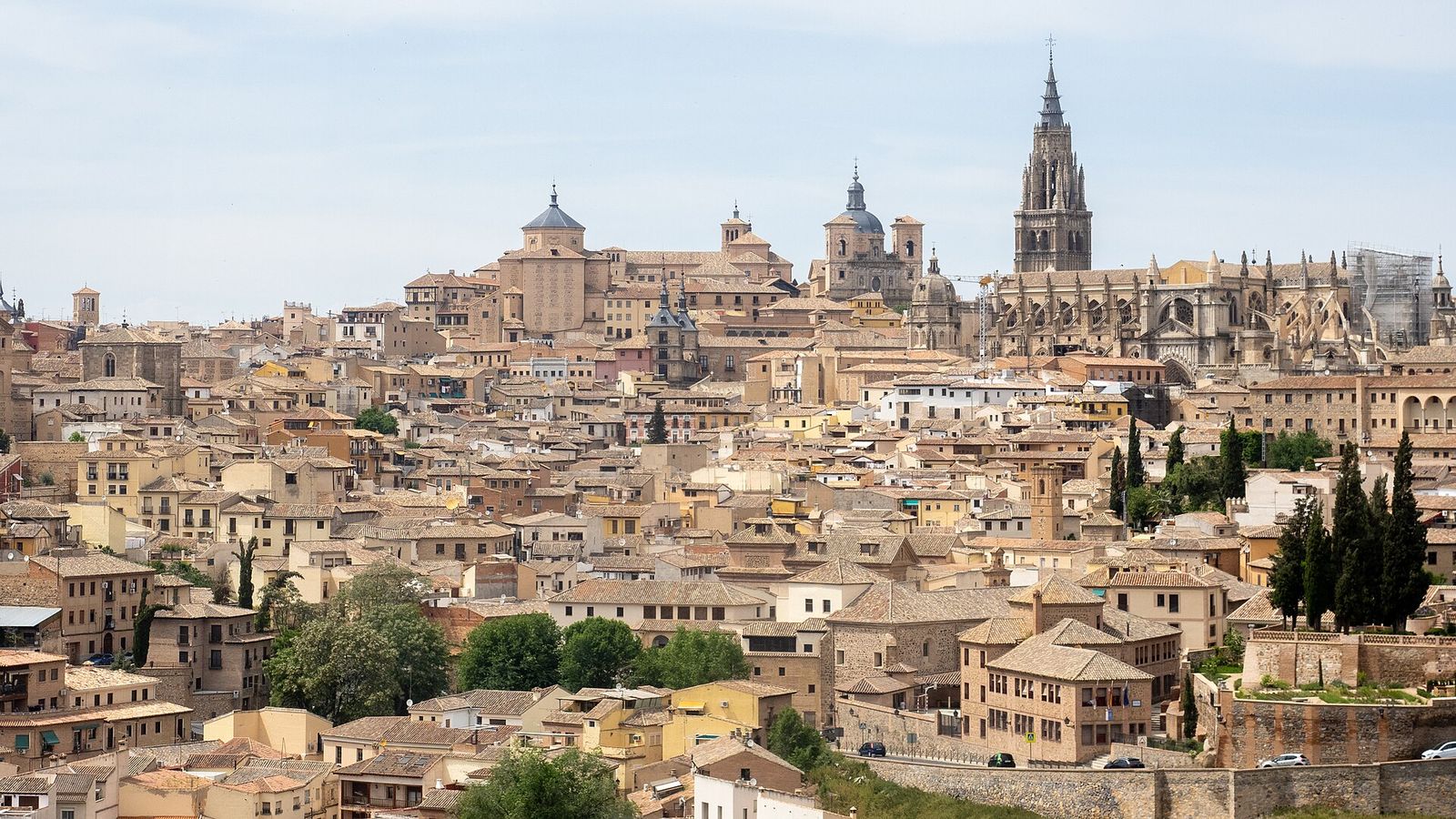
Toledo stands on a granite hill wrapped on three sides by a bend of the River Tagus. It was the Visigothic capital and later a seat of the Castilian court, and many centuries of history are layered in its streets, from Islamic-era gates to Renaissance palaces. The historic city is a UNESCO World Heritage Site.
Getting there: high-speed trains from Madrid's Atocha station take roughly half an hour. Toledo's neo-Mudéjar station is below the old town: allow 20 to 30 minutes to walk up, or take a city bus or taxi. Public escalators also climb part of the hill.
What to see: - The Cathedral: one of Spain's great Gothic cathedrals, with a richly carved choir, a sacristy hung with paintings by El Greco and others, and the Baroque Transparente altarpiece. - El Greco's The Burial of the Count of Orgaz: his best-known painting, displayed in the small Church of Santo Tomé. - The Monastery of San Juan de los Reyes: a late-Gothic royal monastery with a beautiful two-storey cloister. - The Alcázar: the fortress that dominates the skyline, now home to the Army Museum. - The view from across the river: the road along the far bank of the Tagus has the classic panorama of the city.
How long: a full day. The old town is a maze of steep lanes, so wear comfortable shoes.
Segovia: the aqueduct and the Alcázar
Segovia's Roman aqueduct is one of the best-preserved Roman structures anywhere: a double row of granite arches, built without mortar around the end of the 1st century AD, striding across the lower town. The old town and the aqueduct together are a UNESCO World Heritage Site.
Getting there: high-speed trains from Madrid's Chamartín station reach Segovia-Guiomar in about half an hour; the station is outside town, and a city bus takes around 15 to 20 minutes to the aqueduct. Slower regional trains run to Segovia's central station through the Guadarrama mountains, and direct buses leave from Moncloa in Madrid.
What to see: - The aqueduct: best seen from the Plaza del Azoguejo and from the steps that climb beside it to the top of the old walls. - The Cathedral: one of the last great Gothic cathedrals built in Spain, begun in the 16th century, with pale golden stone and a tall tower. - The Alcázar: a castle on a rocky spur at the western tip of the old town, with turrets and slate spires. Its tower has wide views over the plains. - The walk between them: the main street links them all in about 20 to 30 minutes.
How long: a full day. Segovia is famous for cochinillo asado, roast suckling pig, traditionally served at lunch; popular restaurants fill up at weekends, so book ahead.
San Lorenzo de El Escorial: Philip II's monastery
In the foothills of the Sierra de Guadarrama, the Royal Monastery of San Lorenzo de El Escorial was built for King Philip II in the second half of the 16th century. It's a monastery, basilica, royal palace, library and mausoleum in one severe granite complex, and a UNESCO World Heritage Site.
Getting there: suburban trains run from central Madrid stations, including Atocha and Chamartín, to El Escorial in roughly an hour; the monastery is a steep 20-minute walk or a short bus ride up from the station. Buses from Moncloa stop closer to the monastery.
What to see: the basilica, the royal apartments of Philip II, the Royal Pantheon where most Spanish monarchs since Charles I are buried, and the library, with its painted vaulted ceiling. In summer the town is noticeably cooler than Madrid.
How long: half a day for the monastery; a full day if you add a walk in the hills.
Ávila: the walled city
Ávila has the most complete medieval town walls in Spain: around 2.5 kilometres of stone ramparts with dozens of towers and nine gates, largely intact around the old town. It's also the birthplace of Saint Teresa of Ávila, the 16th-century mystic, and many of its churches and convents are connected to her. The old town and its churches outside the walls are a UNESCO World Heritage Site.
Getting there: trains from Chamartín take roughly 1.5 to 2 hours depending on the service. The station is a 15 to 20-minute walk from the walls.
What to see: - The walls: sections are open as a walkway, with views over the town and the surrounding plains. - The Cathedral: partly built into the walls, with its apse forming one of the defensive towers. - The Basilica of San Vicente, a fine Romanesque church just outside the walls. - The Cuatro Postes viewpoint, across the river, with a classic view of the whole walled town.
How long: a full day. Ávila sits high on the plateau and can be cold and windy outside summer. Tours often combine it with Segovia, which makes for a long day.
Alcalá de Henares and Aranjuez: easy half days
Both towns are on the suburban rail network and suit a spare morning or afternoon.
Alcalá de Henares, east of Madrid, is the birthplace of Miguel de Cervantes and home to one of Spain's oldest universities; both are part of a UNESCO World Heritage Site. Walk the arcaded Calle Mayor, visit the museum in the house traditionally identified as Cervantes' birthplace and see the Plateresque façade of the old university.
Aranjuez, to the south, was a spring residence of the royal family. The Royal Palace, its formal gardens along the River Tagus and the larger Prince's Garden make up the UNESCO-listed Aranjuez Cultural Landscape. The town is known for strawberries and asparagus.
Cuenca: houses over the gorge
Cuenca's old town, a UNESCO World Heritage Site, sits on a ridge between two river gorges, and its famous Hanging Houses (Casas Colgadas) cling to the edge of the cliff. One of them houses a museum of Spanish abstract art.
Getting there: high-speed trains from Madrid take about an hour to Cuenca's modern station outside town; a city bus continues to the old town.
How long: a long full day. Cross the iron footbridge over the gorge for the best view of the Hanging Houses.
Practical tips for day trips from Madrid
- Know your stations. Toledo trains usually leave from Atocha, and Segovia and Ávila trains from Chamartín, while Cuenca services can use either; check which station your ticket shows. The suburban lines to El Escorial, Alcalá and Aranjuez stop at several central stations.
- Book high-speed seats ahead. Toledo, Segovia and Cuenca trains have reserved seating and can sell out at weekends and on holidays. Suburban trains don't need reservations.
- Mind the weekly closing day. Many monuments and museums close one day a week, often Monday, and some churches close in the early afternoon. Check the official sites for current hours and entry rules.
- Plan around the heat. Central Spain is very hot in summer; start early and save afternoons for indoor sights.
- Fit the trips around the city. Our three-day Madrid itinerary covers the Prado, the Royal Palace and the tapas districts, and our guide to where to stay in Madrid helps you choose a base near Atocha or with an easy ride to Chamartín.
Bloiq is reader-supported. Some links may earn us a commission; it never affects what we write. How we make money.
Cover photo: ajay_suresh, CC BY 2.0, via Wikimedia Commons