Home / Outdoor & Garden · Product overviews / Generators & Portable Power / Energy Controllers · More from ECO-WORTHY
ECO-WORTHY 60A MPPT Solar Charge Controller: features, specs and who it suits
A 60A MPPT solar charge controller for 12, 24, 36 and 48V battery banks, with an OLED display and multiple protections. What the specs mean and what to check.
This page contains an affiliate link, marked as such. If you buy through it, Bloiq may earn a commission at no extra cost to you.
The ECO-WORTHY 60A MPPT charge controller sits between solar panels and a battery bank, managing how power flows into the batteries. It is meant for off-grid cabins, RVs, boats and backup systems where the panels' output has to be converted into a charge the battery can use.
What MPPT does
Solar panels produce their maximum power at a voltage that shifts with light and temperature. A Maximum Power Point Tracking (MPPT) controller continually adjusts to that point, then converts the panel voltage down to the battery's voltage. In general, this lets a system draw more energy from the same panels than simpler PWM controllers, especially when the array voltage is well above the battery voltage or the weather is cool or overcast.
ECO-WORTHY says this unit reaches up to 99% tracking efficiency and 98% peak conversion efficiency, and that it keeps charging current stable on cloudy days.
Voltage and power range
The controller accepts 12V, 24V, 36V and 48V battery systems and can send up to 60A to the battery bank. ECO-WORTHY lists the maximum solar input as 780W at 12V and 3,120W at 48V. The relationship is simple: more battery voltage means the same 60A can carry more power. Before buying, add up your panels' wattage and open-circuit voltage, and check them against the limits in the manual.
Battery types
Charging profiles are listed for Gel, AGM, flooded, lithium, LiFePO4 and NCM/NCA batteries. A button on the controller changes the battery type. Choosing the wrong profile can undercharge or overcharge a battery, so match it to your battery maker's recommendation.
Display and monitoring
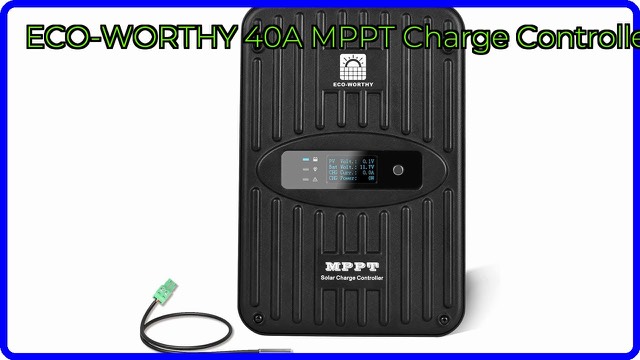
An OLED screen shows PV voltage, battery voltage, charging current and charging power. The listing includes a temperature sensor and USB and RJ45 connections. For remote monitoring of panels, battery and load, ECO-WORTHY states that you need its separate Bluetooth Module 5.0, which isn't part of the controller.
Protections
ECO-WORTHY lists protection against reverse polarity, short circuits, high temperature, over-current, and over-voltage and low-voltage conditions. These guard the controller and the system against wiring mistakes and fault conditions, but they don't replace correct fusing and breakers sized for your installation.
Who it suits
It suits owners of mid-sized solar systems, from an RV or van with a few panels to a larger home-backup or cabin bank, who want to be able to change battery voltage later without replacing the controller. It also suits people who like to see live numbers at the unit.
What to check before you buy
- Array size: confirm total panel wattage and voltage stay within the controller's limits, including cold-weather voltage rise.
- Battery system: check your battery voltage and chemistry against the supported profiles.
- Wiring and fusing: use cable and protection rated for the current, and follow the manual and local electrical codes.
- Monitoring: decide whether you need the separate Bluetooth module.
- Mounting: allow space and ventilation around the unit, which measures roughly 9.4 x 6.5 x 2.4 inches.
- Installation: if you're unsure, have a qualified electrician check the system.
The short version
- A 60A MPPT solar charge controller for 12, 24, 36 and 48V battery banks.
- Up to 780W of solar input at 12V and 3,120W at 48V.
- Supports Gel, AGM, flooded, lithium, LiFePO4 and NCM/NCA batteries.
- OLED display, temperature sensor, and several electronic protections.
- Bluetooth monitoring needs a separate module.
Bloiq is reader-supported. Some links may earn us a commission; it never affects what we write. How we make money.