Above-ground pool pumps and sand filters: sizing, flow and run time
How to work out your pool's volume and turnover, match a pump to a filter, choose between sand, cartridge and DE, and decide how many hours a day to run it.
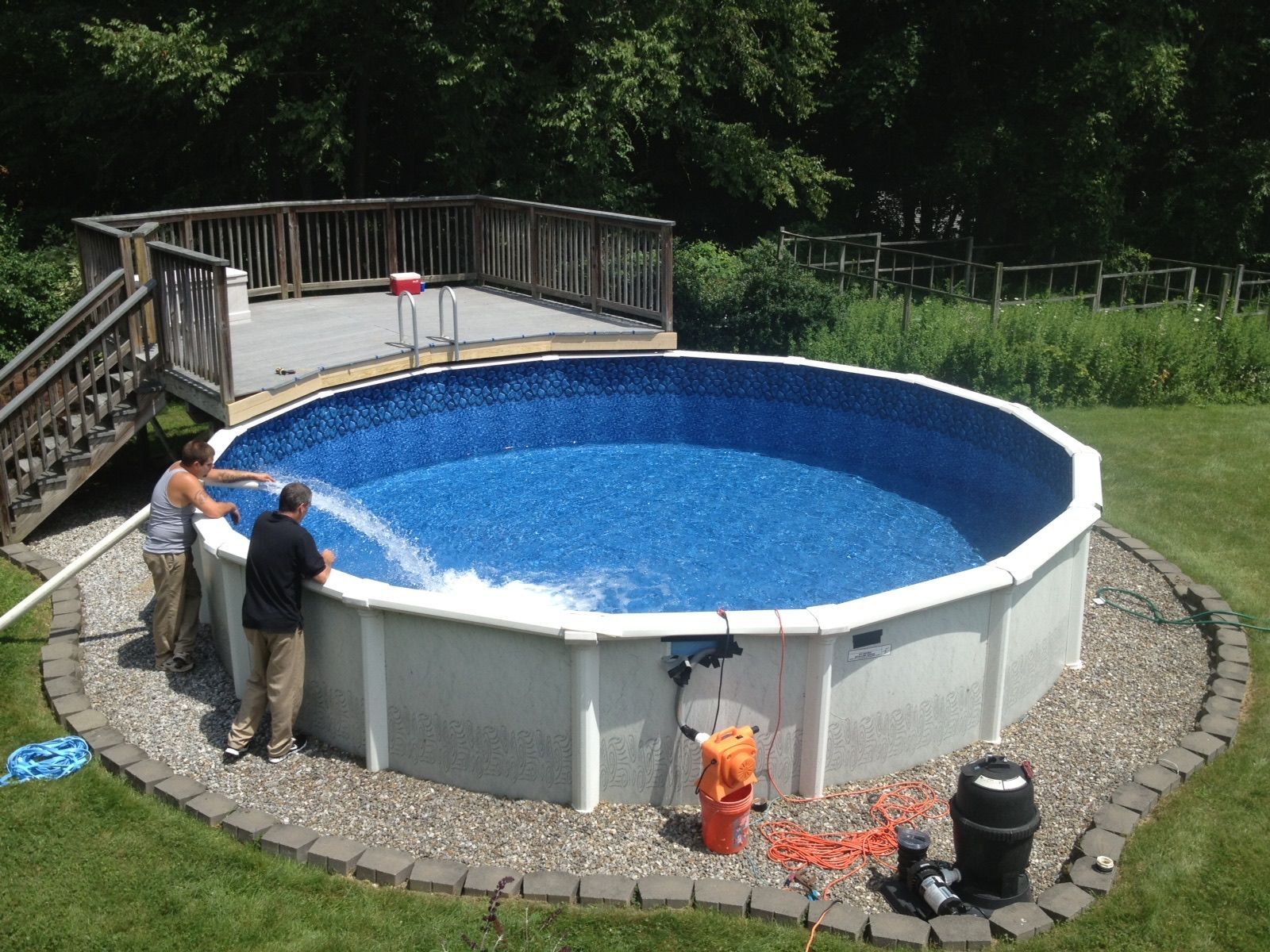
Clear pool water depends less on chemicals than most people think. Chlorine does its job only if the water keeps moving through a filter that can trap what the chlorine leaves behind. The pump and filter that come with many above-ground pools are the bare minimum, and upgrading without a plan often means a pump that's too big for its filter. Here is how to size the system from your pool's volume, what the different filters do, and how long to run it.
Start with your pool's volume
Everything else follows from how much water you have. Measure the water depth, not the wall height; a 132 cm (52 in) wall usually holds water around 10–15 cm below the top.
- Round pool: diameter × diameter × depth × 0.785 = cubic metres (multiply by 1,000 for litres). In imperial: diameter (ft) × diameter (ft) × depth (ft) × 5.9 = US gallons.
- Oval pool: length × width × depth × 0.785 = cubic metres; or length × width × depth (ft) × 5.9 = US gallons.
- Rectangular frame pool: length × width × depth = cubic metres; or × 7.5 in feet for US gallons.
Pool makers print a capacity figure too, usually at 90% fill. It's a useful cross-check.
Turnover: the number that sizes everything
Turnover is the time it takes to pass the whole volume of the pool through the filter once. It's the basis for choosing a pump and for deciding how long to run it. For residential pools, a turnover of about 8 hours is a common design target, so that the water is filtered at least once, and ideally two or three times, in a day. Hot weather, heavy use, trees overhanging the pool and algae problems all argue for more.
Required flow = pool volume ÷ turnover time. An 18 ft round pool with 4 ft of water holds about 7,600 US gallons (about 29 m³). For an 8-hour turnover it needs roughly 950 GPH, or 16 GPM (about 3.6 m³/h), of real flow through the filter.
| Round pool diameter | Volume at 1.2 m (4 ft) water depth | Flow for an 8-hour turnover |
|---|---|---|
| 3.7 m (12 ft) | about 13 m³ / 3,400 US gal | about 1.6 m³/h / 425 GPH |
| 4.6 m (15 ft) | about 20 m³ / 5,300 US gal | about 2.5 m³/h / 665 GPH |
| 5.5 m (18 ft) | about 29 m³ / 7,650 US gal | about 3.6 m³/h / 955 GPH |
| 6.4 m (21 ft) | about 39 m³ / 10,400 US gal | about 4.9 m³/h / 1,300 GPH |
| 7.3 m (24 ft) | about 51 m³ / 13,600 US gal | about 6.4 m³/h / 1,700 GPH |
| 8.2 m (27 ft) | about 65 m³ / 17,200 US gal | about 8.1 m³/h / 2,150 GPH |
Pump flow ratings: box figures versus real flow
A pump's flow depends on the resistance it pushes against, called head. The filter, the valve, the hoses and every bend and fitting add resistance, and a dirty filter adds more. Box figures are often the maximum flow with little or no resistance. Real flow through a working system is lower.
When comparing pumps:
- Look for a flow chart or pump curve showing flow at different heads, and read the flow at a realistic, moderate head rather than the headline number.
- Horsepower is a poor guide. Two pumps with the same rated horsepower can move quite different amounts of water, depending on design and efficiency.
- Hose size matters. Above-ground systems commonly use 32 mm (1¼ in) or 38 mm (1½ in) hoses. Wider hoses and fewer tight bends let the same pump move more water.
Match the pump to the filter, not just to the pool
Every filter has a maximum rated flow. A pump that exceeds it pushes water through the media too fast: in a sand filter, the water carves channels through the sand and dirt passes straight through, and pressure rises quickly. The better approach:
- Work out the flow you need from the turnover calculation.
- Choose a filter whose maximum rated flow is comfortably above that figure. A larger filter runs longer between cleanings.
- Choose a pump whose real-world flow falls between your required flow and the filter's maximum.
Bigger is not better with pumps. An oversized pump costs more to run, can overwhelm the filter and the skimmer, and may exceed what the pool's fittings are designed for.
Sand, cartridge or DE?
| Sand | Cartridge | DE (diatomaceous earth) | |
|---|---|---|---|
| Approximate particle size trapped | 20–40 microns | 10–20 microns | 3–5 microns |
| Cleaning | Backwash via valve | Remove and hose off | Backwash, then add fresh DE |
| Water used for cleaning | Most | Least | Moderate |
| Upkeep | Lowest | Moderate | Highest |
| Media life | Several years | One or more seasons per cartridge | Grids last years; powder added each backwash |
Sand is the most common upgrade for above-ground pools: simple, tolerant of neglect and cheap to run. Its filtration is the coarsest, although it improves slightly as the bed gets a little dirty.
Cartridge filters trap finer particles and need no backwash line, which helps where draining water is awkward or restricted. The pleated cartridge needs regular rinsing, and small cartridges supplied with entry-level pools can clog within days in a busy summer. Keep a spare to swap in while one dries.
DE filters give the clearest water. The fine powder coats internal grids and must be topped up after each backwash. Wear a dust mask when handling the powder, and check local rules on where backwash water containing DE may be discharged.
Filter media: sand, glass and alternatives
Use only the media the filter maker specifies:
- Pool filter sand is a graded silica sand, often sold as No. 20 silica, with grains of roughly 0.45–0.55 mm. Never use play sand or builder's sand; the grains are the wrong size and can pass through the laterals into the pool.
- Glass media is crushed, tumbled recycled glass graded for pool filters. It is usually specified at somewhat less weight than sand for the same filter, so follow the conversion on the bag or the filter manual. Makers claim finer filtration and longer life than sand.
- Other media such as zeolite, or fibre balls marketed for small sand filters, are only worth using if the filter manufacturer approves them.
Replace sand when the filter backwashes more and more often, or when the sand has clumped or become greasy; many owners find that is every three to five years.
Backwashing and pressure
A pressure gauge on the filter is your best maintenance tool. Note the reading just after cleaning, with the pump running; that's your clean baseline. When pressure climbs about 8–10 psi (roughly 0.5–0.7 bar) above the baseline, it's time to backwash a sand or DE filter or clean a cartridge.
Always switch the pump off before turning a multiport valve, then backwash until the sight glass or waste hose runs clear, and use the rinse setting briefly to resettle the bed before returning to filter.
How long to run the pump each day
Divide your pool volume by the pump's real flow to get hours per turnover, then run long enough for at least one turnover a day, and more in hot weather or after heavy use.
- Run during the day. Circulation distributes chlorine while sunlight is breaking it down and while people are swimming.
- Salt chlorinators only produce chlorine while water is flowing, so the run time must also cover your chlorine demand.
- Variable-speed pumps save energy by running longer at a lower speed. Power draw falls much faster than flow when speed is reduced, so a slow, long run usually costs less than a short, fast one.
- Use a timer so the schedule happens every day.
Plug the pump into a GFCI- or RCD-protected outlet and follow the manual on distance from the pool, cords and extensions.
The short version
- Calculate volume from water depth, then divide by an 8-hour turnover to get the flow you need.
- Pick a filter rated comfortably above that flow, then a pump whose real flow sits between the two.
- Sand for simplicity, cartridge to save water, DE for the clearest water.
- Backwash or clean at 8–10 psi above baseline, use only approved media, and run the pump long enough each day to turn the water over at least once.
Bloiq is reader-supported. Some links may earn us a commission; it never affects what we write. How we make money.
Cover photo: Chris Grazioli, CC BY 2.0, via Wikimedia Commons