Sous vide immersion circulators: wattage, containers and food safety
How a sous vide circulator holds a water bath at an exact temperature, what wattage and flow rate mean, which containers work, and the food-safety rules to follow.
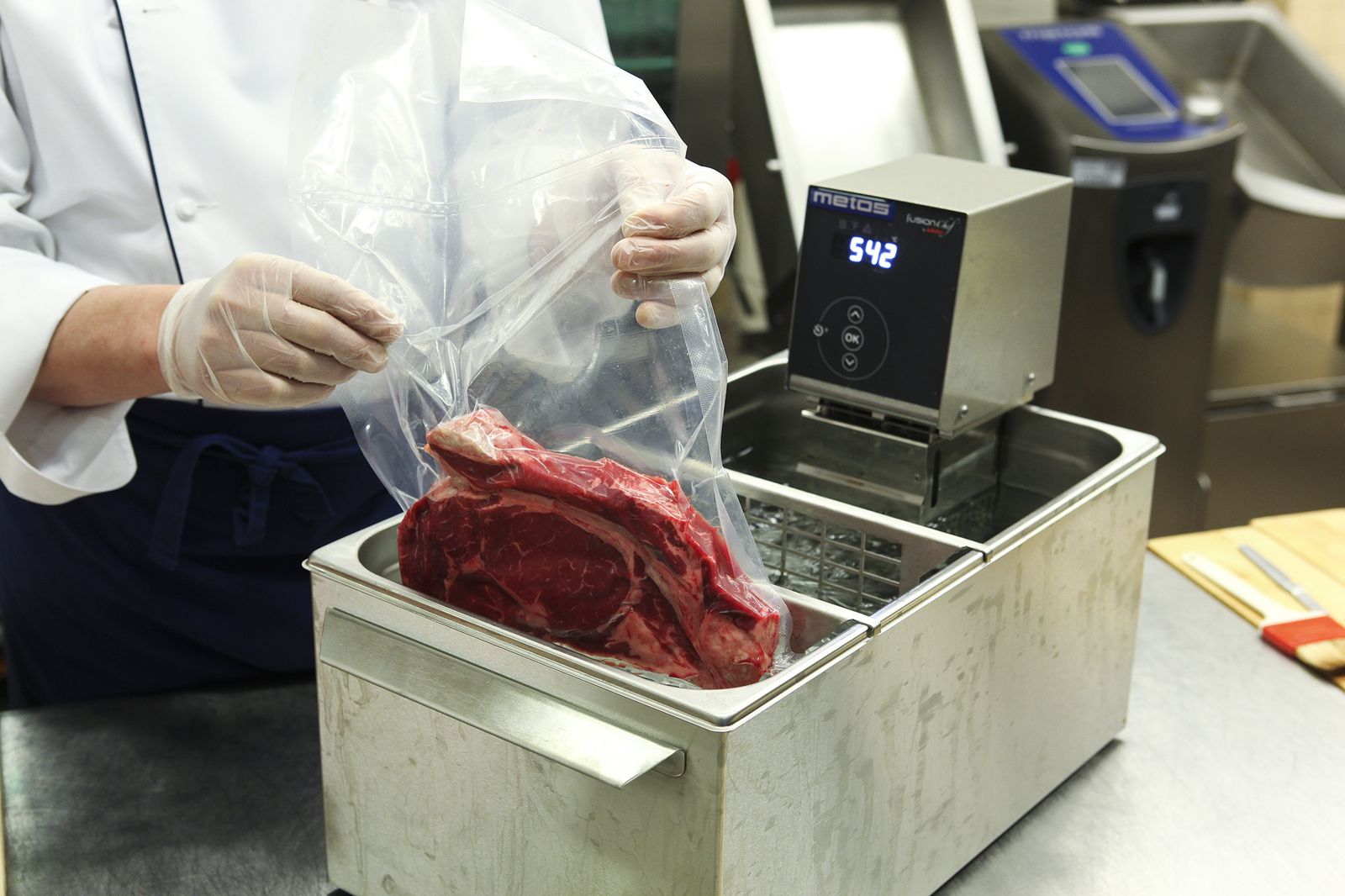
Sous vide cooking means sealing food in a bag and cooking it in a water bath held at a precise temperature, so a steak comes out the same pink from edge to edge and chicken breast stays moist. An immersion circulator is the device that makes this practical at home: a stick that clamps to a pot and controls the water. The specifications are short but easy to misread, and because sous vide often cooks food at lower temperatures than usual, the food-safety rules matter more. This guide explains both.
How an immersion circulator works
A circulator combines four parts in one housing:
- a heater that warms the water;
- a pump that keeps the water moving, so there are no hot or cold spots;
- a temperature sensor in the water;
- a controller that switches the heater on and off to hold the set temperature, typically within a fraction of a degree.
You clamp it to the side of a pot or tub, fill with water between the minimum and maximum lines on the stick, set the temperature and wait for the bath to heat up. Then you add the bagged food and leave it for the set time. Because the water never goes above the temperature you choose, the food can't overcook in the usual sense, though very long cooks can turn some foods soft or mushy.
What it can't do is brown anything. Most meat and fish are seared in a very hot pan, on a grill or with a blowtorch after cooking, ideally after patting the surface dry.
Wattage and heat-up time
Home circulators typically range from about 750 to 1,200 W. Wattage mainly affects how quickly the bath heats up from cold. Once the water is at temperature, the heater only needs to replace what's lost through the sides and surface, so a lower-wattage model holds temperature just as well in a covered, moderate-sized bath.
Rule of thumb: water needs about 4.2 kJ per litre for every degree it rises. Heating 10 litres from 20 °C to 60 °C takes about 1,700 kJ: roughly 28 minutes at 1,000 W, or 35 minutes at 800 W, before any heat losses.
To save time, start with hot water from the tap or add a kettle of boiling water, then let the circulator fine-tune the temperature. A lid makes the biggest difference on long cooks.
Flow rate, bath size and accuracy
- Flow rate, quoted in litres per minute, is how much water the pump moves. Higher flow keeps a large or crowded bath more even.
- Maximum bath volume is the maker's limit for holding temperature. If you cook big batches or large joints, check this figure; lower-powered models are designed for smaller baths.
- Accuracy and stability claims, often 0.1 °C, describe how closely the controller holds the set point. Any reputable circulator is precise enough for home cooking; what matters more is a correctly placed sensor and good circulation around the bags.
- Temperature range: most go up to around 90 °C or more, which covers vegetables. Displays usually switch between Celsius and Fahrenheit.
Containers and lids
- A large stockpot is the easiest start. Metal loses heat faster than plastic, so cover it.
- Polycarbonate food containers are the most popular choice: clear, light, heat-tolerant and available in sizes from about 8 to 20 litres or more. Lids with a cut-out for the circulator reduce evaporation.
- Insulated sleeves or an insulated cool box cut heat loss and noise on cooks of 24 hours or more.
- Floating insulating balls cover the surface around odd-shaped items and slow evaporation.
Whatever you use, it must be heat-tolerant, stable and deep enough to keep the water above the circulator's minimum line all the way through. On long cooks, top up the water, and choose a model that switches off automatically if the level drops too low. A simple rack keeps bags apart so water can flow between them.
Bags and keeping them under
Food goes into vacuum-sealed bags or into zip-top bags with the air pushed out by lowering them into water (the water-displacement method). Use bags rated for cooking temperatures. For long cooks and freezing portions to cook later, vacuum sealing is more reliable; see our guide to vacuum sealers.
Bags float if air is trapped or if gases escape from the food during a long cook. Food above the waterline doesn't cook properly, so clip bags to the side, weigh them down with a heavy spoon or plate, or reseal any that balloon.
Food safety: time, temperature and thickness
Sous vide is safe when you follow reliable time-and-temperature tables, and risky when you guess. The key ideas:
- Bacteria are killed by time at temperature, not temperature alone. Standard advice gives a single safe temperature (for poultry, 74 °C or 165 °F), at which harmful bacteria die almost instantly. At lower temperatures, holding the food there long enough achieves the same result, which is how sous vide chicken can be both safe and juicy.
- Thickness sets the time. The centre of the food must reach the bath temperature before the holding time starts to count, and heating time rises roughly with the square of thickness: a piece twice as thick needs about four times as long. Good tables account for this.
- Respect the lower limit. Bacteria multiply between roughly 5 °C and 60 °C. Many food-safety sources advise against long cooks below about 54 °C (130 °F); at lower temperatures, keep cooking times short.
- Start cold, not warm. Put food into the bath straight from the fridge, and avoid "delayed start" settings that leave raw food sitting in unheated water for hours.
- Chill quickly. If you're not eating straight away, cool the sealed bags in iced water, then refrigerate or freeze. Treat leftovers like any cooked food and eat them within a few days.
- Fish: at the low temperatures often used for fish, it isn't pasteurised, so buy it very fresh and eat it at once. Many cooks use fish that has been frozen first, which kills parasites.
- Vulnerable people, including pregnant people, young children, older adults and anyone with a weakened immune system, should eat only food cooked to fully pasteurising times and temperatures, or cooked conventionally.
Features worth having
- Clamp: an adjustable screw clamp fits more pots than a fixed clip; some models also have a magnetic foot for metal pots.
- Controls on the device: apps and Wi-Fi are convenient for alerts, but check that the circulator can be fully used without them.
- Timer and alerts for long cooks.
- Low-water shut-off and a removable, cleanable sleeve over the heater.
- Water resistance: some heads are rated against splashes or brief immersion, which helps if one slips into the bath.
- Size and noise: compact models store in a drawer; pump noise matters on overnight cooks.
All-in-one water ovens and multicookers with a sous vide mode are alternatives; our guides to pressure cookers and multicookers and slow cookers compare them.
The short version
- A circulator heats, stirs and controls a water bath to a set temperature.
- Higher wattage heats faster; a lid and insulation help any model hold temperature.
- Use a heat-tolerant container deep enough for the minimum water line, and keep bags fully submerged.
- Follow reliable time-and-temperature tables that allow for thickness, and avoid long cooks below about 54 °C.
- Chill quickly if you're not eating straight away, and take extra care with fish and with food for vulnerable people.
Bloiq is reader-supported. Some links may earn us a commission; it never affects what we write. How we make money.
Cover photo: Erikoinentunnus, CC BY-SA 3.0, via Wikimedia Commons