Countertop ice makers: bullet, nugget and clear ice compared
How the three main types of countertop ice maker work, what daily output figures really mean, and how to keep one clean so the ice stays fresh.
A countertop ice maker is handy if your freezer has no ice dispenser, if you entertain often, or if you just go through a lot of ice in summer. They need no plumbing: you pour water in and ice starts appearing within minutes. But the three main types make very different ice, and all of them need regular cleaning. This guide explains the differences and what the specifications mean.
How a countertop ice maker works
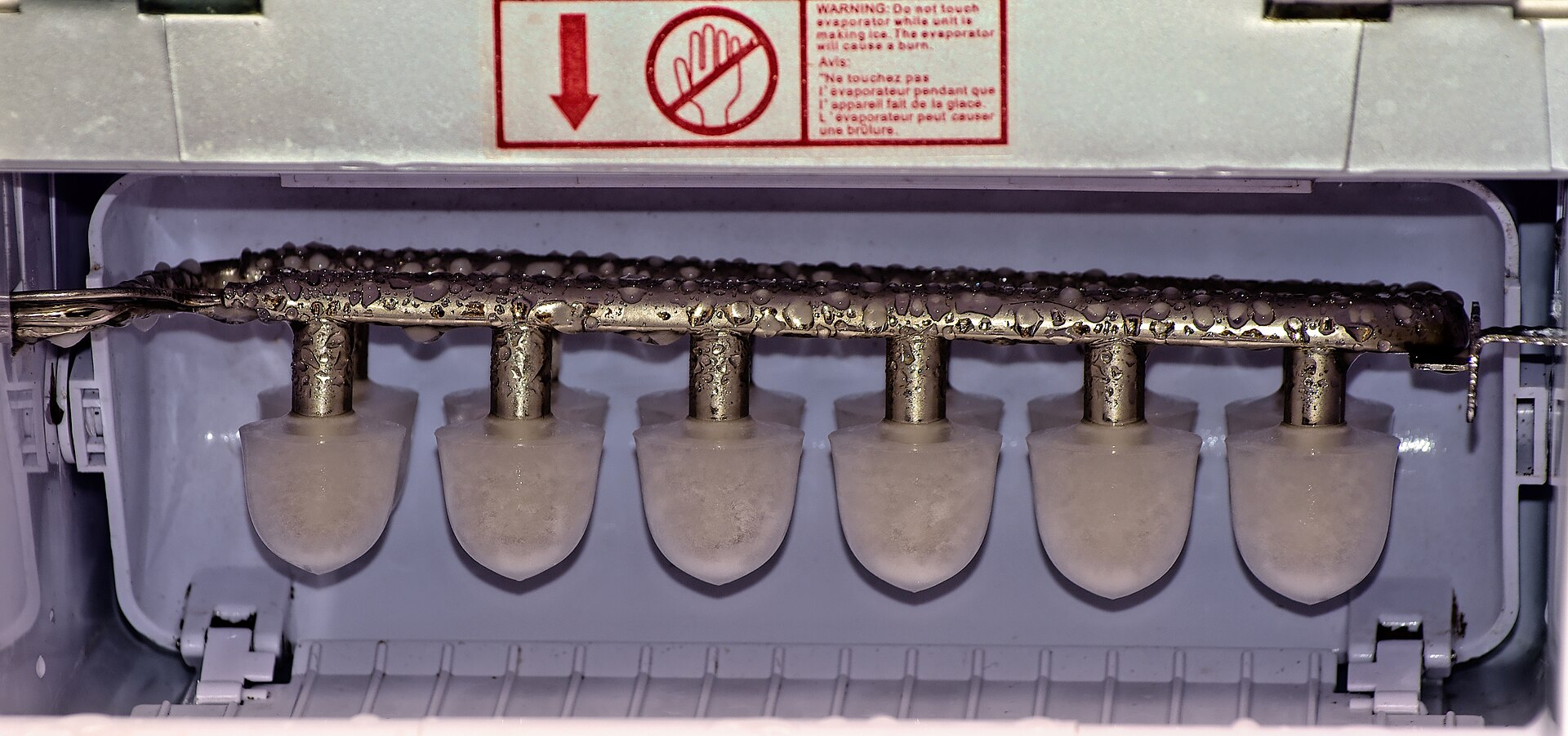
A countertop ice maker is a small refrigeration unit, with a compressor, refrigerant and a fan, much like a mini fridge. You fill a reservoir with water, a pump moves it to a freezing area, and finished ice drops into a basket.
One point surprises many buyers: in most models, the basket is not a freezer. The ice slowly melts, and the meltwater drains back into the reservoir to be made into ice again. That's fine while the machine is running, but if you want to store ice for hours or overnight, transfer it to a freezer.
Bullet ice
Most affordable countertop ice makers make bullet ice. Chilled metal prongs dip into water, ice builds up around them in layers, and then the prongs are warmed briefly so the pieces slide off into the basket. The result is a hollow, bullet-shaped piece with a hole where the prong was.
- Speed: the first batch usually arrives within about 6 to 15 minutes, and new batches follow on a similar cycle.
- Ice quality: cloudy, fairly soft and melts faster than solid freezer cubes. Many machines let you choose small or large pieces.
- Price and size: the least expensive and most compact type.
Bullet ice is ideal for everyday drinks, coolers and parties, less so for cocktails where you want slow dilution.
Nugget ice
Nugget ice (also called pellet or "chewable" ice) is made differently. Water freezes into thin flakes on the inside of a chilled cylinder, an auger scrapes them off and compresses them into small, soft pellets.
- Texture: soft, airy and easy to chew; it absorbs the flavour of the drink.
- Speed: ice comes out continuously once the machine is cold, rather than in batches.
- Consider: nugget machines are usually more expensive, larger, and can be noisier because of the auger and ice dropping. They also need more careful descaling, especially in hard-water areas.
Clear ice
Clear ice machines freeze water gradually, usually by running it over a chilled plate or grid. Because the water keeps moving, trapped air and many dissolved minerals are washed away instead of being frozen in, leaving solid, transparent cubes.
- Quality: dense, clear cubes that melt slowly, which matters for cocktails and spirits.
- Consider: clear-ice machines are generally slower, larger and pricier than bullet models.
Types at a glance
| Bullet | Nugget | Clear | |
|---|---|---|---|
| Ice | Hollow, cloudy, soft | Small, soft, chewable pellets | Solid, transparent cubes |
| Melts | Fairly quickly | Fairly quickly | Slowly |
| Price | Lowest | Higher | Higher |
| Noise | Moderate | Can be louder | Moderate |
| Best for | Everyday drinks, parties | Soft drinks, chewable ice fans | Cocktails, spirits, presentation |
What "daily output" really means
Ice makers are rated for how much ice they can make in 24 hours. Many countertop bullet models are rated at somewhere around 10 to 15 kg (roughly 25 to 35 lb) per day; nugget and clear models vary more widely. Two caveats:
- The rating assumes favourable conditions. A warm kitchen or warm water slows production, and the machine needs space around its vents to shed heat.
- The basket capacity is much smaller than the daily output, often under a kilogram. The machine stops when the basket is full, so for a party you need to empty it into a freezer or cool box as you go.
Rule of thumb: for gatherings, plan on roughly 0.5 kg (about 1 lb) of ice per guest, and start the ice maker several hours ahead, moving ice to the freezer as the basket fills.
Size, noise and setup
- Footprint and height: measure your counter, including the space needed to open the lid, and leave clearance around the vents as the manual specifies.
- Water supply: most models have a manual-fill reservoir. Some have an optional connection to a water line or a larger tank.
- Drain: a drain plug at the bottom makes emptying and cleaning much easier.
- Noise: expect the hum of a compressor and fan, plus the clatter of ice dropping.
- First use: many manuals say to let the machine stand upright for several hours after delivery before switching it on, so the refrigerant oil can settle. Follow your model's instructions.
Cleaning: the part people skip
Because ice makers hold standing water in a dark, damp space, they can grow mould, slime (biofilm) and develop mineral scale if not cleaned. Ice is food, so keep the machine as clean as you would a water bottle.
- Every day or two, when in regular use: empty any leftover water rather than letting it sit for days, and use fresh water.
- Every week or two: empty, wipe the reservoir and basket, and run a cleaning cycle if your model has one.
- Monthly, or more often in hard water: descale with a diluted vinegar or citric-acid solution, or the cleaner the manufacturer recommends, then rinse thoroughly by running a few batches of ice and discarding them.
- Before storage: drain completely and leave the lid open until everything is dry.
A "self-cleaning" function usually circulates water or cleaning solution through the system. It helps, but it doesn't replace wiping and descaling. Using filtered or softened water reduces scale and can improve taste and clarity.
The short version
- Choose bullet for cheap, fast everyday ice, nugget for soft chewable ice, clear for slow-melting cocktail cubes.
- Treat the daily output as a best-case figure, and note the small basket capacity.
- Remember the basket isn't a freezer: move ice you want to keep.
- Look for a drain plug, easy-to-reach reservoir and clear cleaning instructions.
- Clean and descale regularly, and drain the machine before storing it.
Bloiq is reader-supported. Some links may earn us a commission; it never affects what we write. How we make money.
Cover photo: Pannet, CC BY-SA 4.0, via Wikimedia Commons