Basket, oven-style or dual-zone? How to choose the right air fryer
Air fryers come in three main shapes. Here's how capacity, wattage and design differ, and which details decide whether one suits your kitchen.
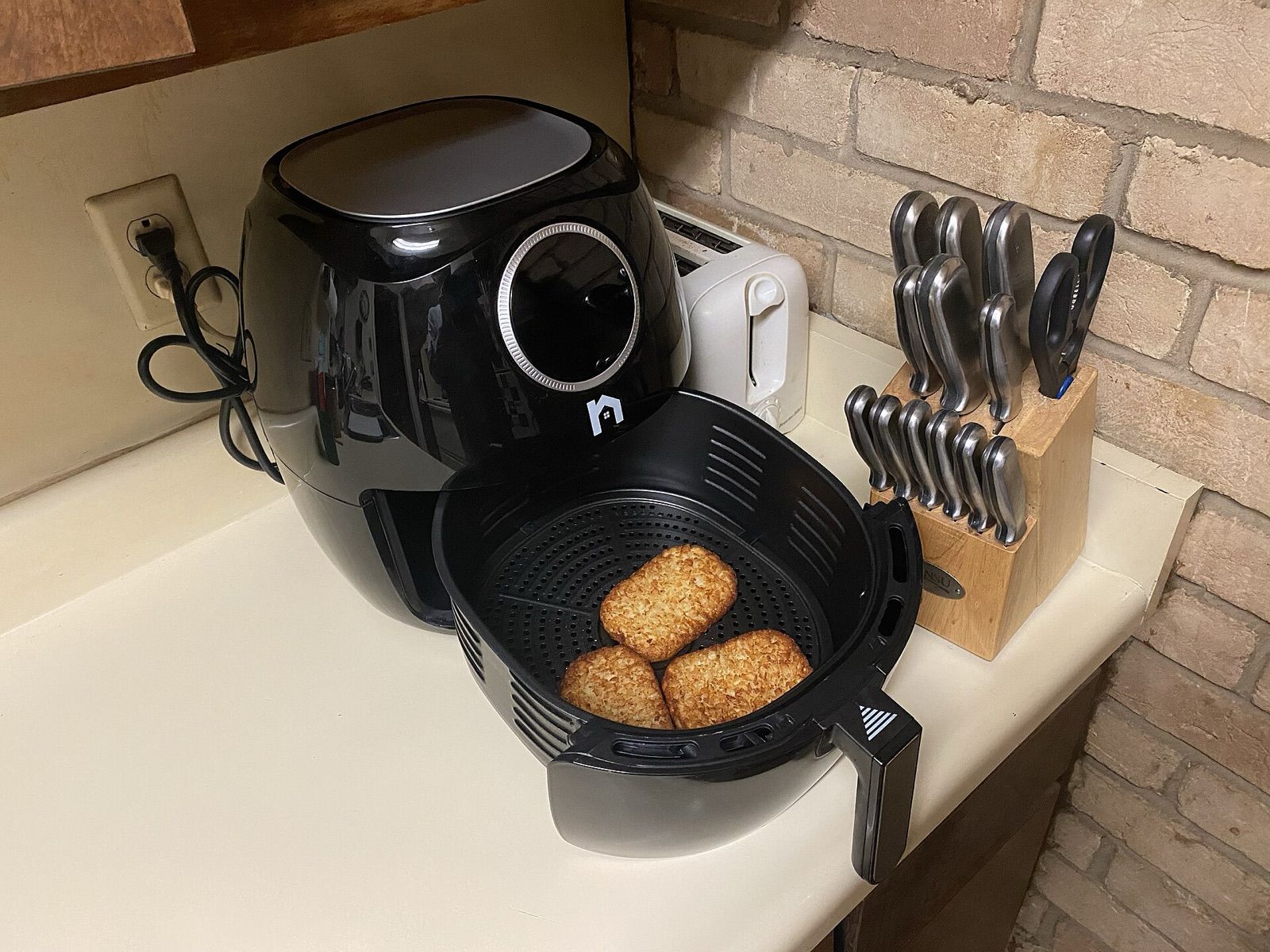
An air fryer is really a small, powerful convection oven: a heating element sits above the food and a fan drives hot air around it, which crisps the surface with far less oil than deep frying. The idea is simple, but the shelves are now full of very different designs, from compact single drawers to countertop ovens and twin-drawer machines. This guide explains how the three main types differ and which numbers to look at before you buy.
How an air fryer cooks
Because the cooking chamber is small and the fan is strong, hot air moves quickly over every surface of the food. That is what browns fries, wings and roast vegetables so effectively. It also means air fryers usually heat up in a few minutes, and for small portions they often use less energy than warming a full-size oven.
The same design sets the limits. Food cooks best in a single layer with space around it. Pile a basket high and the pieces on top brown while those underneath steam. So the useful measure of an air fryer is not just its volume, but how much flat cooking area it offers.
Basket air fryers
The classic design is a pull-out drawer with a perforated basket or a crisper plate inside. Air circulates tightly around the food, which is why basket models are usually the fastest and crispiest for fries, nuggets, wings and roast potatoes.
- Typical capacity: about 2–7 litres (roughly 2–7 US quarts; one quart is just under a litre).
- Typical power: about 1,200–1,800 W.
- Good for: one to four people, quick weeknight sides, reheating.
- Trade-offs: you shake or turn food halfway through, and a round basket fits fewer pieces in a single layer than its litre figure suggests. Square baskets use their floor area better.
Oven-style air fryers
Oven-style models look like a toaster oven with a front door and removable racks. Many add a rotisserie spit, a drip tray and extra modes such as bake, dehydrate and toast.
- Typical capacity: about 10–25 litres.
- Typical power: about 1,500–1,800 W in North America; some 230 V models go higher.
- Good for: cooking on two or three levels, dehydrating, small roasts, and people who want one appliance instead of a toaster oven and an air fryer.
- Trade-offs: the larger chamber heats more slowly, and food on the lower rack browns less than food near the element, so you may need to swap trays. The door and racks also take longer to clean than a single drawer.
Dual-zone air fryers
Dual-zone machines have two independent drawers, each with its own heating element and fan. You can cook two foods at different temperatures and times, and a "sync" or "match" function makes both finish together, for example chicken in one drawer and vegetables in the other.
- Typical capacity: about 7–11 litres in total, split between two drawers of roughly 3–5 litres each. Some designs have a removable divider, so one large drawer can become two.
- Typical power: about 1,700–2,500 W, depending on the market.
- Good for: families, meal prep, and anyone who regularly cooks a main and a side at the same time.
- Trade-offs: a wide footprint, and each individual drawer can be smaller than a good single basket. Large items such as a whole chicken may not fit. On some models, power is shared when both drawers run, which can lengthen cooking times.
Quick comparison
| Type | Typical capacity | Strengths | Watch out for |
|---|---|---|---|
| Basket | 2–7 L | Fast, very crisp, easy to clean | Single-layer limit, shaking needed |
| Oven-style | 10–25 L | Several racks, extra modes, rotisserie | Slower, uneven between shelves |
| Dual-zone | 7–11 L total | Two foods at once, synced finish | Footprint, smaller individual drawers |
What capacity you need
Manufacturers quote capacity in litres or quarts, but think in portions:
- 1–2 people: 2–4 litres is usually enough for sides and small mains.
- 2–4 people: 4–6 litres, or a dual-zone machine if you often cook two things at once.
- 4 or more, or batch cooking: 6 litres and up, a dual-zone model or an oven-style unit.
Rule of thumb: compare the flat floor area of the basket or rack, not only the litre figure. One layer of food is what actually cooks well.
If you can, check the internal dimensions in the manual or specification sheet. A tall, narrow basket and a wide, shallow one can share a litre rating but hold very different amounts of chicken thighs.
Wattage and your kitchen circuit
Higher wattage generally means faster heat-up and better recovery when you add cold food, but it is not the whole story; fan design and chamber size matter too. Two practical points:
- In North America, a standard 15 A, 120 V circuit supplies at most about 1,800 W, which is why most air fryers stop around that figure. Running an air fryer, a kettle and a toaster on the same circuit can trip the breaker.
- In the UK and much of Europe, 230 V supply allows more powerful appliances, but the same principle applies to sharing a socket strip with other high-draw appliances.
Plug air fryers directly into a wall socket rather than an extension lead, as most manuals advise.
What else to check before you buy
- Footprint and clearance. Air fryers vent hot air, usually from the back or top. Check the manual for the recommended clearance from walls and cabinets, and measure your counter space, especially for dual-zone and oven-style models.
- Temperature range and controls. Most run from roughly 80 °C to 200 °C (175–400 °F); a lower minimum is useful for dehydrating. Clear, physical or well-labelled controls matter more than a long list of presets.
- Coatings. Most baskets use a non-stick coating, either PTFE-based or ceramic. Avoid metal utensils and abrasive pads, and replace a basket if its coating is flaking. Stainless-steel and glass interiors are available if you prefer to avoid coatings altogether.
- Cleaning. Check whether the basket and crisper plate are dishwasher-safe. Fewer nooks and a removable plate make daily cleaning much easier.
- Viewing window and light. Handy for checking browning without opening the drawer, though windows can fog and need cleaning.
- Noise. The fan runs constantly. Specifications rarely give decibel figures, so user reports are the best guide.
- Accessories. Racks, skewers and baking tins add flexibility, but only if they fit your particular model.
Using one well
A few habits get better results from any design: preheat briefly if the manual suggests it, keep food in one layer, shake or turn halfway, and use a light spray of oil for crispness. Don't put loose baking paper in an empty, preheating basket, as the fan can lift it onto the element; weigh it down with food or use perforated liners sized for your model.
The short version
Choose a basket air fryer if you mostly cook for one to three people and want the crispest results with the least fuss. Choose oven-style if you want several racks, a rotisserie or dehydrating, and have the counter space. Choose dual-zone if you regularly cook two foods at once for a family. Whatever you pick, judge capacity by usable cooking area, check that the wattage suits your kitchen circuit, and make sure the basket is easy to clean, because that is what decides whether you keep using it.
Bloiq is reader-supported. Some links may earn us a commission; it never affects what we write. How we make money.