Home / Travel / China · Campus tours
Tsinghua University campus tour: what to see on a visit to Beijing
Planning a visit to Tsinghua? The Old Gate, the Grand Auditorium, the Lotus Pond, student life in Wudaokou, campus entry rules and where families stay.
Tsinghua University fills a large, leafy stretch of Haidian District in north-west Beijing, on land that once belonged to Qing-dynasty imperial gardens. For a prospective student it is two places at once: a historic campus of lawns, ponds and early twentieth-century buildings, and one of China's great engineering and science universities. This guide explains how the campus fits together, what to see in a half day, how to get in (visitor access is controlled) and where families tend to base themselves.
How the campus is laid out
Tsinghua is big, several kilometres across, and it helps to think of it in three parts:
- The historic core in the west and centre: the Old Gate, the Grand Auditorium and its lawn, the old library and the gardens around the Lotus Pond. This is what most visitors come to see.
- The main axis running north from the South Gate: a broad avenue lined with newer teaching buildings, with the Main Building at its head.
- The residential east and north, where most students live in dormitory blocks, with canteens, sports fields and shops close by.
Students cross all of this by bicycle, and the lanes are full of them between classes. On foot, allow at least two to three hours just for the historic core.
Landmarks worth your time
The Old Gate. The white, arched gateway known as the Second School Gate carries the university's name in Chinese characters and is the most photographed spot on campus. The original dates from the university's earliest years; the gate you see today is a faithful reconstruction. Expect queues for photos at busy times.
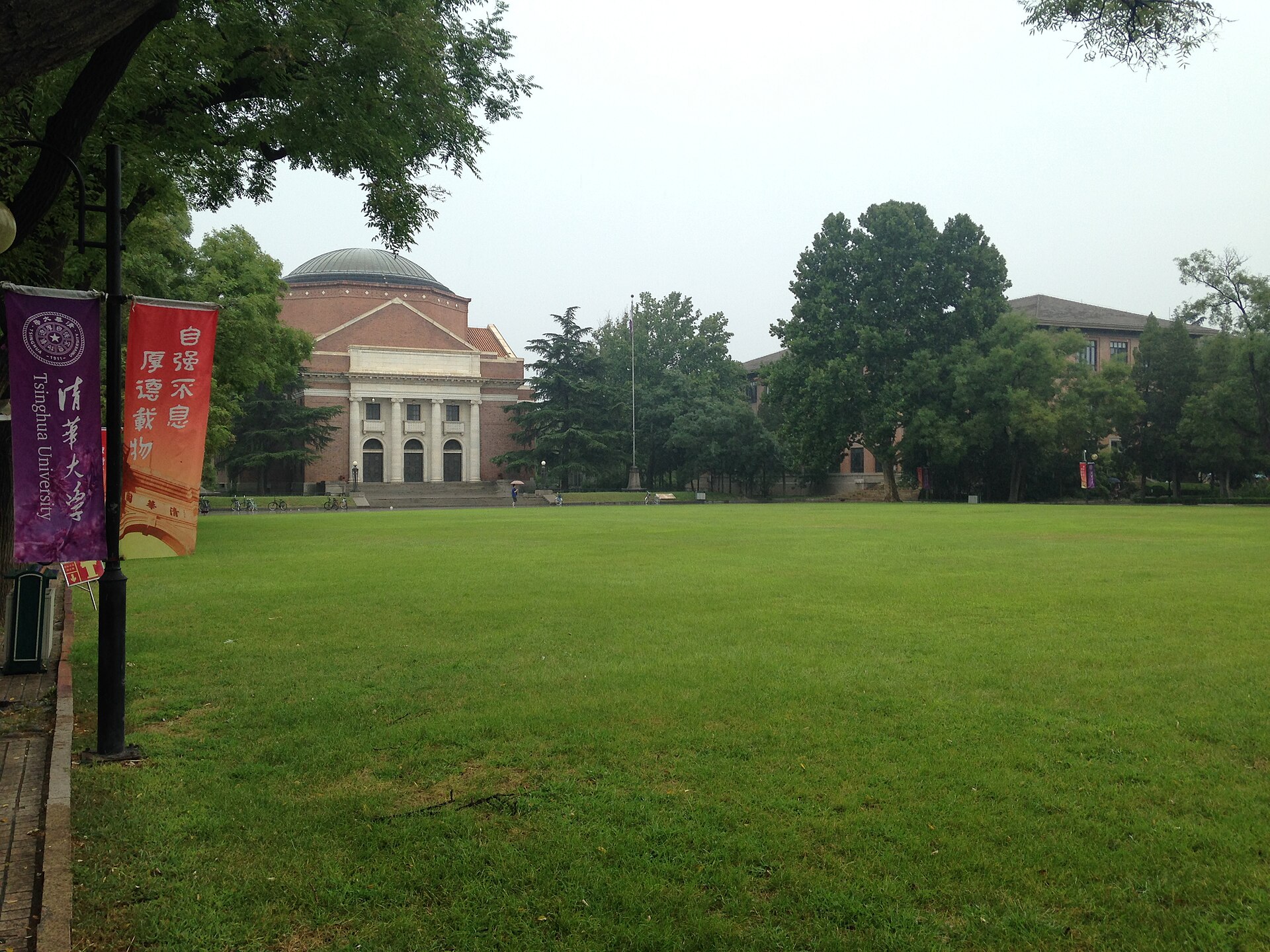
The Grand Auditorium and its lawn. A short walk away, the domed, columned Grand Auditorium looks down a long, open lawn. Together with the old library, the science building and the gymnasium, it belongs to the group of early buildings that give this part of campus an unexpectedly Western, collegiate feel. A sundial on the lawn carries the motto "actions speak louder than words", a phrase the university still uses.
The Lotus Pond and Tsinghua Garden. North of the core, the pond made famous by Zhu Ziqing's essay "Moonlight over the Lotus Pond", written while he taught here, is ringed with willows and small pavilions. Summer is when the lotus is in full leaf. Nearby, the Tsinghua Garden (the old imperial garden that gave the university its name) keeps a traditional gate and courtyard.
The libraries and the Main Building. The historic library has been extended several times, with newer wings added alongside. The Main Building, a large, symmetrical block at the head of the central avenue, anchors the modern side of campus.
A short history, in context
Tsinghua began in 1911 as a preparatory school that sent students to study in the United States, which explains the American influence on its early architecture. It grew into a full university and, after the reorganisation of Chinese higher education in the early 1950s, became above all a school of engineering. It has since broadened again into the sciences, humanities, economics and management.
Life around campus
Almost all undergraduates live on campus, and daily life revolves around dormitory neighbourhoods and large canteens. Sport is taken seriously: running tracks and courts are busy in the early morning and evening. Clubs and student associations are numerous, and the campus has its own shops, banks and post office.
Just beyond the south-east corner lies Wudaokou, Beijing's best-known student neighbourhood. It serves Tsinghua, Beijing Language and Culture University and several other universities, and it has a long-standing international student population, so you'll find cafés, bookshops, language schools and restaurants from across Asia. It is also a practical place for visiting families to eat.
Neighbouring Peking University is a short cycle ride west; see our Peking University campus tour if you're visiting both.
Getting in: visitor access
Access for the general public is controlled, and the rules change. In recent years visitors have generally needed to register in advance through the university's official channels, show ID (a passport for foreign visitors) at the gate, and sometimes accept daily limits or restrictions around holidays and exams. Rules for groups differ from those for individuals.
Prospective students should look for the university's admissions pages instead: Tsinghua holds open days and information events, and international admissions staff can advise on whether a campus visit can be arranged. Check the current rules on the official website before you go, and don't rely on being able to walk in on the day.
How to get there
Beijing's metro is the easiest way in:
- Line 13 stops at Wudaokou, a short walk from the south-east of campus.
- Line 4 runs to the west of campus, with stations for Peking University and the Yuanmingyuan (Old Summer Palace); the university's west side is within walking distance.
From central Beijing, allow roughly 45 minutes to an hour by metro. Taxis and ride-hailing apps work well, but traffic in Haidian can be slow at rush hour. Once inside, shared bikes are the local habit where they are permitted; otherwise, wear comfortable shoes.
Which area to stay in
- Wudaokou and Zhongguancun: closest to campus, practical and lively, with plenty of restaurants. Good if the visit is the main purpose of the trip.
- Around the Summer Palace: quieter, greener and close to the Old Summer Palace and Summer Palace, which make a natural add-on to a campus day.
- Central Beijing (Dongcheng): better for families combining the visit with the Forbidden City and the hutongs, at the cost of a longer daily commute on Line 4 or Line 13.
Practical tips for your visit
- Carry your passport; you may need it at the gate and for other sights.
- Go early on a weekday in term time to see the campus as it really is; weekends can bring long queues at the gate.
- Combine Tsinghua with Peking University and the Old Summer Palace, all in the same corner of the city.
- Spring blossom and autumn colour make the campus at its most photogenic; summer is hot and busy.
- Confirm access and events on the university's official site shortly before you travel, as arrangements change at short notice.
Bloiq is reader-supported. Some links may earn us a commission; it never affects what we write. How we make money.
Cover photo: そらみみ (Soramimi), CC BY-SA 4.0, via Wikimedia Commons