Home / Travel / China · Campus tours
Peking University campus tour: Weiming Lake, Boya Pagoda and more
A visitor's guide to Peking University in Beijing: the West Gate, Weiming Lake, Boya Pagoda, the library, student life, campus entry rules and where to stay.
Peking University, known to almost everyone as Beida, is China's oldest modern university and one of its most beautiful. Its main campus in Haidian, north-west Beijing, is built around a lake, a pagoda and a string of old gardens, and it feels closer to a classical Chinese landscape than to a campus. This guide is for prospective students and families: what to see, how the university and its neighbourhood work, how public access is managed, and how to plan the day.
Beida in brief
- Founded: 1898, as the Imperial University of Peking, in the last years of the Qing dynasty.
- Main campus: Yan Yuan, in Haidian District, taken over from the former Yenching University in the early 1950s.
- Known for: the humanities, sciences, social sciences and medicine, and a long association with China's intellectual and political history, from the May Fourth Movement onwards.
- Neighbours: Tsinghua University to the east and the Old Summer Palace (Yuanmingyuan) to the north.
Walking the campus: a suggested route
Start at the West Gate. The traditional gateway, with red doors, stone lions and a name plaque over the entrance, is the ceremonial front door of the university and the classic starting point. It opens onto the oldest, most garden-like part of the campus.
Pass the old Yenching buildings. Beyond the gate, grey-tiled roofs, painted eaves and stone bridges surround a small lawn and ponds. These buildings, designed in a Chinese revival style for Yenching University in the 1920s, now hold offices and departments. Their mixture of Chinese forms with modern construction was deliberate, and it gives the whole campus its character.
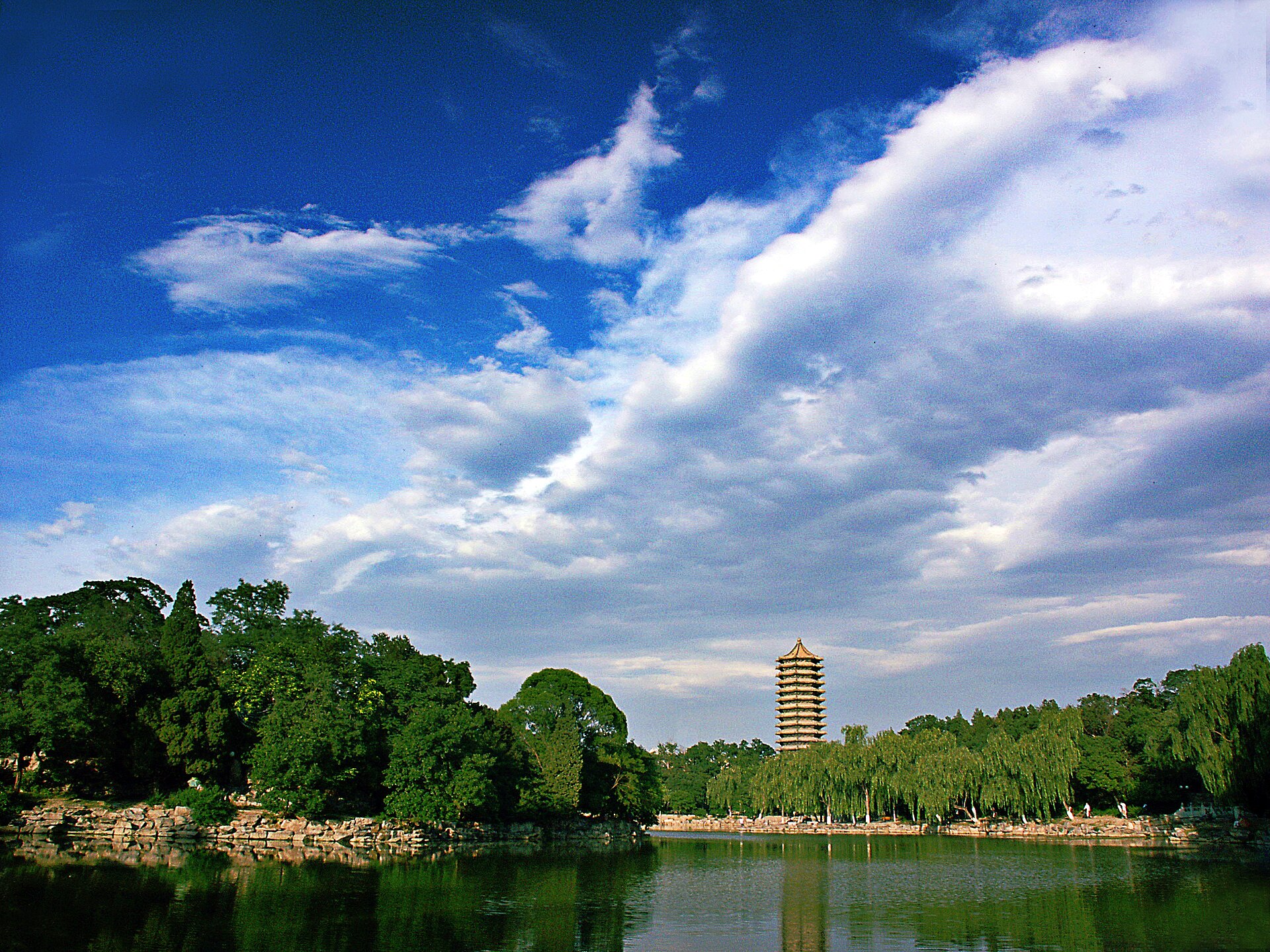
Continue to Weiming Lake. The heart of Beida is Weiming Lake, whose name means "the lake without a name". Paths loop right around it under willows, past a small island with a pavilion, a stone boat and quiet benches used by students reading aloud to practise languages. In winter the lake freezes and becomes an ice rink.
Look up at Boya Pagoda. On the east shore, the thirteen-storey Boya Pagoda looks like a temple building but was built in the 1920s as a water tower, disguised so as to fit the landscape. Students sum up the campus with a pun, "one pagoda, one lake, one library", which sounds in Chinese like a phrase meaning "a complete mess".
Finish at the library. South of the lake, the large main library with its traditional roofline completes that trio. From here, the modern teaching buildings, laboratories and dormitories spread south and east.
Allow two to three hours at an easy pace, longer if you stop at the university's museums or bookshops.
Student life
Most undergraduates live on campus in dormitory areas to the south and east, with canteens that serve a wide range of regional Chinese food. Student societies run everything from debating and drama to hiking and volunteering. Sport happens on the fields and tracks, and in winter on the frozen lake.
International students are a visible part of campus life, and many take Chinese language courses alongside degree programmes. Off campus, Zhongguancun, Beijing's technology district, lies just to the south, and Wudaokou, the lively student neighbourhood shared with Tsinghua, is a short ride east. If you're seeing both universities, read our Tsinghua University campus tour too.
Visiting: what to know about access
Like other universities in Beijing, Peking University controls access for the public. In recent years visitors have usually needed to register in advance through official channels and show ID at the gate (foreign visitors use a passport), and numbers have sometimes been capped, particularly at weekends and during holidays. Prospective students should look at the university's admissions pages, which list open days, information events and contacts for international applicants.
These arrangements change, sometimes at short notice. Check the current rules on the university's official website before you go.
Getting there
- Metro Line 4 has a station named after the university's East Gate, and the Yuanmingyuan Park station is close to the north-west. Line 4 runs south through Zhongguancun and into central Beijing.
- Taxis and ride-hailing are easy, though Haidian traffic can be slow at rush hour. Give the driver the name of the specific gate you've been told to use.
- From the airports, Beijing Capital is generally the easier of the two for Haidian; from Daxing, allow for a longer transfer.
Which area to stay in
- Zhongguancun and the university district: closest to campus, with business hotels, malls and restaurants. Best when the campus visit is the focus.
- Near the Summer Palace and Yuanmingyuan: calmer and greener, with the two imperial gardens on the doorstep.
- Central Beijing: Dongcheng and the area around Wangfujing suit families combining the visit with the Forbidden City, Tiananmen and the hutongs, with Line 4 or a taxi out to Haidian.
Making a day of it
Beida sits in one of the richest corners of Beijing for visitors. The ruins and lakes of the Old Summer Palace are a short walk north, and the Summer Palace, with Kunming Lake and Longevity Hill, is a little further west. A realistic plan is Peking University in the morning, lunch in Wudaokou or Zhongguancun, and one of the palaces in the afternoon.
Before you go
- Register for entry in advance if required and carry the ID you registered with.
- Spring blossom and autumn leaves around the lake are the most photogenic; July and August are hot and humid.
- Avoid national holidays, when queues at the gate can be long.
- Wear comfortable shoes; paths around the lake are uneven in places.
- Confirm open days and visitor rules on the official site shortly before you travel.
Bloiq is reader-supported. Some links may earn us a commission; it never affects what we write. How we make money.
Cover photo: endeneon, CC BY-SA 4.0, via Wikimedia Commons