Home / Travel / Ireland · Campus tours
Trinity College Dublin campus tour: squares, libraries and city life
A future student's guide to Trinity College Dublin: Front Square and the Campanile, the Old Library, College Park, student life, open days, transport and where to stay.
Step through the Front Gate of Trinity College Dublin and the traffic of College Green gives way to cobbles, granite and lawns. Founded in 1592 under a charter from Elizabeth I, Trinity is Ireland's oldest university, and its walled campus sits right in the middle of the capital, between Grafton Street and the Georgian squares. For a future student it offers something unusual: a self-contained historic campus with a whole city on the doorstep. Here is what to look for and how to plan a visit.
First, a word on names
Trinity College is the only college of the University of Dublin, so the two names effectively describe one institution. Degrees are awarded by the University of Dublin; everyday life, from lectures to societies, is simply "Trinity" or "TCD".
Front Square and Parliament Square
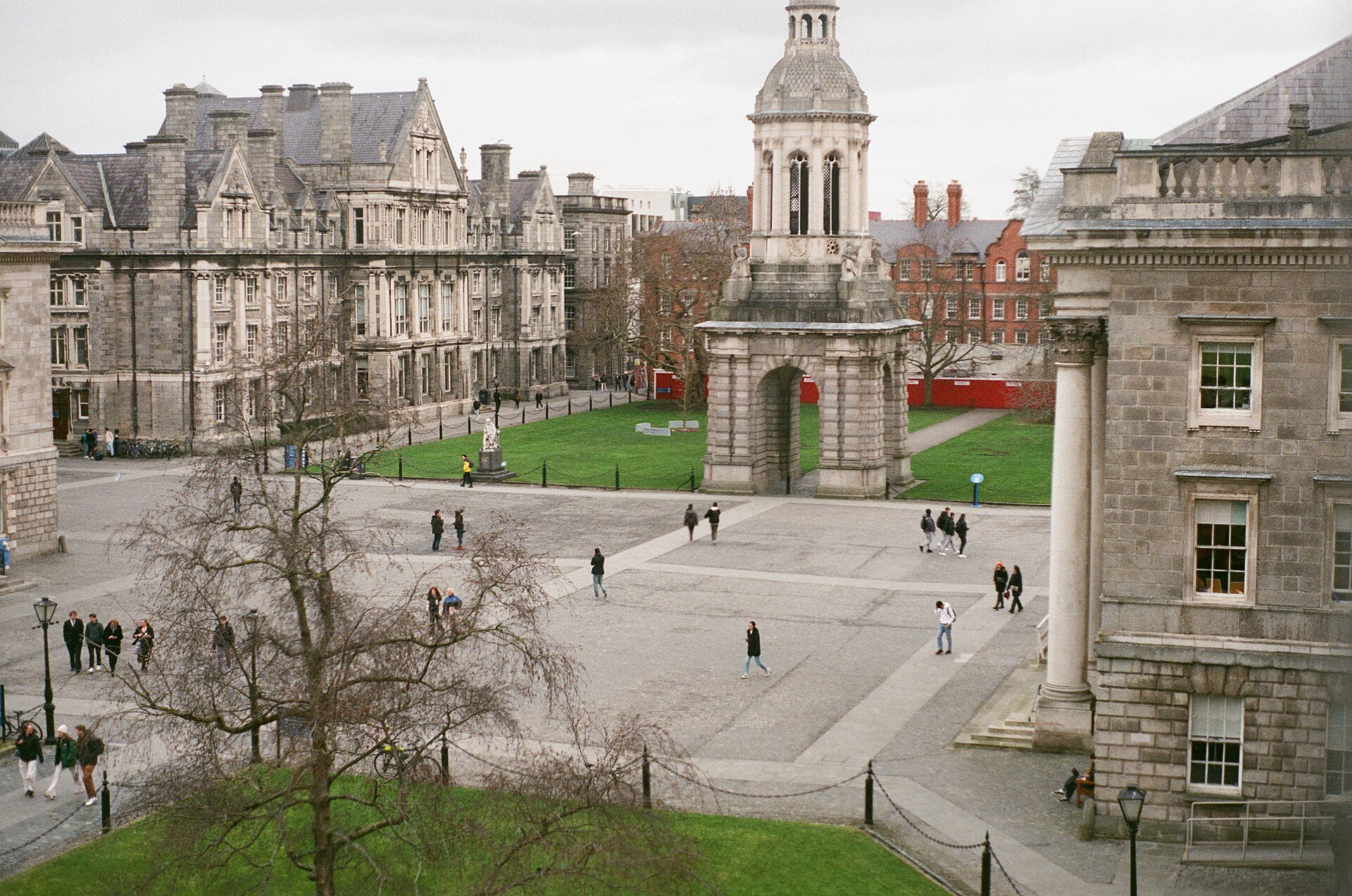
The Front Gate faces College Green and the curved facade of the former Irish Parliament House. Beyond it opens Parliament Square, the grand cobbled space most people call Front Square. On either side stand two matching 18th-century buildings by the architect William Chambers: the Chapel and the Exam Hall, also known as the Public Theatre, which is used for exams, concerts and ceremonies.
At the centre rises the Campanile, the bell tower completed in the 1850s. It carries one of Trinity's best-known superstitions: students who walk beneath it when the bell rings are said to fail their exams, so many take the long way round.
Library Square and the Old Library
Behind the Campanile, Library Square is flanked by the Rubrics, red-brick buildings from around 1700 that are the oldest surviving on campus and still house students and staff.
To the south stands the Old Library, built in the early 18th century. Its upper hall, the Long Room, a vast barrel-vaulted gallery lined with marble busts, is one of the most photographed library interiors anywhere. The library is also home to the Book of Kells, the richly illuminated Gospel manuscript made around the year 800, and to an old Irish harp that inspired the national emblem.
The Old Library is in the middle of a long-term conservation and redevelopment project, so what visitors can see inside, and how the Book of Kells is displayed, may differ from older descriptions and photos. Check Trinity's official pages for what is open before you go.
The modern campus
Walk east and the architecture jumps forward two centuries. The Berkeley Library, a bold 1960s concrete building, is one of Ireland's best-known modernist designs; in front of it sits Arnaldo Pomodoro's bronze sculpture Sphere Within Sphere. The Arts Building on Nassau Street and the science and engineering buildings towards Pearse Street hold most teaching. Health sciences and medicine also use hospital sites elsewhere in the city, so check where your course is based.
College Park and student life
At the east end, College Park is Trinity's great lawn, with a cricket pitch and rugby grounds. On summer days it fills with students, and the Pavilion bar beside it is a campus institution.
Trinity's society scene is one of its strongest traditions. Two debating societies, the University Philosophical Society and the College Historical Society, date back to the 17th and 18th centuries, and there are over a hundred others alongside dozens of sports clubs. The Trinity Ball, held on campus each spring, is the biggest night of the student year. Former students include Jonathan Swift, Oscar Wilde, Bram Stoker and Samuel Beckett.
Some students live in rooms on the campus itself, which is a rare experience in a capital city. Many first-years live at Trinity Hall, a residence in the southern suburb of Dartry, a short tram or bike ride from the college. Outside the walls, the pubs, cafés and shops of Grafton Street, Temple Bar and Dawson Street are the students' neighbourhood.
Visiting as a prospective student
Trinity holds open days for prospective undergraduates, with subject talks, admissions information and tours of the campus. Registration is usually required. The campus grounds are generally open to the public during the day, and student-led walking tours for visitors run at busy times of year, so you can explore even outside official events. For times, booking and any restrictions, check Trinity's official visitor and open-day pages before you travel.
Travel logistics
- From the airport: Dublin Airport has no rail link, but express coaches and city buses run to the city centre, including stops near Trinity. The journey usually takes 30 to 45 minutes, depending on traffic.
- Luas tram: the Green Line stops right beside the college at Trinity and Dawson, and continues south through Ranelagh to the southern suburbs.
- Rail: Pearse Station, beside the east side of the campus, is on the DART coastal line. Heuston and Connolly stations serve trains from the rest of Ireland.
- On foot: most of central Dublin, from Temple Bar to Merrion Square, is within 15 minutes' walk.
Staying overnight
- Grafton Street and St Stephen's Green, the classic centre, a few minutes from the Front Gate.
- Georgian Dublin around Merrion Square, elegant and slightly quieter, near the National Gallery.
- Temple Bar, right next to the college but loud at night.
- Ballsbridge and the Docklands, calmer areas a short tram, train or bus ride away.
Our where to stay in Dublin guide covers these areas in detail.
Practical tips
- Visit Front Square early in the morning, before the tour groups arrive.
- Tickets for the Old Library and Book of Kells often sell out at busy times; book ahead.
- Walk the whole campus from College Green to College Park to see how its history layers up.
- Pack a light raincoat: Dublin showers come and go quickly.
Bloiq is reader-supported. Some links may earn us a commission; it never affects what we write. How we make money.
Cover photo: Adam McGrath, CC BY-SA 4.0, via Wikimedia Commons