Home / Travel / Canada · Campus tours
University of Toronto campus tour: St. George, colleges and landmarks
A visitor's guide to U of T's downtown St. George campus: King's College Circle, University College, Hart House, Robarts Library, the colleges and where to stay.
The University of Toronto was founded in 1827 as King's College, and its historic St. George campus sits right in the middle of Canada's largest city, a few minutes' walk from Queen's Park and Bloor Street. Unlike a self-contained campus in a college town, it blends into the city: streets run through it, subway stations line its edges, and museums and restaurants are on its doorstep. The university also has campuses in Mississauga and Scarborough, but this guide focuses on St. George, where most visitors start.
Quick orientation
- Heart of the campus: King's College Circle and Front Campus, with University College and Convocation Hall.
- Student hub: Hart House and Soldiers' Tower, just north-east of the Circle.
- Big library: Robarts Library, on St. George Street to the west.
- The colleges: Trinity, Victoria and St. Michael's on the eastern side, near Queen's Park; others spread across the campus.
- Neighbours: the Ontario Legislative Building to the east, the Royal Ontario Museum to the north-east, the Annex to the north-west.
King's College Circle and University College
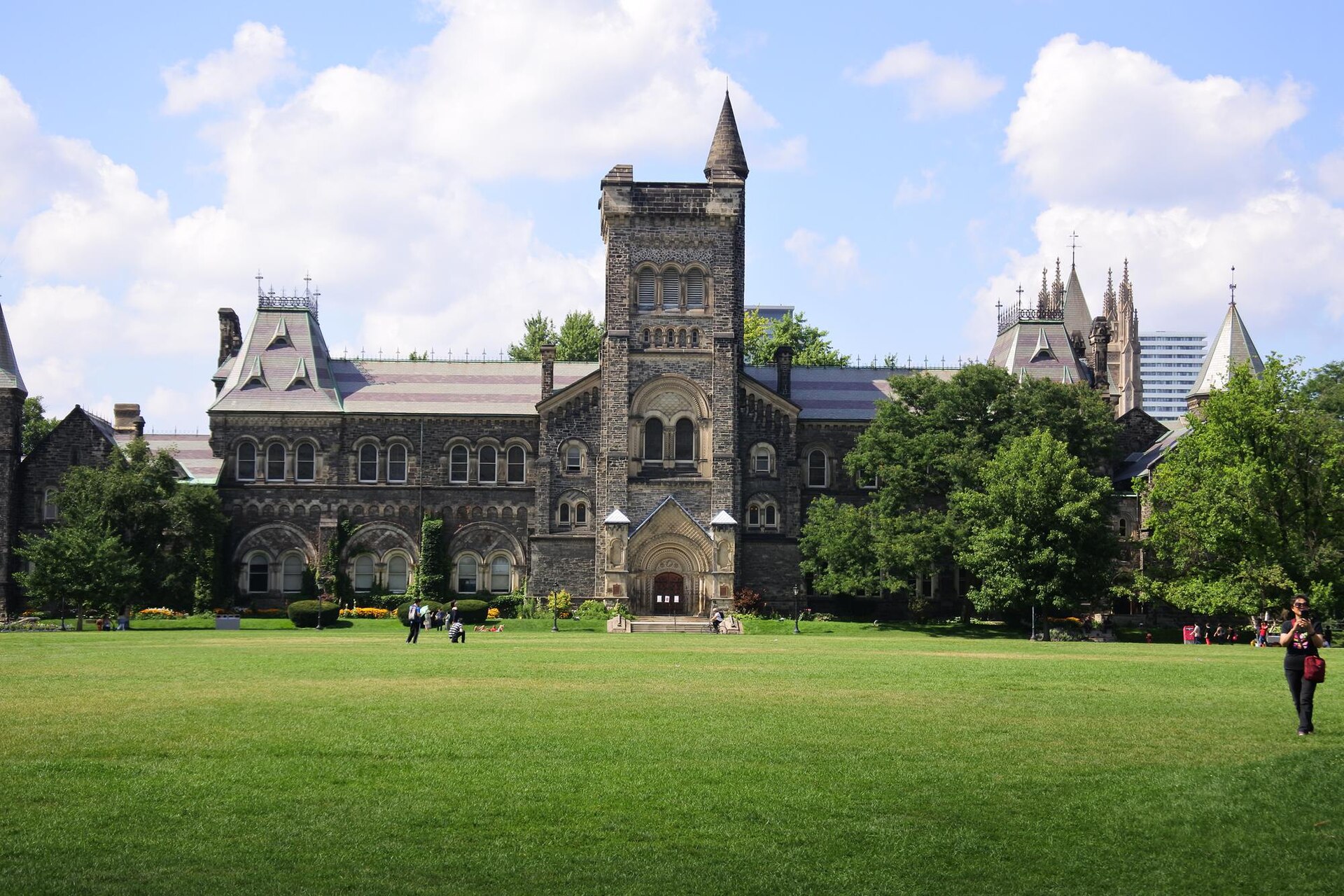
Start at King's College Circle, the great oval green at the centre of the campus. Its northern side is dominated by University College, a Romanesque Revival building from the 1850s with a carved stone entrance, a tall tower and dark stone walls. It's the backdrop to many graduation photographs and the building most people picture when they think of U of T.
At the Circle's southern end stands Convocation Hall, a round, domed building used for graduation ceremonies and large lectures. The lawn in between, Front Campus, is where students cross between classes and gather on warm days.
Hart House and Soldiers' Tower
Walk north-east to Hart House, a large Gothic Revival building opened in 1919 as a centre for student life. It holds a theatre, a great hall used for dining and events, reading rooms, an art collection and athletics facilities, and it's often open to visitors. Next to it, Soldiers' Tower is a memorial to members of the university community who died in the world wars, with a carillon that is played on special occasions.
Robarts Library and the libraries
Robarts Library, on St. George Street, is a vast concrete Brutalist building with a distinctive triangular shape that students have nicknamed for its resemblance to a bird. It's the main humanities and social sciences library and one of the busiest study spaces on campus. The Thomas Fisher Rare Book Library, in the same complex, is much more striking inside than out: tiers of old books rise around a central space, and its public areas are usually open to visitors.
The college system
A distinctive feature of U of T is its colleges. Undergraduates in Arts and Science belong to one of seven colleges: Innis, New, St. Michael's, Trinity, University, Victoria and Woodsworth. Colleges provide residences, dining, advising and a smaller community within a very large university. Walking through Trinity College, with its Gothic quadrangle, and Victoria College, near Queen's Park, is one of the best ways to see how varied they are. Visiting families should ask about the colleges at an information session, as they shape much of day-to-day student life.
Life around the campus
Philosopher's Walk, a leafy path running from Bloor Street down past the Royal Ontario Museum and the Faculty of Music, is a favourite shortcut. The Royal Ontario Museum and the Bata Shoe Museum sit on Bloor Street on the campus's northern edge, and the Gardiner Museum of ceramics is across from the ROM. To the north-west, the Annex is a residential neighbourhood popular with students, with cafés, bookshops and pubs. South-west, Kensington Market and Chinatown along Spadina Avenue offer food from around the world. Varsity Stadium, on Bloor, hosts university sport.
How visits work
The university typically runs student-led campus tours and information sessions for prospective students, as well as self-guided tour options. Individual colleges and faculties may offer their own visits too. Registration is usually required and times change through the year, so check the university's official visitor pages before you travel.
How to get there
- By air: from Toronto Pearson airport, the UP Express train reaches Union Station downtown in about 25 minutes. From there, take Line 1 north.
- By subway: Line 1 has stations at Queen's Park, Museum and St George along the campus's eastern and northern edges; Line 2 stops at St George and Spadina.
- By streetcar and bus: several routes cross the campus edges, including along College Street and Spadina Avenue.
- On foot: the St. George campus is walkable, and most sights are within 15 minutes of each other.
Staying overnight
- Yorkville and Bloor Street: close to the campus's northern edge and the ROM, with plenty of restaurants.
- The Annex: a quieter, residential feel with some smaller guest houses and hotels.
- Downtown and the Financial District: more choice, with a quick subway ride to campus.
- Around Queen's Park and College Street: within walking distance of the main sights.
The where to stay in Toronto guide compares these areas in more detail.
Tips for your visit
- Autumn and spring show the campus at its best and busiest; winters are cold and snowy, so dress warmly.
- Plan at least half a day for the core, plus time for the ROM if it interests your family.
- Check the university's official visitor pages again shortly before your trip for any changes to tours or building access.
Bloiq is reader-supported. Some links may earn us a commission; it never affects what we write. How we make money.
Cover photo: Ken Eckert, CC BY-SA 4.0, via Wikimedia Commons