Home / Travel / Germany · Campus tours
LMU Munich campus tour: a walk along Ludwigstraße and beyond
A campus walk for future LMU Munich students: the main building and its atrium, the White Rose memorial, Schwabing, the English Garden, open days and where to stay.
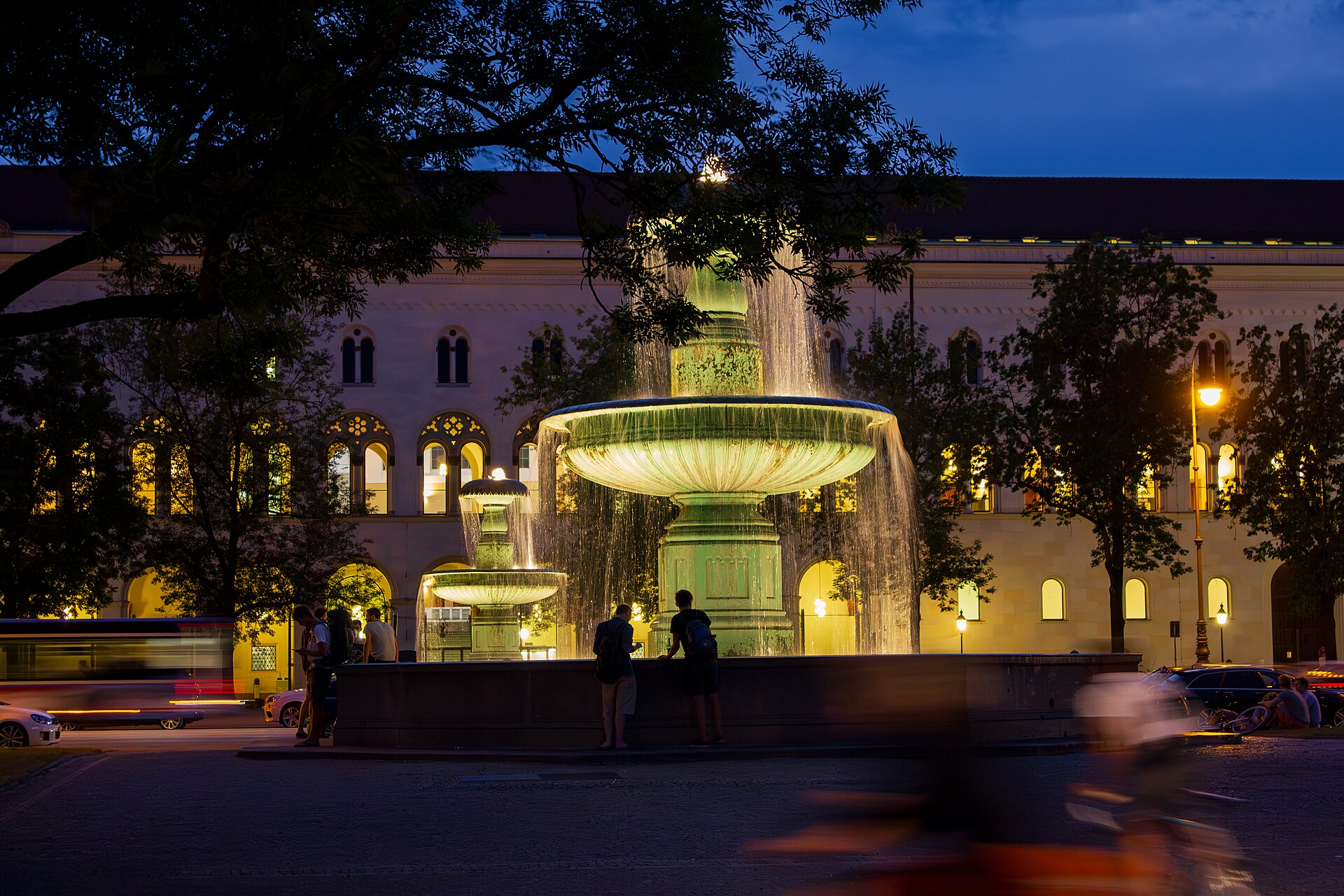
Ludwig-Maximilians-Universität München, usually just LMU, has no gates and no campus lawn. Its main building stands on one of Munich's grandest boulevards, and its faculties are spread across the Maxvorstadt and Schwabing districts and out to a large medical and life-sciences site in the south-west. The best way to get a feel for it is on foot. This guide suggests a walking route through the historic core, then covers student life, visiting, transport and where to stay.
A university that moved twice
LMU was founded in 1472 in Ingolstadt. It moved to Landshut in 1800 and then to Munich in 1826, under King Ludwig I, who was building Ludwigstraße as a showpiece avenue of royal and academic buildings. The main building, designed by Friedrich von Gärtner, still anchors that avenue today. Knowing the story helps you read the street: the library, the church and the university were all part of one plan.
Start at Geschwister-Scholl-Platz
Take the underground to the Universität stop and come up between two squares. On the west side, Geschwister-Scholl-Platz fronts the main building, with its two large fountains; on the east, Professor-Huber-Platz faces it across the road. Both names honour members of the White Rose, the student resistance group of the Second World War.
Look down at the pavement in front of the main entrance: bronze replicas of leaflets and photos are set into the ground as a memorial to the group.
Inside the main building
The main building is open to the public during normal university hours. Walk in to the Lichthof, the tall glass-roofed atrium at its centre. It was here, in February 1943, that Hans and Sophie Scholl scattered leaflets from the upper gallery before they were arrested. The DenkStätte Weiße Rose, a small memorial exhibition off the atrium, tells the story of the group; it's short and well worth the time. Check its opening hours before you go.
Beyond the atrium, corridors lead to lecture halls, the Great Aula and inner courtyards. This is a working building, so keep quiet near lecture rooms and don't wander into offices.
North to the Siegestor and Schwabing
Walk north along Ludwigstraße and in a few minutes you reach the Siegestor, the victory arch that marks the boundary between Maxvorstadt and Schwabing. Beyond it, Leopoldstraße is lined with cafés and shops. Schwabing has long been Munich's artists' and students' quarter, and many LMU buildings are tucked into its side streets.
Into the English Garden
Head east from the university and within ten minutes you're in the English Garden, one of the largest city parks in Europe. In good weather, this is where LMU students study, picnic and meet. Walk to the Monopteros, a small classical temple on a hill with views of the city's towers, and continue to the Eisbach, where river surfers ride a standing wave near the southern tip of the park.
Other LMU sites worth knowing about
- Großhadern and Martinsried: in the south-west of the city, home to the large university hospital campus and many of the life sciences.
- Science buildings around Maxvorstadt: chemistry, pharmacy and other departments are spread across the district and beyond.
- The university library: its main building is part of the Ludwigstraße complex, with faculty libraries across the city.
If a prospective student is interested in medicine or biology, it's worth checking where the first-year teaching actually happens.
What student life looks like
LMU is a big, city-integrated university with students from all over the world. There are no US-style residences on a single campus. Students rent rooms in halls run by the regional student services organisation, including the large Studentenstadt complex in the north, or share flats across Munich, whose housing market is famously tight. Mensa canteens, the university sports programme and hundreds of student groups fill the gaps. Most bachelor's programmes are taught in German, while many master's programmes are in English.
Visiting LMU and meeting advisers
LMU holds information days for school students and prospective applicants, with subject talks and advice sessions, plus online events through the year. The central student advisory service can answer questions about programmes and language requirements. There's no need to book anything to walk the public parts of the main building. For event dates and any guided visits, check the university's official pages for prospective students.
Reaching campus
From Munich Airport, the S-Bahn reaches the city centre in about 40 minutes; change to the U3 or U6 underground for the Universität stop. Those lines run straight along Ludwigstraße and Leopoldstraße, so the same trains serve the Siegestor and Schwabing. Munich's centre is compact and bike-friendly, and the rental bikes are a quick way to link LMU sites.
Which area to stay in
Maxvorstadt and Schwabing are the natural bases: walkable to the main building and the English Garden, with good cafés and a residential feel. The Altstadt is a short ride south, and the Hauptbahnhof area is practical for early trains. Our guide to where to stay in Munich compares these areas in more detail.
Before you go
- LMU and the Technical University of Munich are a short walk apart; our TUM campus tour covers the other university and its Garching research campus.
- Avoid Oktoberfest weeks if you can; rooms in the city get scarce.
- Visit during the lecture period (roughly mid-October to February and mid-April to July) to see the building busy.
Bloiq is reader-supported. Some links may earn us a commission; it never affects what we write. How we make money.