Home / Travel / United States · Campus tours
Harvard campus tour: what to see on a visit to Harvard Yard and beyond
A visitor's guide to Harvard's campus in Cambridge: Harvard Yard, Widener Library, the river Houses, the museums, Harvard Square, and how to plan a visit.
Harvard, founded in 1636, is the oldest university in the United States, and its campus is woven into the streets of Cambridge, Massachusetts, just across the Charles River from Boston. There's no single gate or fence line: the university spreads out from Harvard Yard in every direction. This guide follows a natural walking route for prospective students and their families, then covers how visits work, how to get there and where to stay.
A walking route in one morning
Everything below fits into a loop of roughly two to three hours on foot, starting and ending in Harvard Square:
- Harvard Yard, the John Harvard statue and the first-year dorms
- Widener Library, Memorial Church and Tercentenary Theatre
- Memorial Hall and Annenberg Hall, just north of the Yard
- The Science Center and the museums on Divinity Avenue and Oxford Street
- Down to the river Houses and Weld Boathouse on the Charles
- Back to the Square for lunch
Harvard Yard: the first-year home
The Yard is the leafy, walled heart of the university, crossed by paths and dotted with the colourful chairs students drag into the sun. Most first-year students live in the dorms in and around it, so for them the lawns really are a front yard. Some of the red-brick halls here are among the oldest college buildings in the country; Massachusetts Hall dates from the early 18th century.
Near University Hall sits the bronze John Harvard statue by Daniel Chester French. Guides like to call it the statue of three lies: the face isn't John Harvard's (no portrait of him survived), he was an early benefactor rather than the founder, and the inscription gives 1638 although the college dates from 1636.
Widener, Memorial Church and Tercentenary Theatre
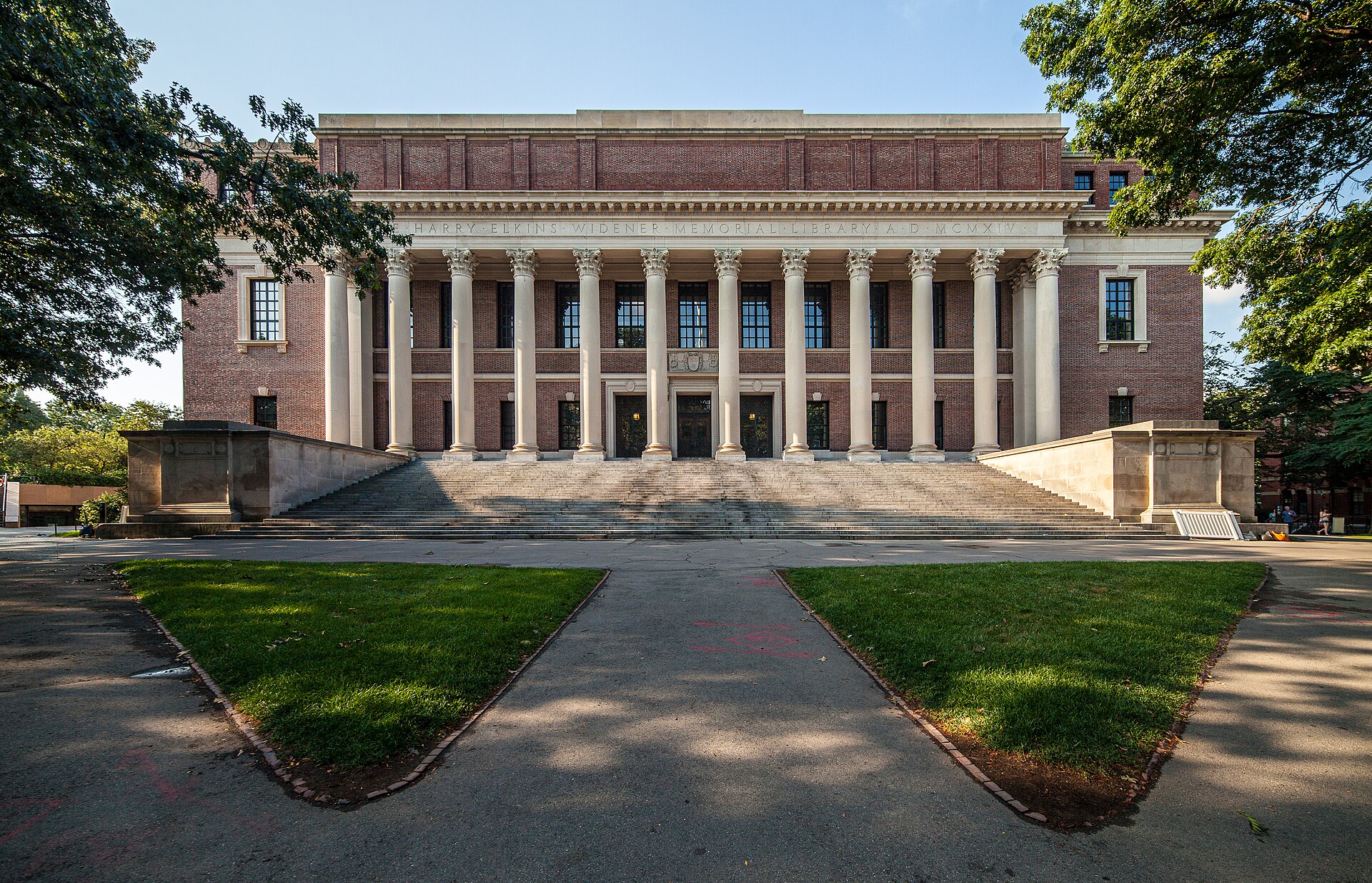
Walk through to the larger eastern half of the Yard and you reach Tercentenary Theatre, the open space between Widener Library and Memorial Church where Commencement is held each spring. Widener, with its broad steps and columns, is the flagship of a library system that spans dozens of libraries across the university. Widener's reading areas are for the Harvard community, so visitors generally see it from outside. Memorial Church, with its white steeple, faces it across the lawn.
Where first-years eat: Annenberg Hall
Just north of the Yard stands Memorial Hall, a huge High Victorian Gothic building honouring Harvard men who died for the Union in the Civil War. Inside, Annenberg Hall serves as the first-year dining hall, under a soaring timber roof and tall stained-glass windows. Access to the hall itself is usually limited to students, but the building's exterior and the memorial transept are well worth a look.
Science, engineering and the museums
The Science Center, a modern building immediately north of the Yard, holds large lecture halls, teaching labs and a busy plaza. Engineering and applied sciences have a newer home across the river in Allston, where a large science and engineering complex opened in recent years, alongside the business school.
Two museum stops fit easily into a visit:
- Harvard Art Museums on Quincy Street combine three collections (the Fogg, Busch-Reisinger and Arthur M. Sackler museums) beneath a single glass roof designed by Renzo Piano.
- Harvard Museum of Natural History on Oxford Street is known above all for the Glass Flowers, thousands of botanical models made in glass by Leopold and Rudolf Blaschka.
Life after first year: the Houses and the river
After first year, undergraduates move into one of twelve residential Houses, and most stay in the same House until graduation. Each has its own dining hall, library, common rooms and traditions, along with resident faculty. Most sit along the Charles River a few minutes south of the Yard, with their distinctive towers and cupolas; a smaller group is at the Radcliffe Quadrangle, a longer walk north.
The river is also the home of rowing. Harvard's crews train from Weld Boathouse and Newell Boathouse, and each October the Head of the Charles Regatta fills the banks and bridges with spectators. The riverside paths are good for a walk or run at any time of year.
Harvard Square and the neighbourhood
Harvard Square is the everyday hub: bookshops, cafés, casual restaurants, street musicians and the Red Line station. Beyond it, residential Cambridge streets lead toward Central Square, with more restaurants and music venues. Boston's museums, parks and Back Bay are a short subway ride away, and MIT is two stops down the Red Line, so families often see both campuses on the same trip.
How visits work
Harvard's admissions office runs information sessions paired with student-led campus tours on many weekdays during the academic year, with a more limited schedule in some seasons. They generally need to be registered for in advance, and spaces can go quickly around school holidays. The university also offers general historical tours of the Yard for visitors. Times, formats and booking rules change, so check Harvard's official admissions and visitor pages before you travel.
Getting there and around
- By air: Boston Logan International Airport is the gateway. Take the Silver Line bus from the terminals to South Station and change to the Red Line, or take a taxi; either way, Harvard Square is usually well under an hour away outside rush hour.
- By train: intercity trains arrive at South Station and Back Bay in Boston; from South Station, the Red Line runs straight to Harvard.
- On foot: once there, walk. The Yard, museums and river Houses are all within about 15 minutes of each other. Driving and parking in Harvard Square are best avoided.
Which area to stay in
- Harvard Square: the most convenient choice, with a handful of hotels within a few minutes' walk of the Yard. Rooms fill quickly on busy weekends such as Commencement and the regatta.
- Central Square and Kendall Square: a short Red Line ride away and convenient if MIT is also on your list.
- Boston (Back Bay or downtown): more choice, and easy access by subway; good if you are also seeing the city.
Practical tips for the day
- Register for the information session and tour first, then plan the rest of the day around them.
- Wear comfortable shoes: the Yard's paths are brick and uneven in places.
- Spring and autumn are the prettiest seasons; winter visits are cold but quieter.
- Classes, exams and move-in days affect what's open, so check the academic calendar.
- Respect student spaces: dorms, dining halls and libraries are generally closed to visitors.
Bloiq is reader-supported. Some links may earn us a commission; it never affects what we write. How we make money.
Cover photo: Kenneth C. Zirkel, CC BY 4.0, via Wikimedia Commons