Home / Travel / Switzerland · Campus tours
ETH Zurich campus tour: what to see on a visit to the Polytechnikum
A visitor's guide to ETH Zurich: the Semper main building and Polyterrasse, the Polybahn, Hönggerberg, student life in Zurich, open days and where to stay.
ETH Zurich, the Swiss Federal Institute of Technology, doesn't have a single enclosed campus. Its historic core sits on a slope just above Zurich's old town, and a second, much larger science campus spreads across a hill on the city's northern edge. That split shapes any visit. This guide explains what to see at each site, how student life in Zurich actually works, and how to plan a day that includes an information event.
Two campuses, one afternoon
Most first-time visitors start at ETH Zentrum, the city-centre campus on Rämistrasse. It shares the hillside with the University of Zurich, whose tower rises next door, so the whole quarter feels like a university district rather than a single site. Lectures, libraries and departments spill across dozens of buildings in the surrounding streets.
ETH Hönggerberg, sometimes called Science City, lies about 20 minutes away by bus. It holds much of physics, chemistry, biology, architecture and civil engineering, set among modern blocks, lawns and wide views over the Limmat valley. If a prospective student is interested in one of those fields, it's worth seeing both; otherwise the Zentrum campus gives the stronger first impression.
The main building and the Polyterrasse
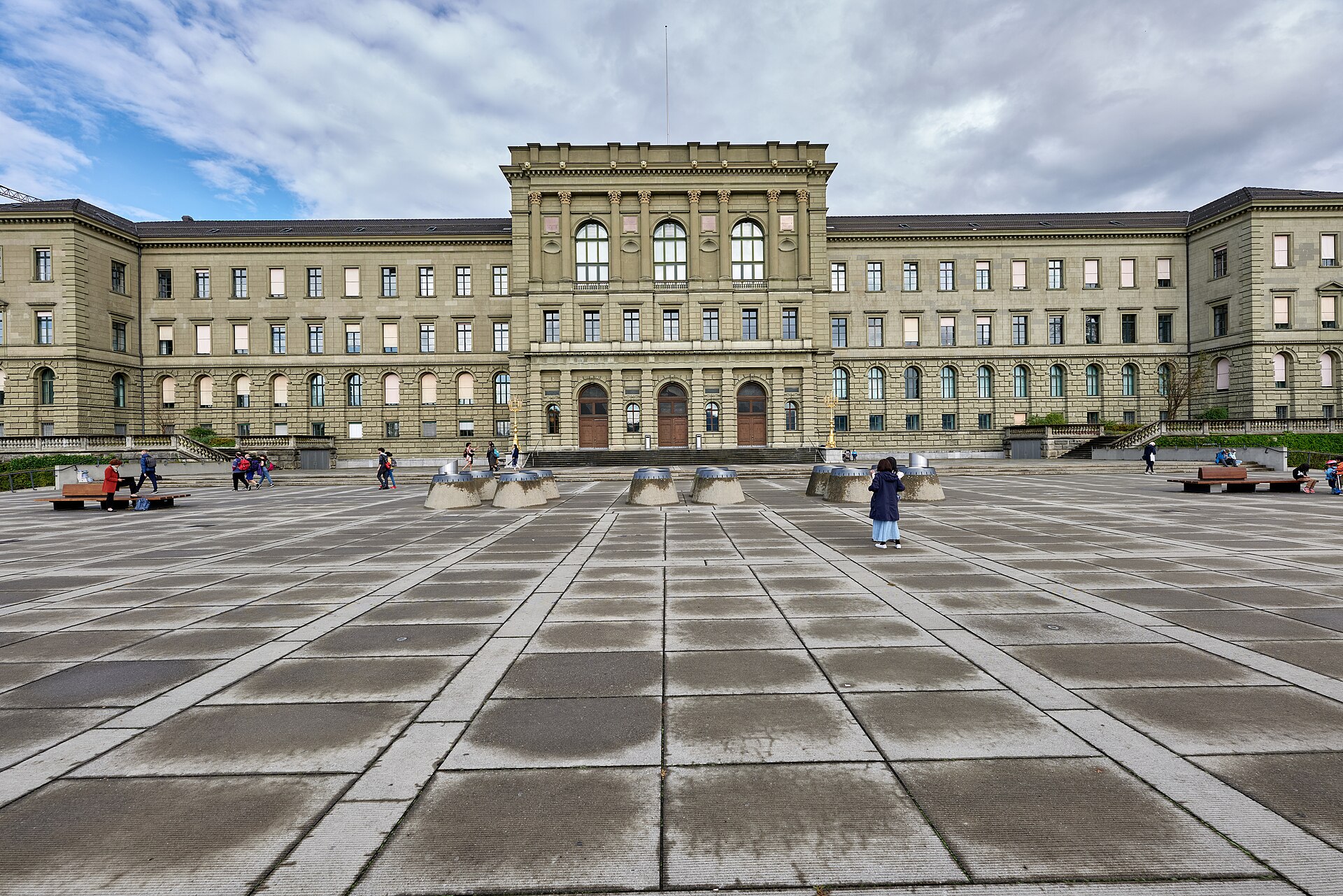
The Hauptgebäude was designed by Gottfried Semper, the architect who also taught at the school after it opened in 1855 as the federal polytechnic. Its long neo-Renaissance front faces the city, and the dome was added in an early 20th-century extension. Inside, the large central hall and stairways are open during term, and the ETH Library, one of the biggest scientific libraries in the region, has its main reading rooms here.
Step out onto the Polyterrasse, the broad paved terrace in front of the building, for the classic view: the old town, church spires, the lake and, on clear days, the Alps. Students gather here between lectures, and there are cafeterias and a student mensa underneath and around it.
Ride the Polybahn
The easiest way up from the old town is the Polybahn, a short red funicular that has run since 1889 from Central, by the river, to the Polyterrasse. It takes a couple of minutes, and plenty of students use it every day. Walking up the lanes of the Niederdorf takes ten to fifteen minutes and passes plenty of cafés.
Einstein, and a school built on science
ETH counts many Nobel laureates among its alumni and staff, and its most famous student is Albert Einstein, who studied here and graduated in 1900, later returning as a professor. You won't find a museum shrine to him, but the history adds weight to a walk through the corridors. The school's character is research-driven and demanding; the first-year exams are known as a real hurdle, so students tend to take the early semesters very seriously.
What student life is like
There are no US-style residential colleges. Students rent rooms across the city or in shared flats, and non-profit student housing organisations offer rooms in halls and houses; places are limited and Zurich's rental market is tight, so admitted students should start looking early. Many students commute by tram, bike or train from other parts of the canton.
Social life is spread through the city: the lake shore and the river baths in summer, bars in the old town and in Kreis 4 and 5, student associations for each subject, and the academic sports association (ASVZ), which ETH shares with the University of Zurich and which runs a huge range of sports, including sessions at Hönggerberg. Most bachelor's programmes are taught in German, while many master's programmes are in English, a point worth checking early for international applicants.
How to visit
ETH holds annual study information days for prospective bachelor's students, with talks by each department, lab visits and a chance to meet current students. Master's applicants can join information events and online sessions. Outside those events, you can walk the public areas of both campuses on your own, but labs and teaching rooms are not open to visitors. Dates, formats and registration change from year to year, so check the university's official visitor and study information pages before you plan a trip.
Getting there and around
- From the airport: trains run frequently from Zurich Airport to Zurich Hauptbahnhof in roughly 10 to 15 minutes.
- To ETH Zentrum: from the main station, walk across the river and up through the old town, take the Polybahn from Central, or ride a tram to the ETH/Universitätsspital stop.
- To Hönggerberg: city buses run from the centre and from nearby train stations; allow about 20 to 30 minutes.
- Tickets: Zurich's trams, buses, trains and the Polybahn use one integrated fare system. Check the current options before you travel; day tickets are handy for a campus visit.
Staying overnight
- The old town (Altstadt, Niederdorf): walkable to ETH Zentrum and full of restaurants; the most atmospheric base.
- Around the main station: practical for train arrivals and day trips, and a short tram ride from campus.
- Oberstrass and Fluntern: quieter residential hillside neighbourhoods close to the university quarter.
- Zurich West (Kreis 5): a converted industrial area with newer hotels and nightlife, useful if you want a livelier evening scene.
Practical tips for your visit
- Pair the trip with a look at the other Swiss federal institute: our EPFL campus tour covers the French-speaking sister school in Lausanne, a little over two hours away by train.
- Go midweek in term time to see the campus busy, but remember that libraries and some buildings may ask for a student card.
- Bring a light jacket: the Polyterrasse is exposed, and the view is best in the clear light after rain.
- If you have an extra day, the mountains are close; the Swiss Alps by train guide describes an easy rail route from the lowlands into the Jungfrau region and Zermatt.
Bloiq is reader-supported. Some links may earn us a commission; it never affects what we write. How we make money.
Cover photo: Leonhard Lenz, CC0, via Wikimedia Commons