Home / Travel / Czechia · Day trips
Day trips from Prague: Kutná Hora, Český Krumlov, Karlštejn and more
How to reach Kutná Hora, Český Krumlov, Karlštejn Castle, Karlovy Vary and the Terezín Memorial from Prague, what to see in each and how long to allow.
Prague is the obvious highlight of Czechia, but some of the country's most memorable places lie within a few hours of it: a medieval silver town with a cathedral and a bone chapel, a castle built to guard the crown jewels of the Holy Roman Empire, a Renaissance town in a loop of the Vltava, and elegant spa towns in the west. Trains and long-distance buses reach them all. Here's how the main options compare and how long each one needs.
The quick comparison
Travel times are rough guides from central Prague and don't include waiting for connections.
| Trip | Typical travel time | Best for |
|---|---|---|
| Kutná Hora | About 1 hour by train | Gothic cathedral, silver-mining history, the Sedlec Ossuary |
| Karlštejn Castle | About 40 minutes by train, plus an uphill walk | A Gothic castle in wooded hills |
| Český Krumlov | About 3 hours by bus or train | A Renaissance town and a vast castle |
| Karlovy Vary | About 2–2.5 hours, usually fastest by bus | Spa colonnades and hot springs |
| Terezín Memorial | About 1 hour by bus | History and remembrance |
| Konopiště Castle | About 1 hour by train, plus a walk | A Habsburg archduke's residence |
| Mělník | Under an hour by bus | Vineyards where two rivers meet |
| Bohemian Switzerland | About 2 hours or more | Sandstone gorges and rock arches |
Kutná Hora: silver, a cathedral and the ossuary
In the Middle Ages, Kutná Hora's silver mines made it one of the richest towns in Bohemia, and the coins struck there circulated across Central Europe. Its historic centre, with the Church of St Barbara and the Cathedral of Our Lady at Sedlec, became a UNESCO World Heritage Site in 1995.
What to see: - St Barbara's Church, a Gothic cathedral with a striking tent-like roof, flying buttresses and wall paintings of miners and minters at work. - The Italian Court, the former royal mint and residence. - The Czech Museum of Silver, where you can join a tour into part of a medieval mine (sturdy shoes; not for anyone uneasy in tight spaces). - The Sedlec Ossuary, a small chapel in the suburb of Sedlec decorated with the bones of tens of thousands of people, arranged in the 19th century into a chandelier, garlands and a coat of arms. It is a consecrated place and a cemetery chapel, so visit quietly and respectfully. Rules on photography change, so check before you go. - The Cathedral of the Assumption of Our Lady at Sedlec, recently restored, a short walk from the ossuary.
Getting there: the main Kutná Hora station is in Sedlec, close to the ossuary but a few kilometres from the old town. A local train, a bus or a walk of about 45 minutes links the two.
How long to allow: a full day.
Karlštejn Castle
Emperor Charles IV founded Karlštejn in 1348 as a stronghold to keep the imperial crown jewels and his collection of holy relics. Its towers rise one above another on a wooded ridge above the Berounka river. Inside, the highlight is the Chapel of the Holy Cross, its walls covered in gilding, semi-precious stones and more than a hundred panel paintings by Master Theodoric.
Getting there: trains run from Prague to Karlštejn in about 40 minutes. From the station, cross the river and walk up through the village to the castle, roughly 30 minutes, uphill at the end.
What to know: the interiors can only be seen on guided tours. The Chapel of the Holy Cross has its own tour with very limited places and a shorter season, so book it well ahead on the official site. The surrounding hills have marked walking trails.
How long to allow: half a day; a full day with a walk.
Český Krumlov
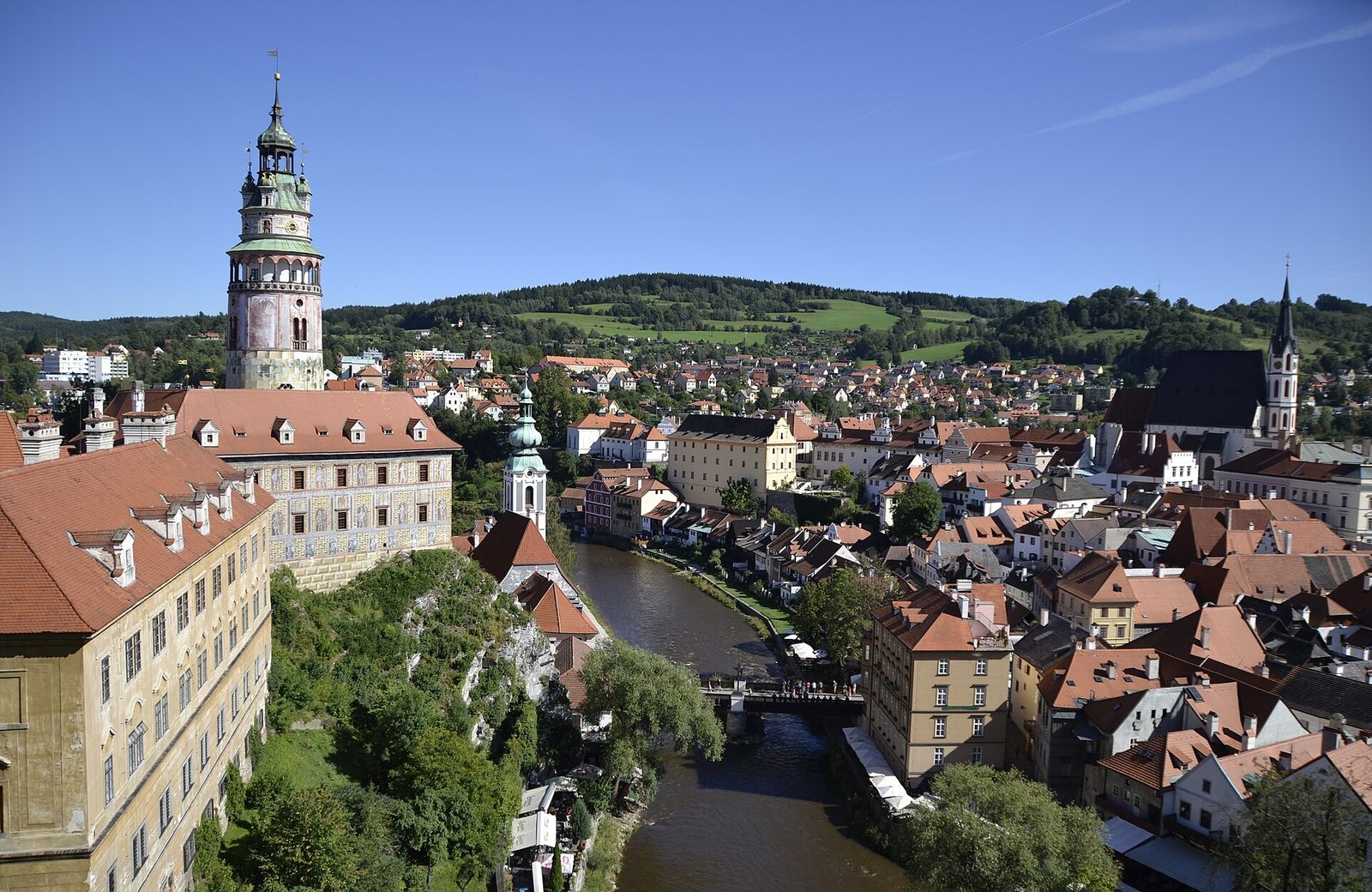
Český Krumlov, in South Bohemia, is a small town of Gothic, Renaissance and baroque houses wrapped in a tight bend of the Vltava, beneath a castle that is the country's second-largest castle complex after Prague Castle. The historic centre has been a UNESCO World Heritage Site since 1992.
What to see: climb the painted castle tower for the view over the rooftops, cross the Cloak Bridge, a multi-storey covered bridge linking parts of the castle, and walk through the terraced castle gardens. The castle's baroque theatre is one of the best-preserved in Europe, with its original stage machinery, but tours are limited and seasonal. In town, the Egon Schiele Art Centrum remembers the painter, whose mother came from here. Bears have traditionally been kept in the castle moat. In summer, people paddle canoes and rafts down the river.
What to know: with about three hours each way, this is a long day. Many visitors stay overnight, and the town is calmest in the early morning and evening. The regional capital České Budějovice and the neo-Gothic Hluboká Castle lie on the way.
How long to allow: a long full day, or better, an overnight stay.
Karlovy Vary and the spa towns
Karlovy Vary (Carlsbad) grew up around hot springs in a narrow, wooded valley. According to tradition, Charles IV discovered them while hunting. Its grand 19th-century spa houses and colonnades, along with nearby Mariánské Lázně and Františkovy Lázně, are part of the UNESCO site The Great Spa Towns of Europe.
What to see: walk the riverside promenade past the colonnades, where visitors sip mineral water from spouted spa cups. At the Hot Spring Colonnade, the strongest spring shoots water several metres into the air at over 70°C. Take the funicular up to the Diana lookout tower for the view, and try the local herbal liqueur and thin spa wafers. The international film festival fills the town each summer.
Getting there: direct buses are usually quicker than the train.
How long to allow: a full day.
Terezín Memorial
Terezín was built as a fortress town in the late 18th century. During the Nazi occupation, the Small Fortress became a Gestapo prison and the town itself the Theresienstadt ghetto. Tens of thousands of Jews died there, and most of the others held there were deported to extermination camps. The Terezín Memorial includes the Small Fortress, the Ghetto Museum, the Magdeburg Barracks and the crematorium.
Getting there: buses take about an hour. Guided tours run from Prague, and the memorial offers its own guided visits; check the official site.
What to know: it's a sobering visit. Allow time to take it in, and behave as you would at any place of remembrance.
How long to allow: most of a day.
Shorter trips and nature
- Konopiště Castle, near Benešov, was the residence of Archduke Franz Ferdinand, whose assassination in 1914 helped spark the First World War. It is known for his enormous collection of hunting trophies and its park. Allow half a day.
- Mělník stands on a hill above the meeting of the Vltava and the Elbe, with a château, vineyards and wide views. Allow half a day.
- Bohemian Switzerland National Park, near the German border, has sandstone gorges and the Pravčická brána, the largest natural sandstone arch in Europe. It's a long day, and parts of the park have been affected by a large forest fire in 2022, so check which trails and boat trips are open.
Practical tips for day trips
- Compare trains and buses. Several companies run buses and trains on the main routes, and the fastest option varies: buses often win for Karlovy Vary and Český Krumlov, trains for Kutná Hora and Karlštejn. Booking a seat ahead is wise in summer and at weekends.
- Book timed tours ahead for Karlštejn's Chapel of the Holy Cross and Český Krumlov's castle interiors and theatre.
- Check seasonal schedules. Many castles open only at weekends or close entirely in winter, and some tours run only in the main season.
- Bring some Czech crowns. Czechia uses the koruna; cards are widely accepted, but small cafés, toilets and spa-cup stalls may prefer cash.
- Plan city days around the trips. Our Prague in two days itinerary covers the essentials, and our guide to where to stay in Prague compares the neighbourhoods; staying near the main station or a metro line saves time on early starts.
- Going on to Austria? Vienna is about four hours by train; see our day trips from Vienna.
Pick Kutná Hora or Karlštejn for an easy day, Karlovy Vary for spa-town elegance, and give Český Krumlov a night if you can.
Bloiq is reader-supported. Some links may earn us a commission; it never affects what we write. How we make money.
Cover photo: High Contrast, CC BY 3.0 de, via Wikimedia Commons