Home / Travel / United States · Campus tours
Cornell campus tour: gorges, the Arts Quad and views over Cayuga Lake
Planning a visit to Cornell in Ithaca? The Arts Quad, McGraw Tower, Libe Slope, the gorges, where students live, getting to Ithaca and where families stay.
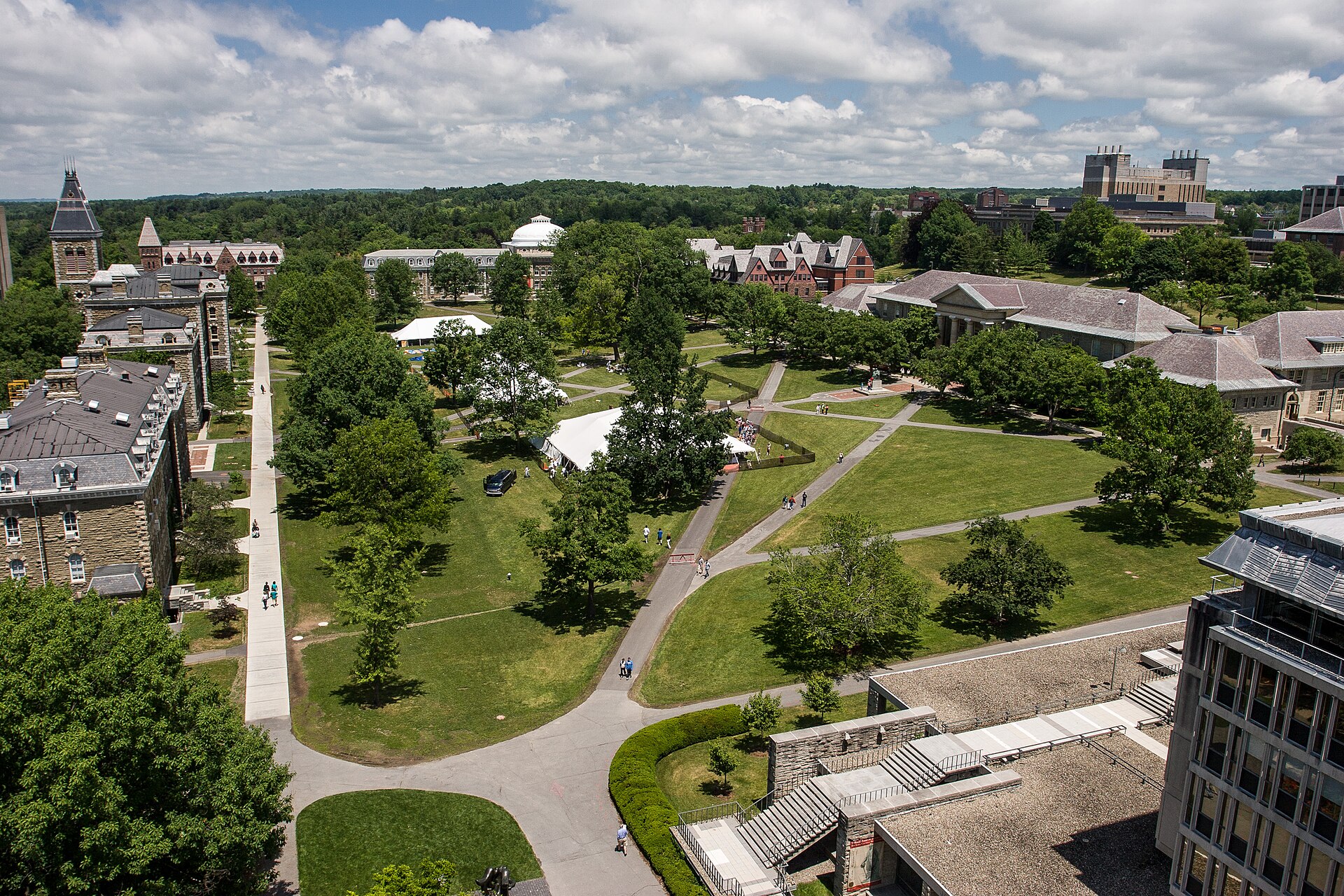
Few campuses have a setting like Cornell's. The university sits on East Hill above the small city of Ithaca, in upstate New York, with Cayuga Lake stretching away to the north and deep gorges with waterfalls cutting through the grounds on either side. Founded in 1865 by Ezra Cornell and Andrew Dickson White, it was meant from the start to be a place where anyone could study anything, and its sheer size and range still reflect that. Getting there takes some planning, so this guide covers the journey as well as the campus itself.
The lie of the land
Cornell's central campus is big and hilly. It's bounded by Fall Creek Gorge to the north and Cascadilla Gorge to the south, and it climbs steeply from the city below. Roughly speaking:
- Central Campus holds the historic Arts Quad, the main libraries and most academic buildings.
- North Campus, across Fall Creek, is where first-year students live.
- West Campus, down the slope toward the lake, has residential houses for upper-year students.
- Collegetown, just south of Cascadilla Gorge, is a dense neighbourhood of student apartments, cafés and restaurants.
The university is both private and New York State's land-grant institution, so its colleges range from arts and sciences and engineering to agriculture, hotel administration and veterinary medicine.
The Arts Quad
The Arts Quad is the historic heart of Cornell: a broad lawn framed by some of the oldest buildings on campus, including the stone halls of Morrill, McGraw and White on its western side. Bronze statues of the two founders face each other across the grass, Ezra Cornell standing and Andrew Dickson White seated. Students cross it all day, and on sunny days it fills with people lying in the grass.
McGraw Tower and the chimes
At the south-west corner of the Quad rises McGraw Tower, beside Uris Library. Its bells, the Cornell Chimes, are played by students several times a day during term, and the music carries across campus. Visitors can often climb the tower's 161 steps to watch a concert and see the view over the lake; check current access before you go.
Uris Library itself contains the A.D. White Library, a magnificent reading room of cast-iron galleries and book stacks, one of the most photographed interiors at Cornell.
Libe Slope at sunset
Below the library, Libe Slope drops steeply toward West Campus, with a sweeping view over Ithaca and Cayuga Lake. It's the best place on campus to watch the sunset, and each spring it hosts Slope Day, a big celebration marking the end of classes.
Gorges, bridges and gardens
"Ithaca is gorges" is the local slogan, and the campus lives up to it.
- Fall Creek Gorge: a suspension footbridge and several road bridges cross it, with views down to waterfalls. Beebe Lake, just upstream, has a waterside path.
- Cascadilla Gorge: a trail follows the creek past waterfalls from Collegetown down toward downtown Ithaca. It is usually closed in winter.
- Cornell Botanic Gardens: gardens and a large arboretum on the eastern side of campus, pleasant for a quiet walk.
Stay on marked paths: swimming and climbing in the gorges are prohibited and genuinely dangerous.
Also worth a stop is the Herbert F. Johnson Museum of Art, a concrete building by I. M. Pei at the edge of the Arts Quad, whose upper floor offers some of the best lake views in town. And many visitors make time for ice cream made from the university's own dairy.
Student life on the hill
First-year students live together on North Campus, and many then move to West Campus houses or apartments in Collegetown. Willard Straight Hall, on Central Campus, is the main student union. Downtown Ithaca, at the foot of the hill, centres on the Commons, a pedestrian street of shops and restaurants. Outdoor life is a big draw: hiking, sailing and rowing on Cayuga Lake, and state parks with waterfalls within a short drive.
Reaching Ithaca
Ithaca is relatively remote, so plan the journey carefully.
- By air: Ithaca's small regional airport has connecting flights via major hubs. Syracuse is roughly an hour's drive away, with more choice of flights.
- By coach: intercity buses connect Ithaca with New York City, typically in four to five hours.
- By car: New York City is roughly four to five hours away; roads can be snowy in winter. If the trip also includes the city, the Columbia campus tour covers a very different, urban campus.
- Locally: the regional bus network serves campus, Collegetown and downtown. The hills are steep, so allow time between stops.
Tours and information sessions
Cornell's admissions office usually runs information sessions and student-led campus tours on many days, and individual colleges often offer their own sessions too, which is useful because Cornell admits students to a specific college. Registration ahead is normally expected. Check the official Cornell admissions and visitor pages for current times and booking before you travel.
Choosing a base for the visit
- On or near campus: there's a hotel on campus linked to the hotel school, plus a few options in Collegetown.
- Downtown Ithaca: walkable to the Commons, a short bus ride or steep walk up to campus.
- Along the lake and main roads: more hotels and easy parking if you're driving.
Rooms fill quickly around graduation, family weekends and big football weekends, so plan early.
Tips for the day
- Wear sturdy, comfortable shoes: the hills and stairs are serious.
- Autumn colour and late spring are the prettiest seasons; winters are long and cold.
- Allow a full day, including the gorges and a sunset on Libe Slope.
Bloiq is reader-supported. Some links may earn us a commission; it never affects what we write. How we make money.
Cover photo: Kenneth C. Zirkel, CC BY-SA 4.0, via Wikimedia Commons