Home / Tools & DIY · Product overviews / Building Supplies / Hoists · More from VEVOR
VEVOR BLH10 2-Speed Electric Chain Hoist: 2,200 lb capacity and specs
A 120V electric chain hoist rated for 2,200 lb with a 10 ft lift, two lifting speeds, wired and wireless remotes and limit switches. What the specs mean.
This page contains an affiliate link, marked as such. If you buy through it, Bloiq may earn a commission at no extra cost to you.
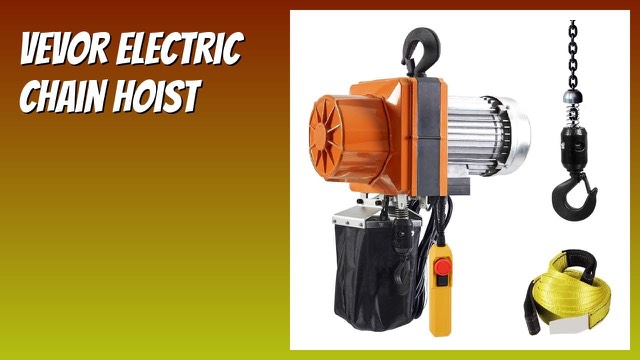
The VEVOR BLH10 is an electric chain hoist for lifting heavy loads in a workshop, garage or warehouse. It replaces hand-pulled chain blocks with a motor, so one person can raise engines, steel stock or machine parts and set them down in a controlled way. It runs on ordinary 120V household-style power rather than needing a three-phase supply.
What the 2,200 lb capacity covers
VEVOR rates the hoist at 2,200 lb (1,000 kg), with a lift height of 10 ft (3 m). It uses a two-chain system, which VEVOR says balances the load. A rated capacity is the maximum working load, so the weight of any slings, shackles or spreader bars counts toward it. The 10 ft figure is how far the hook can travel, not the clearance you need; the hoist body, hook and chain take up headroom above and below.
Two speeds for power and precision
The hoist lifts at 13.2 ft/min (4 m/min) in fast mode and 6.6 ft/min (2 m/min) in slow mode. Fast is useful for moving the hook up or down with little or no load, while slow gives finer control when you're lining up a part, seating an engine on its mounts or setting something onto a pallet.
Wired and wireless control
Two controllers are included. An 8 ft (2.4 m) wired pendant keeps you close to the work. A wireless remote is rated at 328 ft (100 m) in open conditions. Real-world range is typically shorter around metal structures and walls. Whichever controller you use, keep the load in clear view while it moves.
Limit switches, braking and emergency stop
VEVOR lists upper and lower limit switches, which stop the hook at the ends of its travel, an automatic brake that engages when power is lost, and an emergency stop. These are standard hoist features. They support careful operation but don't replace the manual's instructions on inspection, rigging and safe working practice.
Chain, hook and motor
The load chain is G100 alloy steel, a grade commonly used for overhead lifting. The hook is forged and rotates 360°, which lets the load turn without twisting the chain. The housing is aluminium. VEVOR lists an IP54 motor (protected against dust ingress and splashing water), a cooling fan and F-class insulation, which is a heat-tolerance class for the motor windings. The unit weighs 53.1 lb (about 24 kg) and measures roughly 20.7 x 6.7 x 10.6 in.
Who it suits
It suits home and professional workshops, garages, small factories and warehouses that lift repeatedly and want a fixed overhead point. It is a hoist, not a winch for pulling loads sideways, and it is for lifting equipment, not people.
What to check before you buy
- Mounting point: the beam, trolley or frame must be rated for more than the hoist's capacity, and installed to the manual.
- Headroom: measure the space between the ceiling or beam and the lowest height you need.
- Power: confirm a suitable 120V, 60Hz supply and circuit.
- Your heaviest load: include rigging weight and keep a margin below the rated capacity.
- Inspection and upkeep: check the manual for chain lubrication and regular checks of the hook, chain and brake.
- Local rules: workplaces may have regulations on overhead lifting and operator training.
The short version
- Electric chain hoist rated at 2,200 lb (1,000 kg) with a 10 ft lift.
- Two speeds: 13.2 ft/min and 6.6 ft/min.
- 8 ft wired pendant and a wireless remote rated to 328 ft.
- Limit switches, automatic braking on power loss and an emergency stop.
- G100 alloy chain, 360° forged hook, aluminium housing, IP54 motor.
Bloiq is reader-supported. Some links may earn us a commission; it never affects what we write. How we make money.