Home / Tools & DIY · Product overviews / Material Handling Products / Electric Hoists · More from VEVOR
VEVOR 480W Electric Hoist with Wireless Remote: specs and who it suits
A 110V, 480W electric hoist with a 328 ft wireless remote, single and double line lifting and up to 39.4 ft of height. What the specs mean and what to check.
This page contains an affiliate link, marked as such. If you buy through it, Bloiq may earn a commission at no extra cost to you.
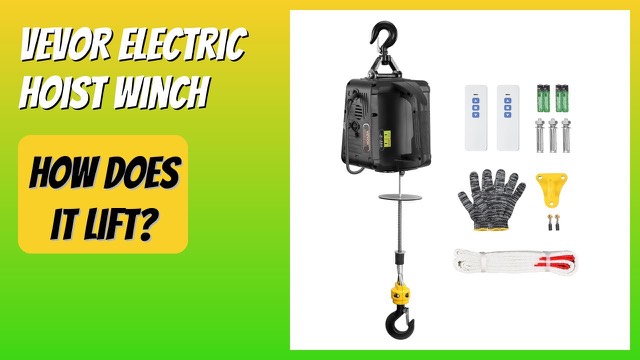
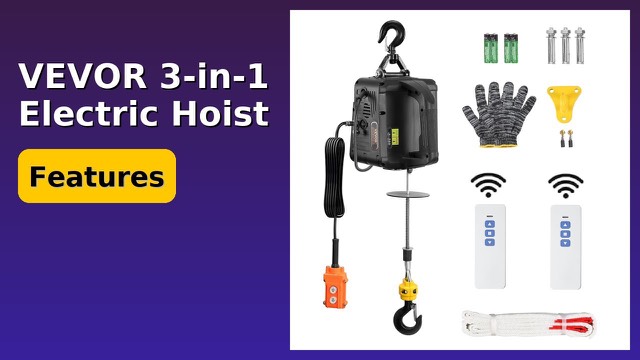
The VEVOR electric hoist is a ceiling or beam-mounted winch that raises and lowers loads with a steel cable, powered from a standard 110V outlet. It is aimed at garages, workshops, warehouses and home projects where lifting by hand is slow or awkward. A wireless remote means the operator can stand clear of the load instead of beside the motor.
Single line and double line lifting
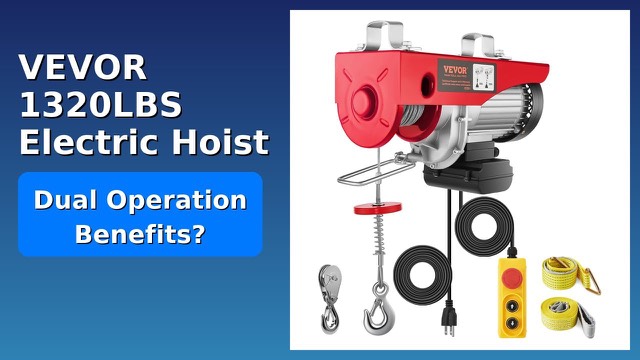
The hoist offers two ways to rig the cable. In single line mode, VEVOR says it lifts 220 lb at 32 ft/min, to a maximum height of 39.4 ft. In double line mode the cable is doubled back through a pulley block, which halves the speed and doubles the capacity: 440 lb at 16 ft/min, to a maximum height of 19.7 ft.
That trade-off is how pulley systems generally work. Doubling the lines shares the load between them, so the motor does less work per unit of cable, but you need twice the cable length for the same lift. If a job needs the full 440 lb, the lift height is roughly halved.
The motor and cable
The motor is rated at 480W. VEVOR says a large cooling fan keeps it from overheating, and the body is steel. The cable is a braided, 19-strand steel wire rope with a metal hook. As a general rule, more strands make a wire rope more flexible, which helps it wind neatly on a drum.
Hoists like this are usually rated for intermittent duty, not continuous running. Check the manual for the duty cycle and let the motor rest as it directs.
The wireless remote
The remote has a stated range of 328 ft (about 100 m) and includes an emergency stop button. Range figures are normally measured in open space, and walls, metal shelving and other radio sources can shorten them in practice. The remote lets you watch the load rather than the controls, which is useful when positioning an engine, a heavy tool or a stack of materials.
Mounting and what's in the box
The hoist hangs from a ceiling or beam using mounting brackets, and VEVOR describes installation as two steps. It comes with a 13 ft lifting sling strap and a 3.2 ft shaft belt with a metal ring. The unit measures about 15 x 11 x 6.7 inches (38 x 28 x 17 cm) and weighs 21 lb (about 9.5 kg), so one person can usually lift it into position, though a helper is sensible.
Whatever it hangs from must carry the full load plus the hoist itself. Have a qualified person confirm the beam or anchor point, and follow the manual and local rules for overhead lifting.
Who it suits
It suits home garages, hobby workshops and small commercial spaces that need to lift engines, equipment or materials now and then. People who lift heavy items daily, or who need a certified lifting device for a workplace, should check what standards their situation requires.
What to check before you buy
- Your loads: weigh what you plan to lift, and remember that 440 lb applies to double line mode only.
- Lift height: confirm you have the ceiling height and the cable length for single or double line use.
- Mounting point: check that the beam or anchor can carry the load, with a margin.
- Power: it needs a 110V outlet; check the plug type and the circuit.
- Duty cycle and upkeep: read the manual for running limits, cable inspection and lubrication.
- Workplace rules: some workplaces require rated and inspected lifting equipment.
The short version
- A 110V, 480W electric hoist with a braided steel cable and metal hook.
- Single line: 220 lb at 32 ft/min, up to 39.4 ft. Double line: 440 lb at 16 ft/min, up to 19.7 ft.
- Wireless remote with a stated 328 ft range and an emergency stop button.
- Weighs 21 lb; ceiling or beam mounting with brackets, sling strap and shaft belt included.
- Always follow the manual and confirm the mounting point can carry the load.
Bloiq is reader-supported. Some links may earn us a commission; it never affects what we write. How we make money.