Home / Tools & DIY · Product overviews / Measuring & Layout Tools · More from VEVOR
VEVOR 203HG Green Rotary Laser Level: features, specs and who it suits
A self-leveling green-beam rotary laser with a 2,000 ft range, five rotation speeds, scan angles up to 160°, IP66 housing, remote control and receiver.
This page contains an affiliate link, marked as such. If you buy through it, Bloiq may earn a commission at no extra cost to you.
The VEVOR 203HG is a self-leveling rotary laser that spins a green beam through 360 degrees to mark a level reference around a site. It is meant for jobs such as setting floor and foundation levels, aligning ceilings and fences, and grading ground, where a single point-to-point line is not enough. It comes with a receiver, a remote and a carrying case.
What a rotary laser does
A rotary laser sits on a tripod and spins a beam fast enough to appear as a continuous horizontal line. You then measure from that line, with a receiver on a staff, to set heights across a site. Unlike a simple line laser, it can cover a whole room or field, and the receiver lets you find the beam even over long distances.
Range and the receiver
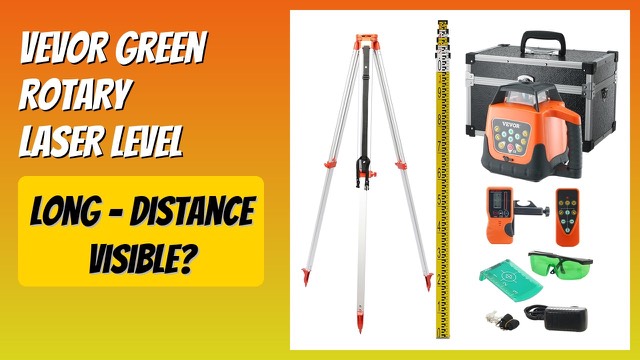
VEVOR rates the working distance at 2,000 ft (610 m). That figure is with the receiver, and the brand states plainly that a receiver is required outdoors and indoors in bright light, because the beam cannot be seen reliably by eye over long distances. The package includes a laser detector with a handle bracket.
Self-leveling and accuracy
The unit levels itself within a range of ±3°. Beyond that it needs to be placed more level by hand. The stated accuracy is 1/9 inch at 33 ft (10 m). VEVOR also says manual alignment is possible. As with any laser, accuracy depends on a stable tripod and on checking calibration as the manual describes.
Rotation speed and scan modes
Five speeds are available: 0, 60, 120, 300 and 600 rpm. Faster rotation makes the line look continuous and is generally used with a receiver, while slower speeds are easier to follow by eye. In directional-scanning mode you can limit the beam to a section of the circle, at 5°, 45°, 90° or 160°, which concentrates the beam on the area you are working in.
Green beam and laser class
The wavelength is 520 nm ±10 nm, which is green. Green light is typically easier for the eye to see than red at the same power. The laser is Class 2 (IEC/EN 60825-1:2014), with output under 5 mW. Never look into the beam. A pair of glasses is included to help you see the beam in bright light, but they are not a substitute for avoiding direct exposure.
Power, build and remote
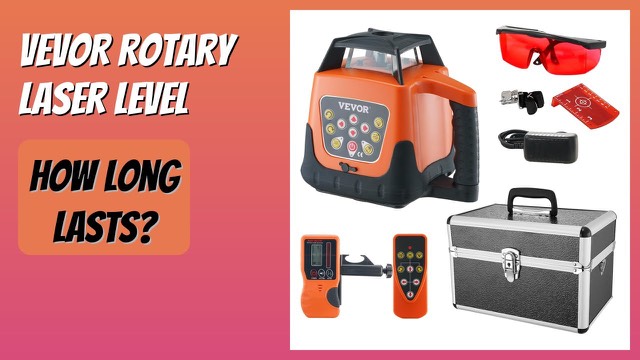
It runs on four 1.2V NiMH rechargeable batteries, which VEVOR says last about 8 to 12 hours, and a charger is included. The ABS and TPE housing is classed IP66, which generally means dust-tight and protected against powerful water jets. It has a 5/8 inch thread for tripod mounting, and the remote works from up to 65 ft (20 m). Size is 7.9 x 6.1 x 7.5 inches, and the case contents include glasses, a target board, remote, charger, receiver bracket and manual.
Who it suits
It suits builders, landscapers and serious DIYers who work on larger areas: slabs, decks, drainage grades and site layout.
What to check before you buy
- Tripod and staff: these are not listed in the package, so check what you need.
- Range: a smaller job may not need 2,000 ft.
- Receiver compatibility: confirm how the included receiver works and its detection range.
- Calibration: learn how to check it, and recheck after knocks or drops.
- Eye safety: follow the manual's laser safety instructions.
- Batteries: plan for charging before a full working day.
The short version
- A self-leveling green rotary laser with a 2,000 ft (610 m) range using the receiver.
- Five speeds up to 600 rpm and scan angles of 5°, 45°, 90° and 160°.
- ±3° leveling range; 1/9 inch at 33 ft accuracy.
- IP66 housing, NiMH batteries (about 8-12 hours) and a 65 ft remote.
- Includes receiver, glasses, target, charger and carrying case.
Bloiq is reader-supported. Some links may earn us a commission; it never affects what we write. How we make money.