Home / Tools & DIY · Product overviews / Hydraulics, Pneumatics & Plumbing / Pumps · More from VEVOR
VEVOR 16 GPM Two-Stage Hydraulic Log Splitter Pump Kit: specs and fit
A two-stage 16 GPM hydraulic gear pump kit with a directional control valve for small-engine log splitters. What the specs mean and what to check.
This page contains an affiliate link, marked as such. If you buy through it, Bloiq may earn a commission at no extra cost to you.
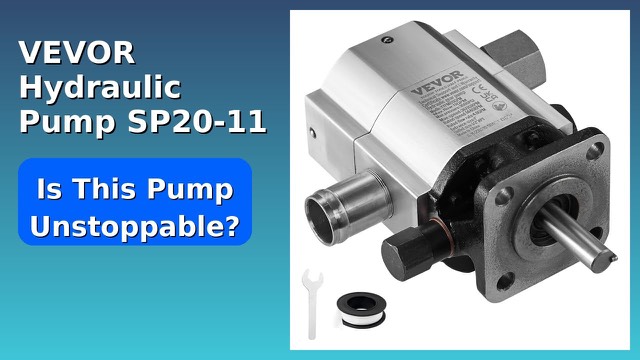
This VEVOR kit (model CLB16+25) is a two-stage hydraulic gear pump with a directional control valve, aimed at people building or repairing a log splitter that runs from a small engine. VEVOR says it is suitable for OEM replacement or a DIY splitter, and that the kit includes what you need to get the hydraulic side connected.
What "two-stage" means
A two-stage pump has a large-volume section and a small-volume section. At low pressure both deliver oil, so the cylinder moves quickly. When resistance rises, the pump typically shifts so that only the small section works at high pressure, trading speed for force. For a log splitter, this means a fast approach and a stronger push once the wedge meets wood. The model name, CLB16+25, appears to reflect two displacement sections, but VEVOR does not spell this out.
Flow, pressure and speed
VEVOR lists 16 GPM flow, a maximum operating pressure of 4,000 psi and a maximum speed of 3,600 RPM. These are upper limits, and they apply under particular conditions, so the figures you get will depend on the engine, the cylinder and the rest of the system. The engine must be able to drive the pump at the load involved; check the manual and your engine's horsepower figure against what the pump needs.
Inlet, outlet and shaft
The pump has a 1-inch inlet and a 1/2-inch NPT outlet, with a 1/2-inch shaft diameter and a shaft length of 1.5 inches. These standard dimensions matter most: the shaft must match your engine coupler or mounting, and the inlet and outlet must match your hoses and fittings. Measure both before you order.
The kit contents
Besides the pump, the kit has a hydraulic directional control valve, which routes oil to extend or retract the cylinder. A wrench, a flat key and Teflon tape are also included. You still need a tank, filter, hoses, a cylinder and a suitable engine or motor.
Noise and other uses
VEVOR says noise stays below 75 dB, which is a quoted figure rather than a measured outcome in your setup, and engine noise will usually be louder. The brand also lists other applications: presses, machine tools and snowplow hydraulic systems. It says the pump is compatible with many OEM log splitters, naming Speeco, Huskee and Champion as examples. Check your splitter's make and model with the seller before assuming a direct swap.
Who it suits
It suits owners with a worn pump on a small-engine splitter, and builders putting together their own. It requires some mechanical comfort with hydraulics, since hoses, fittings and mounting all need correct matching.
What to check before you buy
- Engine power: confirm your engine can drive a 16 GPM pump at the pressures you plan to use.
- Shaft and mounting: compare the shaft size and coupler with your engine.
- Port sizes: match the 1-inch inlet and 1/2-inch NPT outlet to your hoses.
- System limits: all hoses, valves and cylinders should be rated for the system pressure.
- Rotation direction: check which way the pump must turn.
- Oil and filtration: use the hydraulic oil the manual specifies and keep it clean.
- Safety: hydraulic oil under pressure is hazardous, so follow the manual and local rules.
The short version
- Two-stage aluminum hydraulic gear pump kit for small-engine log splitters.
- 16 GPM flow, up to 4,000 psi and up to 3,600 RPM, according to VEVOR.
- 1-inch inlet, 1/2-inch NPT outlet and a 1/2-inch shaft.
- Includes a directional control valve, wrench, flat key and Teflon tape.
- Also listed for presses, machine tools and snowplow systems.
Bloiq is reader-supported. Some links may earn us a commission; it never affects what we write. How we make money.