Home / Tools & DIY · Product overviews / Test, Measure & Inspect · More from AstroAI
AstroAI CM600 1000A Clamp Meter with Inrush and VFD Modes: specs and uses
The AstroAI CM600 is a 1000A TRMS clamp meter with inrush current, VFD and LoZ modes and NCV detection. What each function does and who it suits.
This page contains an affiliate link, marked as such. If you buy through it, Bloiq may earn a commission at no extra cost to you.
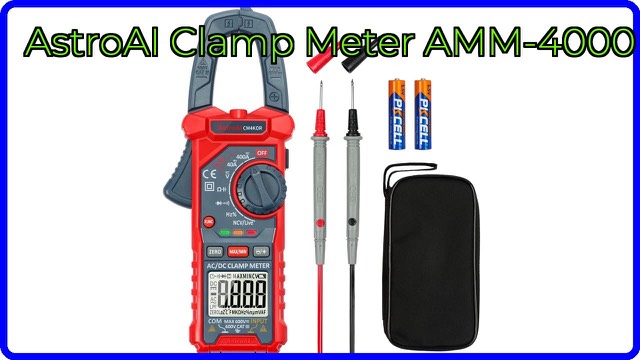
The AstroAI CM600 is a digital clamp meter that measures electrical current without breaking the circuit. You clamp its jaws around a conductor and it reads the current, and it also works as a multimeter for voltage, resistance, capacitance and more. AstroAI positions it for electrical troubleshooting, equipment maintenance and solar projects.
What it measures
AstroAI lists these measurements:
- AC and DC current up to 1000A.
- DC voltage up to 1000V and AC voltage up to 750V.
- Resistance, continuity and diode tests.
- Capacitance, frequency and duty cycle.
- Temperature.
The meter is described as TRMS with 6000 counts. True RMS means it reads AC waveforms that are not perfect sine waves more accurately, which matters with modern electronics. Counts describe the display resolution.
Inrush current
When a motor or compressor starts, it briefly draws much more current than it does while running. The CM600's inrush function captures that startup surge over about 100 milliseconds. AstroAI says this helps locate startup problems in a motor or its starting circuit. Note that the listing says inrush works for AC current only, not DC.
VFD and LoZ modes
A variable frequency drive (VFD) controls motor speed, and its output is noisy, which can throw off standard meters. The VFD mode is intended for current and voltage readings on VFD circuits.
LoZ (low impedance) voltage mode loads the circuit slightly when measuring. That helps eliminate "ghost voltages", the false readings that come from induced voltage on unused wires. AstroAI suggests it for checking whether power is present or absent. Always follow proper lockout and testing procedures.
NCV detection
Non-contact voltage (NCV) detection senses the electric field around a live conductor without touching it. It is a quick first check, but follow it with a proper measurement, and never rely on it alone.
Display and convenience functions
A backlit LCD with larger text and a flashlight help in dim panels and enclosures. Data Hold freezes a reading, Max/Min records the extremes, and REL/ZERO subtracts a baseline. You can use auto or manual ranging.
Safety categories
AstroAI lists the IEC 61010-1 safety standard with CAT IV 600V and CAT III 1000V categories. These categories describe the electrical environments a meter is designed for. Check the category matches where you plan to work, use the supplied leads, and follow local electrical codes and the manual. If you are unsure, leave the work to a qualified electrician.
Who it suits
It suits electricians, HVAC technicians, maintenance staff and keen DIYers who need to measure higher currents and diagnose motors, drives or solar wiring.
What to check before you buy
- Range: confirm 1000A AC/DC and the voltage limits match your jobs.
- Jaw size: check the conductors you work with fit inside the clamp.
- Functions: inrush is AC only; make sure you need VFD and LoZ modes.
- Safety category: match the CAT categories to your environment.
- Power and accessories: check the batteries, leads and case included.
- Skills: read the manual and use proper procedures when working near live circuits.
The short version
- A TRMS clamp meter with 6000 counts, measuring up to 1000A AC/DC.
- Inrush (AC only), VFD and LoZ modes plus NCV detection.
- Backlit LCD, flashlight, Data Hold, Max/Min and REL/ZERO.
- Listed to IEC 61010-1, CAT IV 600V and CAT III 1000V.
Bloiq is reader-supported. Some links may earn us a commission; it never affects what we write. How we make money.