Home / Tools & DIY · Product overviews / Welding & Soldering / TIG Welding Equipment · More from ARCCAPTAIN
ARCCAPTAIN TIG200P 200A 5-in-1 TIG Welder: features, specs and who it suits
A 200A DC inverter welder that covers Lift TIG, HF TIG, Pulse TIG, Spot TIG and Stick on 110V or 220V power. What the modes and settings mean in practice.
This page contains an affiliate link, marked as such. If you buy through it, Bloiq may earn a commission at no extra cost to you.
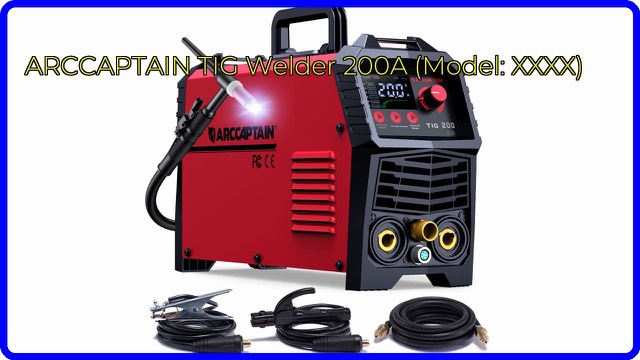
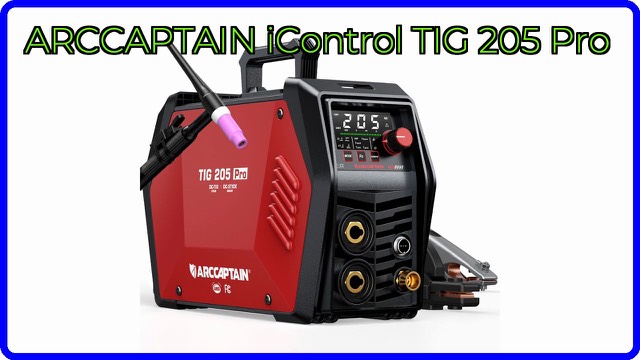
The ARCCAPTAIN TIG200P is a 200-amp DC inverter welder that handles four TIG variations and stick welding in one lightweight case. It is aimed at people who want clean, controllable TIG welds on steel, stainless and copper, but who also need a machine they can carry to a job and plug into either a 110V or 220V supply.
Five modes in one machine
ARCCAPTAIN lists the modes as Lift TIG, HF TIG, Pulse TIG, Spot TIG and Stick. In Lift TIG, you touch the tungsten to the work and lift it to start the arc, which avoids high-frequency interference with nearby electronics. HF TIG starts the arc without contact, which helps keep the tungsten clean. Pulse TIG alternates between a high and a low current, which typically helps control heat on thin material. Spot TIG is meant for tack and spot welds. Stick (also called MMA) uses a flux-coated electrode and is common for outdoor or dirty work.
For stick welding, the brand lists Hot Start and Arc Force. Hot Start gives a burst of extra current to get the arc going, and Arc Force adds current when the arc gets short, which helps prevent the electrode from sticking.
What the inverter and controller do
The welder uses an MCU (a microcontroller) and an IGBT inverter, and ARCCAPTAIN says this gives a digitally controlled DC output with a 99.99% arc-start success rate. An inverter converts mains power to high-frequency power, which is why machines like this weigh a fraction of older transformer welders. This one is listed at 10.25 lb (about 4.6 kg), with a carrying handle and a shoulder strap.
Fine control for TIG work
A large LED display shows the settings as you adjust them. For TIG, the brand lists adjustable pulse frequency, start current, base current, peak current, post-flow gas, down-slope, end current and duty cycle. Down-slope tapers the current at the end of a weld so the crater fills rather than cracks, and post-flow keeps shielding gas on the tungsten and weld as they cool.
The machine offers 2T and 4T trigger modes. In 2T, you hold the trigger while welding. In 4T, you press once to start and again to stop, which is easier on the hand during long seams. The listing also says foot-pedal control is supported in 2T TIG modes.
Power and protection
It accepts 110V and 220V input, so it can run from a standard household outlet or a higher-voltage supply. Typically, the current available at the arc is lower on 110V, so check the manual for the output you can expect on each supply and the breaker size it needs.
The cooling fan runs only when needed, which keeps noise down. Listed protections include VRD (a voltage reduction device that lowers the open-circuit voltage when not welding), over-current, over-voltage, overload and overheat protection. ARCCAPTAIN also quotes a 2-year guarantee. As with any welder, follow the manual, wear proper eye and skin protection, and keep the work area ventilated.
Who it suits
The mix of modes and sizes suits home workshops, fabrication hobbyists, auto repair and outdoor projects. Beginners can start with Lift TIG or stick, while more experienced welders may use the pulse and slope settings. Aluminium needs AC output, and this is a DC machine, so look at the listing for the metals ARCCAPTAIN names: stainless steel, mild steel and copper.
What to check before you buy
- Your power supply: confirm the outlet, breaker and extension cord can handle the machine's draw on 110V or 220V.
- Materials: it is DC only, so it is not intended for aluminium.
- Gas and torch: TIG needs shielding gas (typically argon), a regulator and a torch. Check what is in the box.
- Foot pedal: if you want pedal control, check which pedal is compatible.
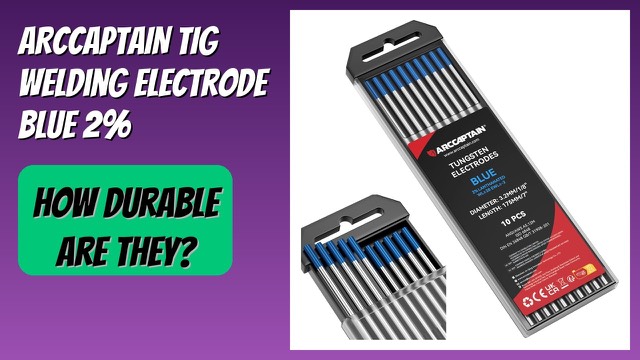
- Consumables: tungstens, electrodes and cups wear out, so plan for spares.
The short version
- A 200A DC welder with Lift TIG, HF TIG, Pulse TIG, Spot TIG and Stick modes.
- Works on 110V or 220V input and weighs 10.25 lb.
- 2T and 4T trigger modes, with a wide set of pulse and slope settings.
- LED display, quiet on-demand fan and VRD, overload and overheat protection.
- DC output, so it suits steel, stainless and copper rather than aluminium.
Bloiq is reader-supported. Some links may earn us a commission; it never affects what we write. How we make money.