Home / Tech · Product overviews / Computers & Accessories / Graphics Cards · More from ASUS
ASUS ROG Strix GeForce RTX 3050 OC 8GB Graphics Card: specs and fit
The ASUS ROG Strix RTX 3050 OC Edition is an 8GB GDDR6 graphics card with three Axial-tech fans and a 2.7-slot cooler. What the specs mean and what to check.
This page contains an affiliate link, marked as such. If you buy through it, Bloiq may earn a commission at no extra cost to you.
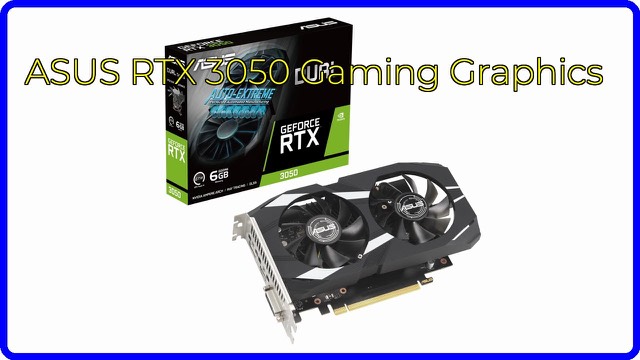
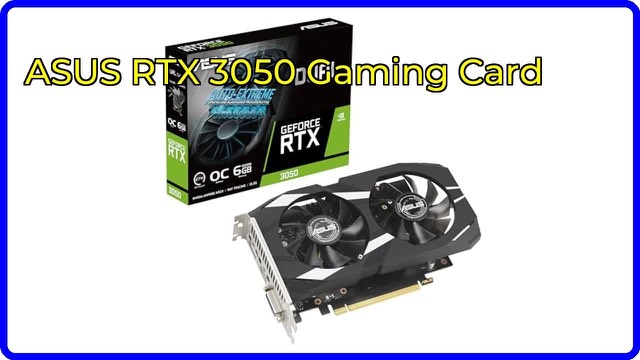
The ASUS ROG Strix GeForce RTX 3050 OC Edition is a desktop graphics card built around NVIDIA's RTX 3050 with 8GB of GDDR6 memory. It is an internal component that goes into a PC's PCIe slot to handle games, video and other graphics work. ASUS pairs the chip with a large three-fan cooler and an overclocked configuration.
The Ampere architecture
The RTX 3050 is based on NVIDIA's Ampere design. The listing highlights three parts of it. The streaming multiprocessors are said to offer twice the FP32 throughput of the previous generation along with better power efficiency. The second-generation RT cores handle ray tracing, a lighting technique that models how light bounces in a scene. The third-generation Tensor cores run AI tasks, including DLSS, a feature that renders a game at a lower resolution and uses AI to produce a sharper final image. Support varies by game, so DLSS only helps in titles that include it.
What the "OC Edition" means
OC stands for overclocked. ASUS sets the card to run its graphics chip faster out of the box than NVIDIA's reference speeds. Exact clock figures are not in the listing, and the gains from factory overclocks are typically modest. The GPU Tweak II software named in the title lets users adjust clocks, fan behaviour and monitoring.
Cooling and the 2.7-slot design
The cooler is the focus. ASUS says its Axial-tech fan design has been retuned, with the central fan spinning in the opposite direction to reduce turbulence. Three fans sit above a larger heatsink. The card occupies 2.7 slots, which gives the heatsink more surface area for cooling. In practice, that is thicker than many compact cards and affects what fits next to it.
Connections and interface
The card uses PCIe 4.0, and the listing names HDMI 2.1 and DisplayPort 1.4a outputs. PCIe is backward compatible, so it typically works in older slots, though bandwidth follows the slower of the card and the motherboard. Super Alloy Power II is ASUS's name for its power-delivery components, aimed at stable operation under load.
Size and weight
The card measures about 11.8 x 5.3 x 2.1 inches (30 x 13.5 x 5.3 cm) and weighs about 2.5 lb (1.1 kg). That is substantial enough that some builders add a support bracket to keep it level.
Who it suits
It suits PC builders and upgraders who want an 8GB card with a robust cooler and ray tracing support for 1080p-class gaming and general graphics work, and who have the room for a 2.7-slot design.
What to check before you buy
- Case clearance: measure the length (about 11.8 in) and the 2.7-slot thickness against your case and neighbouring slots.
- Power supply: confirm your power supply's wattage and connectors against ASUS's published requirements for this model.
- Motherboard slot: you need a free PCIe x16 slot.
- Monitor inputs: make sure your display matches the HDMI or DisplayPort outputs.
- Software: check driver support for your operating system.
The short version
- An overclocked NVIDIA GeForce RTX 3050 card with 8GB of GDDR6 memory.
- Ampere architecture with second-generation RT cores and third-generation Tensor cores.
- Three Axial-tech fans in a 2.7-slot cooler.
- PCIe 4.0, HDMI 2.1 and DisplayPort 1.4a.
- About 11.8 inches long and 2.5 lb.
Bloiq is reader-supported. Some links may earn us a commission; it never affects what we write. How we make money.