Home / Tech · Product overviews / Computers & Accessories / Graphics Cards · More from ASUS
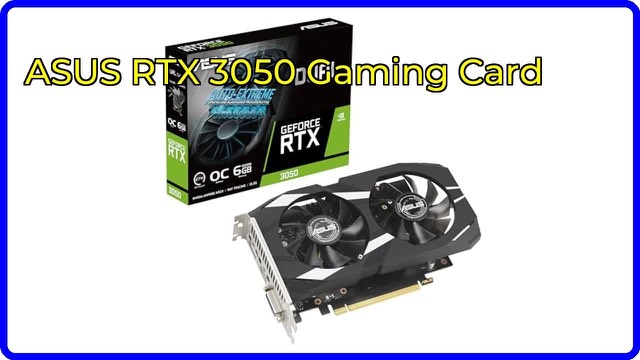
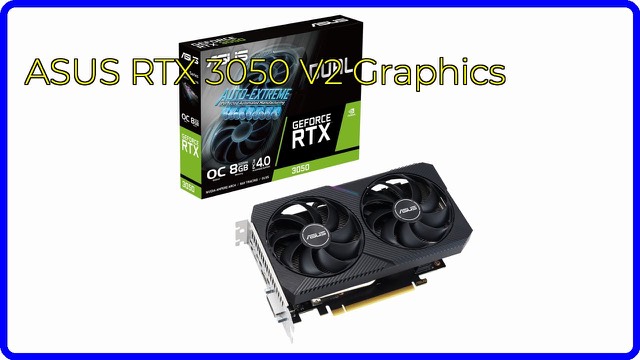
ASUS Dual GeForce RTX 3050 6GB graphics card: specs and who it suits
A 2-slot PCIe 4.0 graphics card with 6GB of GDDR6, HDMI 2.1, DisplayPort 1.4a and IP5X dust resistance. What the specs mean and what to check.
This page contains an affiliate link, marked as such. If you buy through it, Bloiq may earn a commission at no extra cost to you.
The ASUS Dual GeForce RTX 3050 6GB (DUAL-RTX3050-6G) is a graphics card for desktop PCs. It's built on NVIDIA's Ampere architecture and uses a compact 2-slot design, so it can fit in smaller cases. This page explains what its main features mean and what to confirm before adding one to a PC.
What Ampere brings
ASUS lists three headline parts of the Ampere design. The streaming multiprocessors offer twice the FP32 throughput of the previous generation, with better power efficiency. The 2nd generation RT cores handle ray tracing, a lighting technique that models how light bounces in supported games, and ASUS says they offer twice the throughput of the first generation. The 3rd generation Tensor cores support AI features such as DLSS, which renders at a lower resolution and then upscales the image to lift frame rates in supported games.
What 6GB of GDDR6 means
The card has 6GB of GDDR6 video memory. Video memory holds textures and frame data, so the amount matters more as game resolution and texture settings go up. It's typically sufficient for 1080p gaming, and demanding titles at higher settings may call for more, so check each game's recommendations.
The cooling design
The Axial-tech fan design has a smaller hub, which allows longer blades, and a barrier ring that ASUS says increases downward air pressure. Good airflow over the heatsink lets a card hold its speeds with less noise. The Dual name refers to the two-fan layout.
Two slots, steel and dust protection
The 2-slot design takes up less room in the case than three-slot cards. ASUS describes it as maximising compatibility in small chassis. A stainless steel bracket is described as harder and more resistant to corrosion. The card carries an IP5X dust-resistance class, which describes protection against particle ingress and does not cover water. The card weighs 0.9 lb (about 0.4 kg).
Connections and software
Outputs include HDMI 2.1, DisplayPort 1.4a and a native DVI-D port, which is handy if you still use an older monitor. The card connects over PCIe 4.0, and it's normally backward compatible with older PCIe slots, though the link will run at the slower speed. The GPU Tweak III utility lets you adjust settings and monitor the card.
Who it suits
It suits people building or upgrading a compact desktop for 1080p gaming, creators who want hardware ray tracing and AI features, and anyone replacing an older card in a machine with a modest power supply and limited space.
What to check before you buy
- Case clearance: measure the space for the card's length and the two slots it occupies.
- Power supply: check the card's recommended power supply wattage and the power connector it needs against your PC.
- Slot: confirm a free PCIe x16 slot on the motherboard.
- Monitor inputs: match HDMI, DisplayPort or DVI-D to your screen.
- Games: compare the 6GB memory with the settings you want to play at.
- Drivers: download current drivers from NVIDIA and follow the install instructions in the manual.
The short version
- A 2-slot NVIDIA GeForce RTX 3050 card with 6GB of GDDR6 and PCIe 4.0.
- Ampere architecture, 2nd gen RT cores and 3rd gen Tensor cores.
- Axial-tech fans, a stainless steel bracket and IP5X dust resistance.
- HDMI 2.1, DisplayPort 1.4a and native DVI-D outputs.
- Weighs 0.9 lb; tuned and monitored with GPU Tweak III.
Bloiq is reader-supported. Some links may earn us a commission; it never affects what we write. How we make money.