Home / Tech · Product overviews / Computers & Accessories / Graphics Cards · More from ASUS
ASUS Dual GeForce RTX 3050 V2 OC 8GB: features, specs and who it suits
A compact two-slot graphics card with 8GB GDDR6, Ampere architecture, PCIe 4.0, HDMI 2.1 and 0dB fan technology. What the specs mean and what to check first.
This page contains an affiliate link, marked as such. If you buy through it, Bloiq may earn a commission at no extra cost to you.
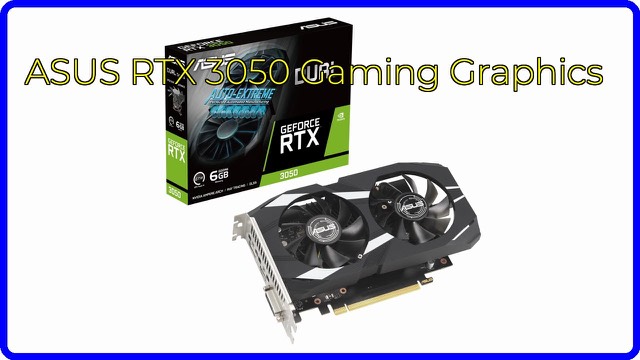
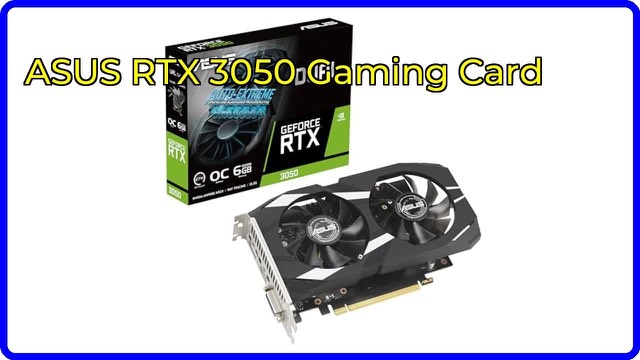
The ASUS Dual GeForce RTX 3050 V2 OC Edition (DUAL-RTX3050-O8G-V2) is a graphics card with 8GB of GDDR6 memory and two fans. It uses NVIDIA's Ampere architecture and a two-slot design, so it can add graphics power to a desktop PC without needing a large case.
The Ampere architecture
The card is built on NVIDIA's Ampere generation. ASUS lists three headline parts:
- Streaming Multiprocessors: the main processing blocks, which ASUS says offer 2X the FP32 throughput of the previous generation along with better power efficiency.
- 2nd generation RT cores: dedicated hardware for ray tracing, a lighting technique that simulates how light behaves in a scene. ASUS cites 2X the throughput of first-generation cores.
- 3rd generation Tensor cores: hardware for AI tasks, including DLSS, which uses AI to produce higher frame rates from a lower internal resolution.
These are the brand's comparisons with earlier designs, not measured results for any game.
Clock speeds and the OC edition
OC mode has a boost clock of 1852MHz, while default mode is 1822MHz. The boost clock is the speed the card typically reaches under load, depending on temperature and power. The difference between the two is small. You can switch modes using ASUS's GPU Tweak III software, which also handles performance tuning, thermal controls and system monitoring.
Cooling and quiet running
The card uses Axial-tech fans. ASUS says a smaller hub allows longer blades, and a barrier ring raises downward air pressure to push air through the heatsink. With 0dB technology, the fans typically stop when the card is lightly loaded, such as when browsing or watching video, and spin up when you game. That makes light use quiet, though the fan behaviour under load depends on your case airflow.
Size and compatibility
The 2-slot design is meant to maximise compatibility in small cases. The card measures 7.9 x 4.8 inches (about 20 x 12 cm) and weighs 1.1 lb. The listed length is short for a graphics card, which helps in compact builds, but always compare against your case's clearance. The card uses a PCIe 4.0 interface. PCIe is backward compatible, so it also fits older PCIe slots, though the listing doesn't state how it performs there.
Display outputs
The card offers HDMI 2.1 and DisplayPort 1.4a. HDMI 2.1 is the version used for high-resolution, high-refresh-rate TVs and monitors, and DisplayPort 1.4a is common on gaming monitors. Check your own screen's inputs and the card's port count in the manual.
Who it suits
It suits people upgrading an older PC for Full HD gaming, building a compact system, or adding DLSS and ray-tracing hardware at the entry level of this generation. If you play demanding games at high resolution, a card higher in the range would offer more headroom.
What to check before you buy
- Case clearance: confirm length and the two-slot width fit.
- Power supply: check the card's recommended power supply wattage and connector on ASUS's specification page, since the listing doesn't state them.
- Slot: you need a free PCIe x16 slot.
- Monitor inputs: confirm HDMI or DisplayPort matches your screen.
- Processor pairing: a very old processor may hold the card back.
- Drivers: install current NVIDIA drivers after fitting.
The short version
- Ampere graphics card with 8GB GDDR6 and PCIe 4.0.
- OC boost clock 1852MHz, default 1822MHz.
- Dual Axial-tech fans with 0dB technology.
- Two-slot design; HDMI 2.1 and DisplayPort 1.4a outputs.
- GPU Tweak III software for tuning and monitoring.
Bloiq is reader-supported. Some links may earn us a commission; it never affects what we write. How we make money.