Home / Tech · Product overviews / Computers & Accessories / Graphics Cards · More from ASUS
ASUS Dual GeForce RTX 3050 6GB OC graphics card: specs and fit
A compact 2-slot ASUS Dual RTX 3050 OC Edition graphics card with 6GB GDDR6, PCIe 4.0, HDMI 2.1, DisplayPort 1.4a and 0dB fan technology. What the specs mean.
This page contains an affiliate link, marked as such. If you buy through it, Bloiq may earn a commission at no extra cost to you.
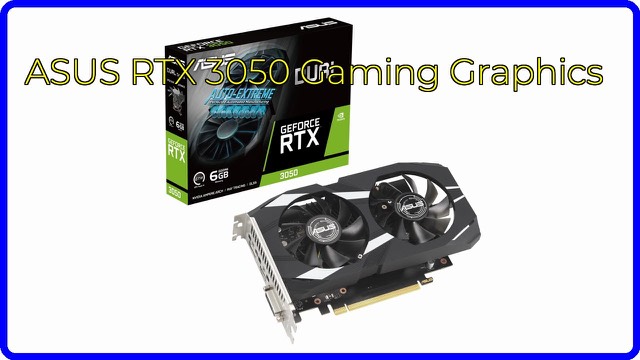
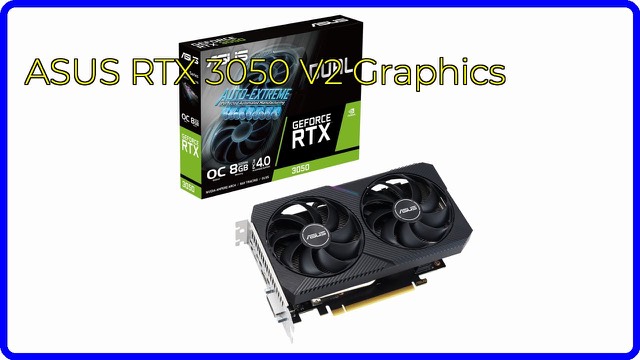
The ASUS Dual GeForce RTX 3050 6GB OC Edition (model DUAL-RTX3050-O6G) is a graphics card for desktop PCs. It is a short, two-slot card with two fans, so it fits into compact cases that cannot take the large cards found at the high end. It suits people who want to add or replace graphics in a desktop for gaming at Full HD, video playback and general use.
What the RTX 3050 offers
The card is built on NVIDIA's Ampere architecture. NVIDIA says the Ampere streaming multiprocessors deliver twice the FP32 throughput of the previous generation along with better power efficiency. FP32 refers to the standard single-precision calculations that games and graphics work rely on.
It also has second-generation RT cores for ray tracing, a lighting technique that models how light bounces in a scene, and third-generation Tensor cores. The Tensor cores run AI-based features such as DLSS, which typically renders a game at a lower resolution and upscales it, raising frame rates. Support depends on the game.
6GB of GDDR6 memory
The card carries 6GB of GDDR6 video memory. Video memory holds textures and other graphics data, so more of it generally helps at higher resolutions and texture settings. A 6GB card is typically aimed at 1080p gaming; some recent games at their highest settings can use more, which is where lowering texture quality helps.
OC Edition
"OC" means factory overclocked: ASUS sets the card's clock speeds slightly above NVIDIA's reference figures. The result is usually a small performance gain. The exact clock figures are not given in the listing, so check ASUS's specification page if they matter to you.
Cooling and the 0dB feature
ASUS uses its Axial-tech fan design, with a smaller hub that allows longer blades and a barrier ring that increases the downward air pressure. Two such fans push air through the heatsink. The listing also mentions 0dB technology, which typically means the fans stop spinning when the card is lightly loaded, for example on the desktop or during web browsing, and start when temperatures rise.
Size and fit
ASUS describes the card as 20 cm long with a 2-slot design. That is short enough for many small-form-factor and mini-tower cases, but you should still measure the space. The listing's dimensions are 7.9 x 4.7 inches, and it includes a steel bracket for the case's rear slots. The card uses a PCIe 4.0 interface; PCIe is backwards compatible, so it also works in older slots, although the link then runs at the slower speed of that slot.
Display outputs
The card has HDMI 2.1 and DisplayPort 1.4a outputs. HDMI 2.1 is the version needed for high resolution at high refresh rates on newer TVs, and DisplayPort 1.4a is common on gaming monitors. Check which cable types your monitors use, and how many outputs of each type the card has.
Who it suits
It suits desktop builders and upgraders who play at 1080p, want modern features such as ray tracing and DLSS, and have a small case. It is not designed for heavy 4K gaming or large professional workloads.
What to check before you buy
- Case clearance: measure the length and make sure two slots are free.
- Power: check the card's power requirement in ASUS's specifications and confirm that your power supply has the right connector and enough capacity.
- Motherboard slot: confirm that you have a free PCIe x16 slot.
- Outputs: match HDMI and DisplayPort ports to your monitors.
- Drivers: download current drivers from NVIDIA after installing.
The short version
- Compact 2-slot NVIDIA GeForce RTX 3050 card with 6GB GDDR6, around 20 cm long.
- OC Edition with PCIe 4.0, HDMI 2.1 and DisplayPort 1.4a.
- Ampere architecture with 2nd-gen RT cores and 3rd-gen Tensor cores.
- Two Axial-tech fans with 0dB technology and a steel bracket.
- Aimed at 1080p gaming in smaller desktop cases.
Bloiq is reader-supported. Some links may earn us a commission; it never affects what we write. How we make money.