Home / Tech · Product overviews / Computers & Accessories / Graphics Cards · More from ASUS
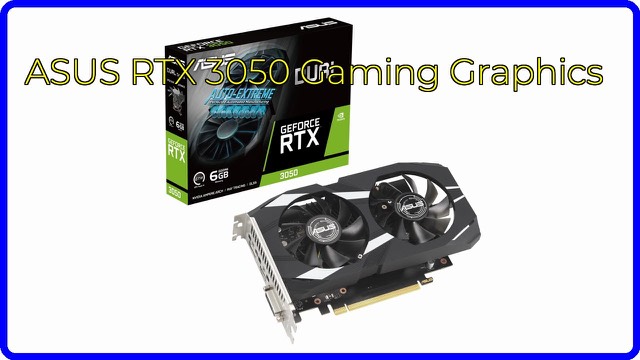
ASUS Phoenix GeForce RTX 3050 8GB Graphics Card: features and specs
A compact 8GB GDDR6 GeForce RTX 3050 graphics card with an Axial-tech fan, dual ball bearings and a protective backplate. What the specs mean and what to check.
This page contains an affiliate link, marked as such. If you buy through it, Bloiq may earn a commission at no extra cost to you.
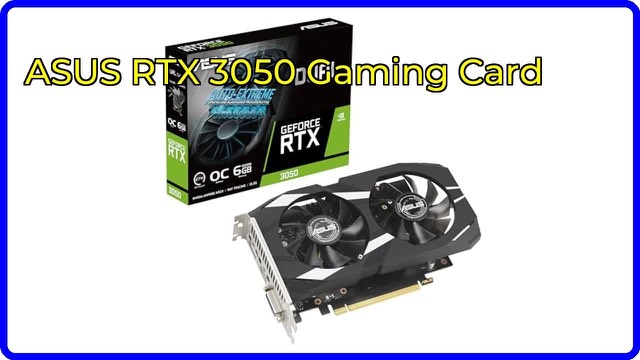
The ASUS Phoenix GeForce RTX 3050 is a compact graphics card with 8GB of GDDR6 memory. It uses NVIDIA's Ampere architecture and a single-fan cooler, making it a fit for smaller PC builds that need a capable graphics upgrade.
What Ampere offers
The listing describes three parts of NVIDIA's Ampere design:
- Streaming Multiprocessors with 2x the FP32 throughput and improved power efficiency.
- 2nd generation RT Cores with 2x the throughput of first-generation cores, plus concurrent ray tracing and shading.
- 3rd generation Tensor Cores with up to 2x the throughput using structural sparsity and AI algorithms such as DLSS.
These comparisons are NVIDIA's and refer to earlier generations. In general, RT Cores handle ray-traced lighting and reflections, while Tensor Cores run AI features like DLSS, which renders a game at a lower resolution and upscales it to boost frame rates.
8GB of GDDR6 memory
The card has 8GB of GDDR6 video memory. That amount is typical for Full HD gaming and many games at higher resolutions with adjusted texture settings. Demanding titles at high resolutions or maximum texture quality can use more, so memory is worth thinking about against your own games.
The cooling and build
ASUS describes an Axial-tech fan design with a reversed central fan direction, tuned for less turbulence. A dual ball bearing fan is listed as lasting up to twice as long as sleeve bearing designs. A protective backplate adds rigidity and covers the circuit board.
ASUS also says each card is made with its Auto-Extreme automated manufacturing process and passes a 144-hour gaming stress test. These are manufacturer statements.
Connections and size
Outputs are HDMI 2.1 and DisplayPort 1.4a, and the interface is PCIe 4.0. The card measures about 7.0 x 5.0 x 2.0 inches (18 x 13 x 5 cm) and weighs 1.3 lb (about 0.6 kg). Its small size means it can often fit cases that cannot take longer cards.
Who it suits
It suits people upgrading an older PC or building a compact Full HD gaming system, as well as anyone who wants hardware ray tracing and DLSS support in a small card.
What to check before you buy
- Case fit: confirm the length, height and slot width against your case.
- Power supply: check NVIDIA's and ASUS's recommended power supply wattage and the power connectors your PSU offers.
- Motherboard slot: PCIe 4.0 is listed; the card typically also works in older PCIe slots, sometimes with reduced bandwidth.
- Monitor connections: check your display has HDMI or DisplayPort.
- Games and resolution: consider the resolution and settings you plan to use against 8GB of memory.
- Drivers: download current NVIDIA drivers after installation.
The short version
- A GeForce RTX 3050 card with 8GB GDDR6 on NVIDIA's Ampere architecture.
- Supports ray tracing (2nd generation RT Cores) and DLSS (3rd generation Tensor Cores).
- Axial-tech fan, dual ball bearings and a protective backplate.
- HDMI 2.1, DisplayPort 1.4a and PCIe 4.0; about 1.3 lb.
Bloiq is reader-supported. Some links may earn us a commission; it never affects what we write. How we make money.