Home / Tech · Product overviews / Computers & Accessories / Graphics Cards · More from ASUS
ASUS Dual GeForce RTX 5060 Ti 16GB OC Edition Graphics Card: specs and fit
The ASUS Dual RTX 5060 Ti 16GB OC Edition is a PCIe 5.0 graphics card with two Axial-tech fans, a 2.5-slot design, DLSS 4 and DisplayPort 2.1b.
This page contains an affiliate link, marked as such. If you buy through it, Bloiq may earn a commission at no extra cost to you.
The ASUS Dual GeForce RTX 5060 Ti 16GB OC Edition (model DUAL-RTX5060TI-O16G) is a graphics card for desktop PCs. It uses NVIDIA's Blackwell architecture, 16GB of GDDR7 memory and a two-fan cooler in a compact 2.5-slot body. Here is what the specs mean and what to check for your PC.
Blackwell, DLSS 4 and AI performance
The card is built on NVIDIA's Blackwell architecture and supports DLSS 4. ASUS rates its AI performance at 767 AI TOPS. DLSS is NVIDIA's AI-based upscaling and frame generation, which in general lets supported games render at a lower resolution and scale up to improve frame rates. The AI figure is a peak measure for AI workloads, so it matters most for software that uses the GPU's AI hardware.
16GB of GDDR7 memory
Video memory holds textures, frame data and, for creative work, large scenes and AI models. 16GB typically gives headroom for high-resolution textures and heavier content than smaller cards allow. GDDR7 is the newer, faster memory generation. How much memory you need depends on the games or programs you use and the screen resolution.
OC mode and clock speeds
This is the OC Edition, meaning ASUS ships it with higher clocks than the reference design. The listing gives 2632 MHz in OC mode and 2602 MHz in Default mode. These are boost clocks, and the actual speed during use varies with temperature and power limits. The gap between the two modes is small, so OC mode is a modest bump rather than a large one.
Cooling: Axial-tech fans and 0dB
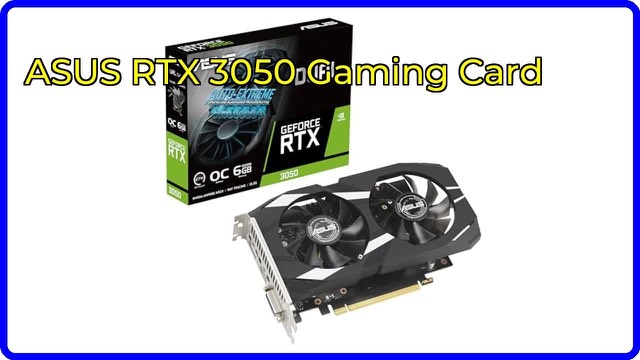
The card has two Axial-tech fans. ASUS says the design has a smaller fan hub, which allows longer blades, and a barrier ring that increases downward air pressure. The description says the cooling borrows approaches from the company's flagship cards. The title also mentions 0dB Technology, which generally means the fans stop at low loads so the card is silent when idle or doing light work.
Size and compatibility
The card is listed at 9.0 x 4.7 inches (about 23 x 12 cm) and 1.4 lb (about 0.6 kg), in a 2.5-slot design. ASUS markets it as SFF-ready, meaning suitable for small-form-factor PCs, and says it combines performance with broad compatibility. The interface is PCIe 5.0; PCIe cards are generally backwards compatible with earlier slots, though bandwidth is then limited by the slot.
Outputs
The card has HDMI 2.1b and DisplayPort 2.1b outputs. These connect to modern monitors and TVs, and support high resolutions and refresh rates, provided the display supports them too.
Who it suits
It suits people building or upgrading a desktop for current games, content creation or AI experiments, particularly in a smaller case. Anyone using an older monitor may need to check input compatibility.
What to check before you buy
- Case space: measure length, height and the 2.5-slot width against your case.
- Power supply: check the card's power requirement and connector in ASUS's specifications, and confirm that your supply provides it.
- Motherboard slot: make sure you have a free PCIe x16 slot.
- Processor pairing: an older CPU can limit what the card delivers.
- Monitor inputs: confirm HDMI or DisplayPort versions match your display.
- Drivers and software: check support for your operating system and the games you play.
The short version
- ASUS Dual GeForce RTX 5060 Ti 16GB OC Edition, model DUAL-RTX5060TI-O16G.
- 16GB GDDR7, NVIDIA Blackwell, DLSS 4, 767 AI TOPS.
- 2632 MHz in OC mode, 2602 MHz in Default mode.
- Two Axial-tech fans and 0dB Technology in a 2.5-slot design.
- PCIe 5.0, HDMI 2.1b and DisplayPort 2.1b.
Bloiq is reader-supported. Some links may earn us a commission; it never affects what we write. How we make money.