Home / Tech · Product overviews / Computers & Accessories / Graphics Cards · More from ASUS
ASUS Dual GeForce RTX 5050 OC 8GB Graphics Card: features and specs
A compact 2-slot GeForce RTX 5050 OC Edition with 8GB GDDR6, PCIe 5.0, DLSS 4, 0dB fan mode and Dual BIOS. What the specs mean for a small PC build.
This page contains an affiliate link, marked as such. If you buy through it, Bloiq may earn a commission at no extra cost to you.
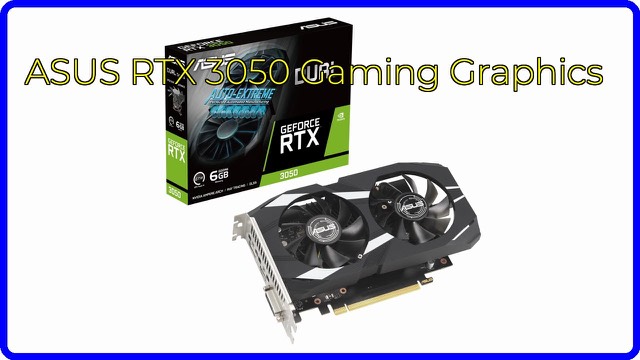
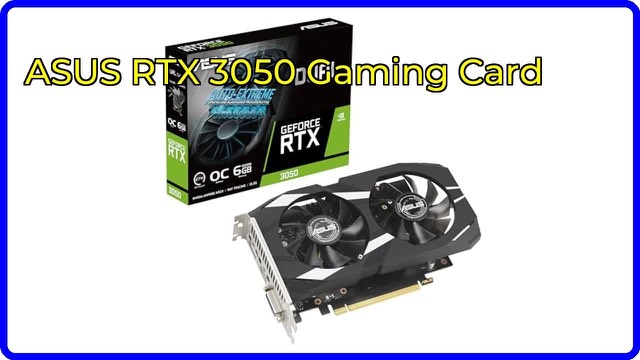
The ASUS Dual GeForce RTX 5050 OC Edition is a compact graphics card built on NVIDIA's Blackwell architecture, with 8GB of GDDR6 memory. It is a 2-slot design with two fans, intended for smaller cases and everyday gaming builds. This page explains what its main specifications mean.
The GPU, DLSS 4 and AI performance
The card uses NVIDIA's GeForce RTX 5050 graphics processor and supports DLSS 4. DLSS is an AI-based technology that renders a game at a lower internal resolution and reconstructs it, which can raise frame rates in games that support it. ASUS lists 433 AI TOPS, a measure of the card's AI throughput; this is mainly relevant to AI features in games and in some creative software.
Clock speeds are listed as 2,677 MHz in OC Mode and 2,647 MHz in the default mode. OC Mode is a factory-overclocked profile selectable in ASUS's software, and the difference between the two is small.
8GB of GDDR6 memory
Video memory holds textures and frame data. 8GB of GDDR6 is usually enough for gaming at 1080p and many titles at 1440p, but very detailed textures and higher resolutions can use more. Check the games you play and the settings you use, since demands vary widely.
PCIe 5.0 and display outputs
The card uses a PCIe 5.0 interface. It is backward compatible with older PCIe slots, though bandwidth is then lower. Outputs are HDMI 2.1b and DisplayPort 2.1b, which support modern high-refresh monitors and televisions.
Cooling and noise
Two Axial-tech fans use a smaller hub for longer blades and a barrier ring to increase downward air pressure. ASUS describes the 0dB technology as stopping the fans under light loads, so light gaming and desktop work can be quiet. Dual ball fan bearings are claimed to last up to twice as long as sleeve bearings. A Dual BIOS switch lets you choose between Quiet and Performance profiles, and GPU Tweak III software handles tuning, thermal control and monitoring.
Size and compatibility
The card measures about 8.0 x 4.7 x 1.6 inches (around 20 x 12 x 4 cm) and weighs 1.1 lb (about 0.5 kg). The 2-slot thickness and short length make it easier to fit in small-form-factor systems, which ASUS highlights with its SFF-Ready label. ASUS says the Auto-Extreme manufacturing process is used for precision and reliability.
Who it suits
It suits people building or upgrading a compact PC for 1080p gaming, as well as those who want DLSS 4 support and quiet operation at light loads. It is not aimed at users who need a lot of video memory for high-resolution gaming or heavy professional work.
What to check before you buy
- Case clearance: confirm that about 8 inches of length and two slots of thickness fit.
- Power supply: check the card's power connector and recommended power supply in ASUS's published specifications.
- Monitor ports: make sure your screen has HDMI or DisplayPort.
- Motherboard slot: you need a free x16 PCIe slot; older versions work at lower bandwidth.
- Games and settings: consider whether 8GB suits the resolution you plan to use.
- Software: check that GPU Tweak III runs on your operating system if you want to adjust settings.
The short version
- A GeForce RTX 5050 OC Edition with 8GB GDDR6 on the NVIDIA Blackwell architecture, with DLSS 4 and 433 AI TOPS.
- OC Mode 2,677 MHz and default 2,647 MHz.
- PCIe 5.0, HDMI 2.1b and DisplayPort 2.1b.
- Two Axial-tech fans, 0dB mode, Dual BIOS and a compact 2-slot form.
Bloiq is reader-supported. Some links may earn us a commission; it never affects what we write. How we make money.