Home / Tech · Product overviews / Computers & Accessories / Graphics Cards · More from ASUS
ASUS Dual GeForce RTX 4060 OC V2 8GB graphics card: specs and who it suits
A 2-slot, 8GB GDDR6 graphics card with DLSS 3, ray tracing, PCIe 4.0 and Axial-tech fans. What the specs mean and what to check before fitting it.
This page contains an affiliate link, marked as such. If you buy through it, Bloiq may earn a commission at no extra cost to you.
The ASUS Dual GeForce RTX 4060 V2 OC Edition (model DUAL-RTX4060-O8G-V2) is a desktop graphics card with 8GB of GDDR6 memory. ASUS describes it as a card for building an entry-level gaming PC, and it adds NVIDIA's current-generation features such as DLSS 3 and ray tracing to a standard desktop.
The Ada Lovelace architecture
The card is built on NVIDIA's Ada Lovelace architecture. ASUS highlights two parts of it. The 4th Generation Tensor Cores run AI workloads, including DLSS 3, and ASUS says they give up to four times the performance of brute-force rendering when DLSS 3 is on. The 3rd Generation RT Cores handle ray tracing, which simulates how light bounces for more realistic reflections and shadows, and ASUS quotes up to twice the ray tracing performance.
These are NVIDIA and ASUS figures for specific comparisons, so real results vary by game and settings.
What DLSS 3 does
DLSS renders a game at a lower internal resolution and uses AI to reconstruct a sharper image. DLSS 3 also generates extra frames in between, which can raise frame rates in supported games. It only works in titles that include support, so check the games you play.
Clock speeds and the OC edition
OC in the name means ASUS has set a factory overclock. The listing gives a boost clock of 2535 MHz in OC Mode and 2505 MHz in Default Mode. The difference is small, and the boost clock is the speed the card can reach under suitable conditions rather than a constant value. ASUS software typically lets you switch between modes.
Cooling: Axial-tech fans and 0dB
ASUS fits Axial-tech fans, which have a smaller hub to allow longer blades and a barrier ring that raises downward air pressure. The listing also mentions dual ball-bearing fans, which ASUS says add to longevity, and 0dB technology. In general, 0dB means the fans stop at low temperatures, so the card is silent when idle or lightly loaded.
Size, connections and bus
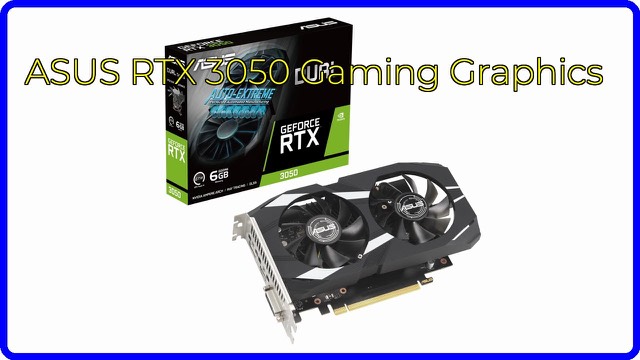
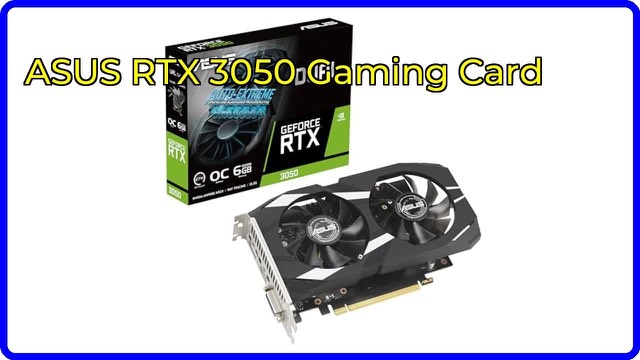
This is a 2-slot design, about 8.0 inches (roughly 20 cm) long according to the listing, and it weighs about 1.2 lb (0.5 kg). The card uses a PCIe 4.0 interface and has HDMI 2.1a and DisplayPort 1.4a outputs. HDMI 2.1a is the version normally needed for high refresh rates at 4K on a TV or monitor. A PCIe 4.0 card typically works in older PCIe slots too, but check the board's documentation.
Who it suits
It suits someone building or upgrading a desktop for 1080p gaming who wants DLSS 3 and ray tracing support in a compact two-slot card. It is a card, not a complete PC, so it needs a compatible desktop.
What to check before you buy
- Case space: measure the available length and width, and confirm two free slots.
- Power supply: check ASUS's recommended power supply wattage and the power connector the card needs.
- Motherboard slot: you need a free PCIe x16 slot.
- Monitor inputs: match HDMI 2.1a or DisplayPort 1.4a to your display.
- Drivers: install current NVIDIA drivers after fitting the card.
- Games: check which titles support DLSS 3.
The short version
- 8GB GDDR6 desktop graphics card on NVIDIA's Ada Lovelace architecture.
- DLSS 3, 4th-gen Tensor Cores and 3rd-gen RT Cores for ray tracing.
- Boost clock of 2535 MHz in OC Mode, 2505 MHz in Default Mode.
- Axial-tech dual-fan cooling with 0dB technology, in a 2-slot design.
- PCIe 4.0, HDMI 2.1a and DisplayPort 1.4a.
Bloiq is reader-supported. Some links may earn us a commission; it never affects what we write. How we make money.