Home / Tech · Product overviews / Computers & Accessories / Graphics Cards · More from ASUS
ASUS Dual GeForce RTX 3060 V2 OC Edition 12GB Graphics Card: specs explained
A 2-slot GeForce RTX 3060 graphics card with 12GB GDDR6, PCIe 4.0, Axial-tech fans and 0dB mode. What the specs mean and what to check for your PC.
This page contains an affiliate link, marked as such. If you buy through it, Bloiq may earn a commission at no extra cost to you.
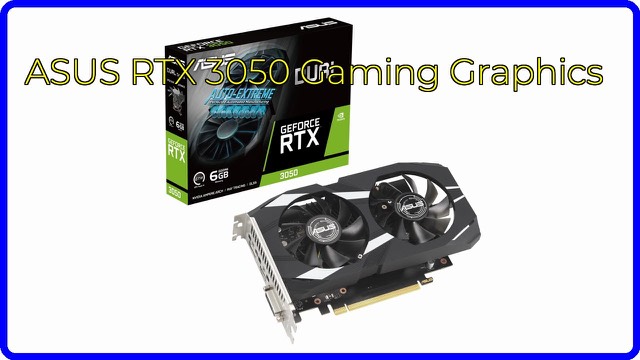
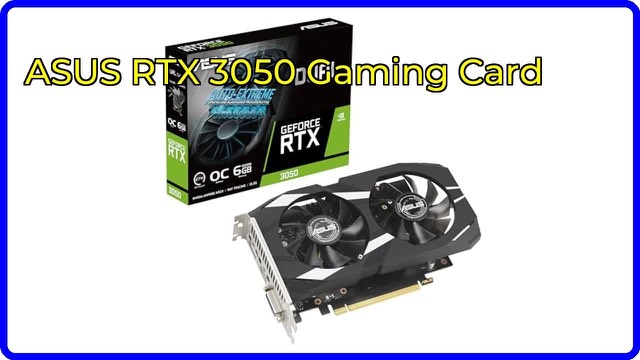
The ASUS Dual GeForce RTX 3060 V2 OC Edition (model DUAL-RTX3060-O12G-V2) is a graphics card for desktop PCs. It is built on NVIDIA's Ampere architecture and carries 12GB of GDDR6 memory. ASUS designed it as a compact 2-slot card with two fans, so it can fit a wide range of cases while giving a gaming PC ray tracing and AI-based upscaling.
What the Ampere architecture adds
NVIDIA's Ampere generation includes three building blocks that ASUS highlights:
- Streaming Multiprocessors: the main processing units, which ASUS says bring twice the FP32 throughput of the previous generation along with better power efficiency.
- 2nd generation RT Cores: dedicated hardware for ray tracing, a lighting technique that models how light bounces in a scene. ASUS cites twice the throughput of first-generation cores and concurrent ray tracing and shading.
- 3rd generation Tensor Cores: hardware for AI tasks such as DLSS, which renders at a lower resolution and upscales the image to raise frame rates. ASUS says support extends up to 8K.
Ray tracing and DLSS only help in games and programs that support them.
Clock speeds and the OC edition
"OC" means factory overclocked. ASUS lists a boost clock of 1867 MHz in OC mode and 1837 MHz in Gaming mode. The difference is small, and in practice the card adjusts its speed with temperature and power limits. The mode can typically be switched in ASUS software.
Why 12GB of memory matters
The card has 12GB of GDDR6 video memory, more than some cards in its class. Video memory holds textures and other game data, and more of it helps at higher resolutions and texture settings, and with some creative tasks. Memory is one factor among several, so it is not a measure of speed by itself.
Cooling: Axial-tech fans and 0dB
The card has two Axial-tech fans. ASUS says a smaller hub allows longer blades, and a barrier ring raises downward air pressure to push more air through the heatsink. The 0dB feature typically stops the fans during light use, such as browsing, and spins them up when the card warms. The cooling system comes from ASUS's flagship cards, packed into a 2-slot body about 7.9 inches long.
Connections
The card uses a PCIe 4.0 interface, which is backward compatible with PCIe 3.0 slots, though bandwidth then drops. Outputs are HDMI 2.1 and DisplayPort 1.4a, enough for high-refresh monitors and modern TVs.
Who it suits
It suits people building or upgrading a desktop PC for 1080p or 1440p gaming, light creative work or video editing, especially in cases where space is tight and a 2-slot card is needed.
What to check before you buy
- Case clearance: confirm length (about 7.9 inches), 2-slot width and your case's space.
- Power supply: check the card's recommended power supply wattage and the connector it needs, on ASUS's product page.
- Motherboard slot: you need a PCIe x16 slot; PCIe 4.0 is not required, but may be better.
- Monitor ports: make sure your monitor's inputs match HDMI 2.1 or DisplayPort 1.4a.
- Processor: a much older processor can limit what the card does.
- Drivers: download current drivers from NVIDIA.
The short version
- A 2-slot GeForce RTX 3060 card with 12GB GDDR6, based on NVIDIA Ampere.
- Boost clock of 1867 MHz in OC mode and 1837 MHz in Gaming mode.
- Dual Axial-tech fans and 0dB technology.
- PCIe 4.0, with HDMI 2.1 and DisplayPort 1.4a outputs.
- 2nd generation RT Cores for ray tracing and 3rd generation Tensor Cores for DLSS.
Bloiq is reader-supported. Some links may earn us a commission; it never affects what we write. How we make money.