Home / Outdoor & Garden · Product overviews / Outdoor Décor · More from VEVOR
VEVOR 7-in-1 Wi-Fi Solar Weather Station with 7-Inch Display: specs and uses
A solar-charged Wi-Fi weather station with a 7-inch colour display and a 7-in-1 outdoor sensor. What it measures and what to check before setting it up.
This page contains an affiliate link, marked as such. If you buy through it, Bloiq may earn a commission at no extra cost to you.
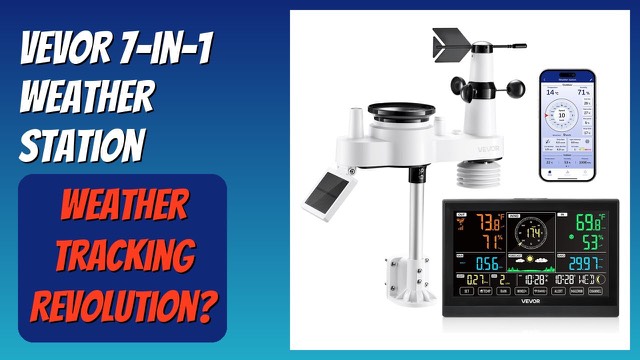
The VEVOR 7-in-1 Wi-Fi Solar Weather Station (model YT60233) is a home weather station made of two parts: a solar-powered outdoor sensor and an indoor unit with a 7-inch colour screen. It tracks conditions around your house or garden, shows them live and can send the readings online through Wi-Fi.
What the "7-in-1" sensor measures
VEVOR says the outdoor sensor monitors wind speed, wind direction, temperature, humidity, rainfall and light. The indoor unit then works out and shows further readings, including wind chill, dew point and pressure, plus a calendar and moon phase. Wind chill and dew point are calculated from the measured values, which is how most home weather stations produce them.
You can also set high and low alarm values, and the station sounds an alert when a reading passes the limit. VEVOR describes the sensor as IPX6 waterproof, which generally means it can handle strong jets of water, and says it can keep monitoring in heavy rain.
The 7-inch colour display
The indoor unit has a 7-inch TFT colour screen. VEVOR says it syncs its time automatically with internet time and includes a snooze alarm. After a restart, once Wi-Fi has reconnected, the brand says the time updates in about two minutes, so you do not need to reset it by hand.
Wi-Fi and online data
The station connects to Wi-Fi and, according to VEVOR, supports Weather Underground and WeatherCloud. These are services where personal weather stations upload data, so you can view, save, analyse, share and compare readings. VEVOR also describes monitoring temperature, humidity, wind speed and light on a smartphone. You will need to follow the manual to register the station and link it to those accounts.
Solar power and range
The outdoor sensor has a 4 x 3 inch (100 x 70 mm) solar panel that charges rechargeable Ni-MH batteries, so you don't need to replace batteries often. An aluminium rod bracket holds the sensor in place outdoors.
VEVOR gives the transmission distance as 328 ft (100 m). That is usually a figure for open ground, and walls, metal and other obstructions typically shorten it. VEVOR advises keeping the sensor away from TV sets, signal towers and high-voltage lines, which can cause interference. The whole station weighs about 3.0 lb (1.4 kg).
Who it suits
It suits gardeners, hobbyists and people living in places with changeable weather who would like local readings of their own rather than a forecast for a nearby town. It also suits anyone who likes to contribute data to an online weather network.
What to check before you buy
- Sensor position: the manual typically calls for an open spot, clear of walls and trees, with good sun for the solar panel.
- Distance: measure the gap between the sensor and the indoor unit, allowing for walls.
- Wi-Fi: confirm your router works with the station's Wi-Fi band and settings.
- Mounting: check the pole or surface you plan to use for the bracket.
- Upkeep: rain gauges and sensors need occasional cleaning, and the Ni-MH batteries age over time.
- Accounts: the online services are third-party sites with their own sign-up.
The short version
- An outdoor sensor measuring wind speed and direction, temperature, humidity, rainfall and light.
- A 7-inch TFT colour display showing readings, wind chill, dew point, pressure and moon phase.
- Wi-Fi support for Weather Underground and WeatherCloud.
- Solar-charged Ni-MH batteries and a quoted range of 100 m.
- Adjustable high and low alarms.
Bloiq is reader-supported. Some links may earn us a commission; it never affects what we write. How we make money.