Home / Outdoor & Garden · Product overviews / Generators & Portable Power / Solar Panels · More from Renogy
Renogy 200W 12V Monocrystalline Solar Panel Starter Kit: specs and who it suits
A 200W solar starter kit with two 100W monocrystalline panels, a 30A PWM Wanderer charge controller, cables and mounting brackets for RVs, boats and cabins.
This page contains an affiliate link, marked as such. If you buy through it, Bloiq may earn a commission at no extra cost to you.
The Renogy 200 Watt 12 Volt Monocrystalline Starter Kit is a bundle of two 100W solar panels, a charge controller, cables and brackets. Renogy designs it for people new to solar who want to charge a 12V battery bank on an RV, trailer, boat, shed or cabin, where quiet power and independence from the grid are the draw.
What's in the kit
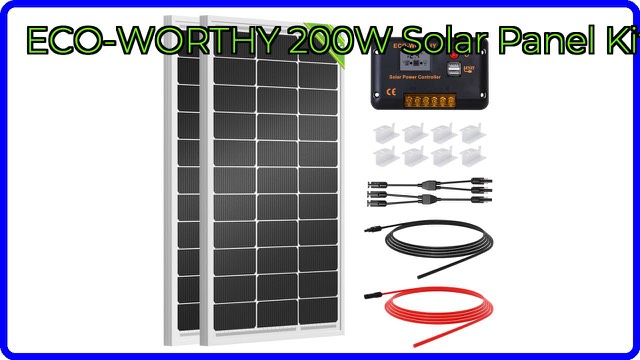
According to Renogy, the kit includes two 100W 12V monocrystalline panels, a 30A PWM Wanderer charge controller, a 20 ft 10AWG solar connector adaptor cable kit, an 8 ft 10AWG tray cable, a pair of branch connectors and two sets of Z-brackets. Renogy says that is everything needed to build a new system, apart from the battery and the tools to mount it.
What 200 watts delivers
Renogy says the kit produces an average of around 1000Wh per day, based on five hours of direct sunlight. That is a rough planning figure: real output varies with the season, latitude, panel angle, shade, temperature and dirt on the panels. To judge whether 200W covers your needs, add up the watt-hours your devices use in a day, such as lights, a fridge or a laptop, and compare.
Renogy lists the cell efficiency as up to 22%. Monocrystalline cells are made from a single silicon crystal, which typically gives better output in a smaller area than polycrystalline. The listing also mentions bypass diodes, which help the panel keep producing when part of it is shaded or in low light, and a TPT back sheet that helps dissipate heat.
The PWM charge controller
A charge controller sits between the panels and the battery and stops the battery from being overcharged. Renogy's Wanderer is a PWM (pulse width modulation) type that handles up to 30A. It works with sealed, gel, flooded and lithium batteries, and uses four-stage charging: bulk, boost, float and equalization.
In general, PWM controllers are simple and common in small 12V systems. They work best when the panel voltage suits the battery bank, which is the case with 12V panels on a 12V battery. The listed protections are reverse polarity, battery overcharge, overload and short circuit.
Size and mounting
Each panel is about 47.3 x 21.3 x 1.4 inches (roughly 120 x 54 x 3.6 cm), going by the listed dimensions. The panels have pre-drilled holes in the back frame, and the Z-brackets are included for fixing them to a roof or other surface. A solid mount matters on a moving vehicle or boat, so check the manual for fixing and sealing advice.
Room to expand
Renogy says you can add more of the same panels, up to 400W in total with this controller. Check the manual for how to wire additional panels in parallel or in series.
Who it suits
It suits first-time solar users with a modest 12V system: weekend camping, a small trailer, a boat's house battery or a shed with lights and a few devices. Larger loads, such as air conditioning or electric cooking, need much more capacity.
What to check before you buy
- Daily energy use: estimate your watt-hours and compare with the expected output.
- Battery: the kit doesn't include one, so check that your battery type and size work with the controller.
- Roof space: measure for two panels and allow for cable runs.
- Wiring: use the right fuses and breakers, and follow the manual and local electrical codes; if unsure, ask a qualified installer.
- Shade and angle: plan the position to get as much direct sun as possible.
- Future expansion: check the controller's 400W limit.
The short version
- A 200W kit with two 100W 12V monocrystalline panels.
- A 30A PWM Wanderer charge controller for sealed, gel, flooded and lithium batteries.
- Cables, branch connectors and Z-brackets are included.
- Renogy quotes about 1000Wh a day in five hours of direct sun.
- Expandable to 400W with more of the same panels.
Bloiq is reader-supported. Some links may earn us a commission; it never affects what we write. How we make money.