Home / Outdoor & Garden · Product overviews / Generators & Portable Power / Solar & Wind Power · More from ECO-WORTHY
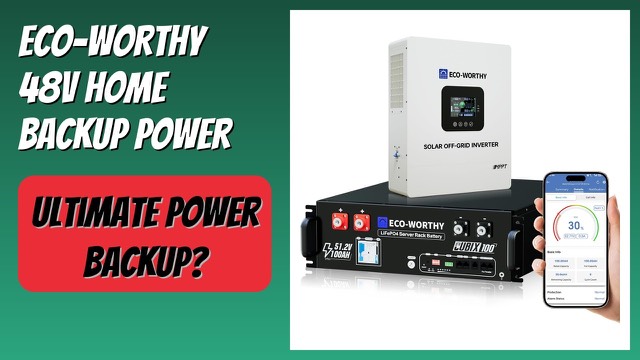
ECO-WORTHY 20480Wh Home Power Station: 5000W inverter and batteries
A home backup kit with a 5000W 120V off-grid inverter and four 48V 100Ah LiFePO4 batteries (20,480Wh). What the specs mean and what to check before installing.
This page contains an affiliate link, marked as such. If you buy through it, Bloiq may earn a commission at no extra cost to you.
The ECO-WORTHY 20480Wh Home Power Station is a home battery backup kit built around a 5000W off-grid inverter and four 48V (51.2V) 100Ah lithium iron phosphate batteries. It is meant for households that want power during an outage, or a battery bank to pair with solar panels. This page explains what the numbers mean and what installing a system like this involves.
What 20,480Wh means in practice
A watt-hour figure is the total energy a battery bank stores. Four batteries at 51.2V and 100Ah each hold about 5,120Wh, which gives the 20,480Wh total. In general, a refrigerator uses a few hundred watt-hours over a day in short bursts, while heating, cooking and air conditioning draw far more, so how long the bank lasts depends heavily on what you connect. Usable runtime is also a little lower than the headline figure, because inverters lose some energy in conversion.
The inverter: 5000W at 120V
ECO-WORTHY says the single MPPT off-grid inverter delivers 5000W at 120V, enough for what it calls heavy-duty household appliances. Motor loads such as pumps and compressors typically draw a surge at start-up, so it is worth checking an appliance's starting wattage against the inverter's limits in the manual.
The inverter can be expanded. The brand states that up to six can be paralleled for 30kW of AC output, and that up to 32 batteries can be paralleled for 163.84kWh of storage.
LiFePO4 batteries with communication
LiFePO4 (lithium iron phosphate) is a common chemistry for stationary storage, typically valued for long cycle life and stable behaviour. The batteries here are rack-style units in a full-metal shell, with a 100A battery management system (BMS) and a 125A air switch. ECO-WORTHY lists Grade A cells, CAN and RS485 communication, and Bluetooth and Wi-Fi monitoring. It also says the battery conforms to UL 1973 and was tested to the UL 9540A standard. Communication between battery and inverter lets the two share state-of-charge and protection information.
Charging from solar or the grid
The batteries can be charged from a solar array through the inverter's MPPT input, or from the grid. The brand gives up to 40A for AC charging, a full charge in about 10 hours, and up to 100A for PV charging, a full charge in about 4 hours. Real times depend on your panels, sunlight and starting charge level.
Monitoring and automatic switching
A 4.3-inch touchscreen battery monitor comes with the four-battery set. It shows voltage, current, state of charge and temperature from four sensors. The listing notes it works with V3 batteries only, not V2.
The system also has a UPS function. You can set whether the grid or the batteries take priority, and when the grid fails, the load is switched to the batteries automatically.
What's in the box
The set includes one 5000W off-grid inverter, four 48V 100Ah lithium batteries and the battery monitor. It ships in multiple packages, so check that every part has arrived.
Who it suits
It suits homeowners planning a whole-home or partial backup system, people building an off-grid cabin or workshop, and those who want to add storage to an existing solar installation and are comfortable working with an installer.
What to check before you buy
- Your loads: add up the running and starting watts of what you want to power, and the hours you want it to run.
- Voltage: the inverter is a 120V unit; confirm that matches your panel and appliances.
- Solar array: check that your panels' voltage and current fit the inverter's PV input.
- Installation: a system of this size should be installed to local electrical codes, typically by a licensed electrician, following the manual.
- Space and weight: rack batteries are heavy; plan where they will sit and how they will be ventilated.
- Compatibility: confirm the monitor and batteries are the matching version (V3).
The short version
- A kit with a 5000W 120V off-grid MPPT inverter and four 48V 100Ah LiFePO4 batteries, 20,480Wh in total.
- Expandable to six inverters (30kW) and 32 batteries (163.84kWh), according to ECO-WORTHY.
- Charges from solar (up to 100A) or from the grid (up to 40A).
- Bluetooth and Wi-Fi monitoring, a 4.3-inch touchscreen monitor and automatic UPS switching.
- Follow local codes and the manual for installation.
Bloiq is reader-supported. Some links may earn us a commission; it never affects what we write. How we make money.