Home / Outdoor & Garden · Product overviews / More Outdoor & Garden · More from DEWENWILS
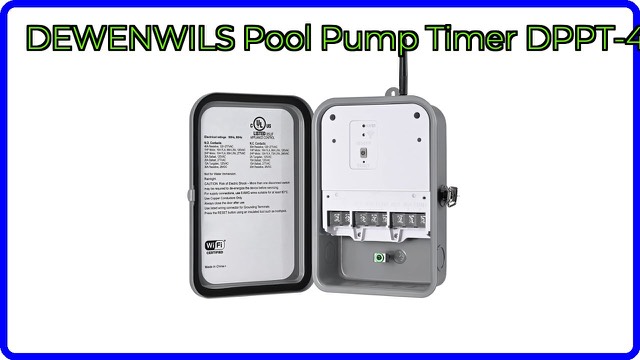
DEWENWILS HOMT12E Mechanical Pool Pump Timer: specs and what to check
An outdoor-rated mechanical timer box for pool pumps and other loads, rated 40A and 2HP at 120-277V, with 96 daily on/off settings in 15-minute steps.
This page contains an affiliate link, marked as such. If you buy through it, Bloiq may earn a commission at no extra cost to you.
The DEWENWILS HOMT12E is a mechanical timer in a weather-sealed box. It switches heavy electrical loads such as pool pumps on and off at set times each day. Because it uses a dial and pins instead of a screen, there's no programming menu: you push pins out for the periods you want the equipment to run.
How the dial and pins work
A mechanical timer has a 24-hour dial. You turn the dial clockwise until the arrow points to the current time. Around the edge are pins, each representing a 15-minute slot, and you push out the ones for the periods when the device should run. That gives up to 96 on/off settings in a 24-hour period, and the schedule repeats daily.
A manual switch gives you two other options, according to DEWENWILS. Set it to "Clock" and the timer follows the pins. Set it to "I" and the device stays on regardless of the schedule. Mechanical timers are simple and don't rely on batteries or an app, but the dial needs resetting to the correct time after a power interruption, as is typical for this type.
Electrical limits
The listing gives a maximum of 40 amps and a 2HP load, with multi-voltage operation from 120 to 277 VAC (120V, or 208-277V). DEWENWILS lists pool pumps, water heaters, fountains, spas, mowers, air conditioners and other motor equipment as suitable applications. It says the timer can control one device or two simultaneously.
Before using it, check your equipment's voltage, running current and motor size against these figures. Motors draw more current when they start than when they run, so keeping well inside the limits is sensible.
Outdoor build
The box is ETL listed, and the sealed plastic shell is designed to keep rainwater and dust from entering the junction box through the opening. The listed operating temperature range is -40°F to 140°F (-40°C to 60°C). The box is described as thinner than usual to save space. It measures 5 x 5 x 2 inches and weighs 1.7 lb (about 0.8 kg).
Wiring and installation
The timer module is removable from the box, which gives more room for wiring and makes settings easier to reach. There are two wiring hole sizes, 1/2 inch and 3/4 inch, and wiring caps are included. The manual shows the installation and wiring for different loads.
This is mains-voltage work. Isolate the power at the breaker, follow the manual and local electrical codes, and use a licensed electrician if you aren't qualified to do it yourself. For pool equipment, local codes often have particular requirements, so check these before installation.
Who it suits
It suits owners who want a plain, battery-free daily schedule for a pool pump or other motor load, such as running the pump at set hours. It also suits people who prefer pins and a dial to an app or touchscreen.
What to check before you buy
- Voltage and current: confirm your equipment's voltage and amperage fit within 120-277 VAC and 40A.
- Motor size: check the motor's horsepower against the 2HP limit.
- Number of devices: see whether you're controlling one load or two, and how each is wired.
- Schedule needs: the smallest slot is 15 minutes, and the schedule repeats daily; it doesn't have separate weekday settings.
- Resetting: expect to reset the dial to the correct time after power outages.
- Wiring and codes: check conduit and hole sizes, and have the work done by a qualified person where needed.
The short version
- A mechanical, outdoor-rated timer box with a daily repeating schedule.
- Up to 96 on/off settings in 15-minute steps, with a manual override.
- Rated 40A, 2HP, 120-277 VAC; ETL listed.
- Removable timer module, two wiring hole sizes and wiring caps.
- Follow the manual and local electrical codes.
Bloiq is reader-supported. Some links may earn us a commission; it never affects what we write. How we make money.