Home / Auto · Product overviews / Replacement Parts / Heaters · More from VEVOR
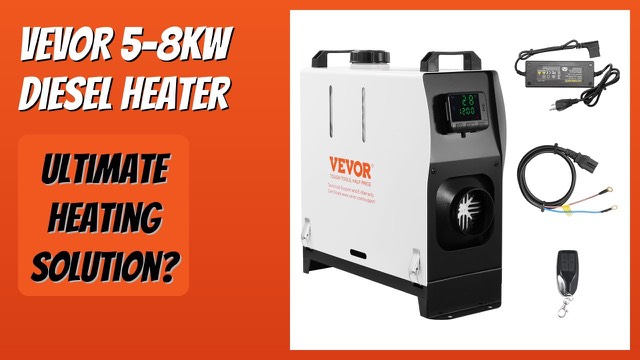
VEVOR 5-8KW Diesel Air Heater XMZ-W-D4: features, specs and who it suits
A portable 5-8kW diesel air heater with remote control, LCD display, 12V and 110V wiring options and overheating protection. What the specs mean.
This page contains an affiliate link, marked as such. If you buy through it, Bloiq may earn a commission at no extra cost to you.
The VEVOR 5-8KW Diesel Air Heater (model XMZ-W-D4) is an all-in-one heater that burns diesel to warm the air in a small enclosed space such as a van, RV, truck cab, trailer or camper. Diesel air heaters of this type are popular with people who want heat that does not depend on an engine running. This one adds a remote, an LCD screen and two ways to power it.
How a diesel air heater works
A diesel air heater draws a small amount of fuel from a tank, burns it in a sealed combustion chamber and passes cabin air across a heat exchanger. The exhaust is carried outside through a separate pipe, and the warmed air goes into the space. Because the burning is sealed off from the air you breathe, the exhaust must be vented outdoors. VEVOR recommends professional installation, and that advice is worth following, as the fuel line, exhaust routing and mounting all need care.
Power output and fuel use
The heater is rated at 5-8kW, with heating efficiency of at least 90% according to VEVOR. The brand says it uses about 1 US gallon of diesel per night to keep roughly 215 sq ft (20 m²) continuously warm. Real consumption varies with the heat setting, the outside temperature and how well the space is insulated. A thermostat is built in, so the heater adjusts its output to hold the temperature you set.
Two ways to power it
The listing describes two wiring options: a 110V adapter for standard US sockets, and a DC 12V T-shaped plug for external wiring to a vehicle or outdoor storage battery. It also mentions 12/24V vehicle batteries. This flexibility lets the same unit work in a plugged-in setting or off-grid.
Remote control and display
A remote with a stated range of 98 ft (30 m) can start the heater in advance so the space is warm when you arrive. The target temperature can be set between 46.4 and 96.8°F (8 to 36°C). The LCD shows the machine's status. VEVOR quotes noise of 75dB or less, which is a manufacturer figure; the sound inside a living space depends on the mounting and the exhaust and intake silencers.
Operating range and protections
VEVOR says the heater and its oil pump work from -40°F to 104°F (-40°C to 40°C), which is relevant for cold-weather starts. The listing describes protection against overheating (at 536°F / 280°C or above), short circuits, overcurrent, overvoltage and reverse connection, and says the product has passed safety certification. Always check which certifications apply in your region and follow the manual.
Who it suits
It suits owners of campervans, RVs, trailers and trucks, and campers who want a dedicated heater rather than a fuel-burning engine idle. It also suits anyone heating a small workshop or tractor cab, provided exhaust can be vented safely outside.
What to check before you buy
- Space: compare the stated 215 sq ft (20 m²) coverage with your own space and insulation.
- Power source: confirm whether you will use the 110V adapter, a 12V battery or both.
- Installation: plan the mounting location, fuel supply, intake and exhaust, and consider professional installation as VEVOR advises.
- Ventilation and alarms: the exhaust must go outside; follow local codes and the manual, and consider a carbon monoxide alarm in sleeping areas.
- Altitude and climate: check the manual for any limits at high elevation.
- Upkeep: ask about fuel quality, cleaning and replacement parts.
The short version
- A portable diesel air heater rated 5-8kW, model XMZ-W-D4.
- Powered by a 110V adapter or 12V DC wiring.
- Remote with a stated 98 ft range, LCD screen and built-in thermostat.
- Operates from -40°F to 104°F, with several electrical and overheating protections.
- The exhaust must be vented outside; professional installation is recommended.
Bloiq is reader-supported. Some links may earn us a commission; it never affects what we write. How we make money.