Home / Auto · Product overviews / Material Handling Products · More from VEVOR
VEVOR 1500 lb Ratcheting Wheel Dolly: features, specs and who it suits
A single VEVOR wheel dolly rated for 1,500 lb with a foot-pedal ratchet, 4-inch casters and a foot brake. What the specs mean and what to check.
This page contains an affiliate link, marked as such. If you buy through it, Bloiq may earn a commission at no extra cost to you.
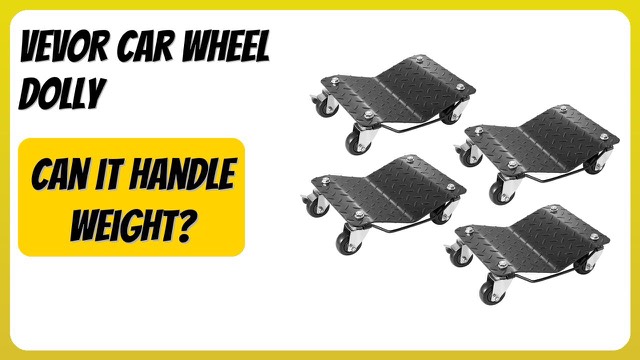
The VEVOR wheel dolly is a single car skate that lifts one wheel and lets you roll the vehicle sideways or around a tight garage. It uses a foot-pedal ratchet rather than a hydraulic jack. It is meant for moving cars, trailers and similar vehicles in spaces where driving them isn't practical.
How the ratchet lift works
You position the dolly's two rollers against the tyre, then press the foot pedal repeatedly. Each press ratchets the rollers closer together, squeezing the tyre and raising it off the ground. VEVOR says this is about 25% faster than hydraulic models and removes the risk of oil leakage, as there is no hydraulic fluid. It also says one person can do the job without additional tools.
A mechanical ratchet has fewer parts to leak or wear than a hydraulic ram. The trade-off is that it needs a foot-pedal motion each time, and you should check that the dolly is locked before you rely on it.
What the 1,500 lb capacity means
VEVOR gives the dolly a capacity of 1,500 lb (about 680 kg). That is a per-dolly figure, and a vehicle is normally moved on several dollies at once, one under each wheel. A common rule is to work out how much weight each wheel carries, which differs front to rear, and keep it well below the figure on the label. The brand lists cars, SUVs, pickups, ATVs, tractors, RVs and trailers as suitable.
Tyre and roller dimensions
- Tyre width: up to 14 inches (355.6 mm).
- Roller spread: 12.4 to 28.3 inches (315 to 720 mm).
Check both numbers against your tyres before choosing this dolly. Very wide or low-profile tyres, or tyres with a large diameter, may not fit between the rollers.
Casters and brake
The dolly sits on 4-inch universal casters, and VEVOR also lists locking casters. A foot brake locks the dolly in position, so the vehicle stays put when you stop pushing. According to VEVOR, the casters are made not to loosen. Smooth, level flooring typically gives the best rolling; cracks, gravel and slopes make any dolly harder to control.
Construction
The body is steel with a rust-resistant surface, and the rollers are aluminium alloy, which VEVOR describes as strong, resistant to deformation and gentle on tyres. It measures about 24.1 x 24.1 x 7.9 inches (61 x 61 x 20 cm) and weighs 37.5 lb (about 17 kg), so it is a heavy item to handle.
Using it safely
Wheel dollies are a moving aid and are not a replacement for jack stands when you work under a vehicle. Follow the manual, use level ground, engage the parking brake as it instructs, and keep people and pets clear while the vehicle is moving. Move slowly: a loaded dolly can be hard to stop on a slope.
Who it suits
It suits home garages where there isn't room to manoeuvre, people who keep a car, trailer or RV in a tight spot, and anyone who wants to reposition a vehicle for tyre changes or repairs. A small workshop might keep a set near the door.
What to check before you buy
- How many you need: one dolly handles one wheel, so a four-wheeled vehicle typically needs several.
- Weight per wheel: check your vehicle's weight distribution against the 1,500 lb capacity.
- Tyre fit: confirm width and diameter against the stated ranges.
- Floor: use on smooth, level, hard surfaces.
- Handling: at 37.5 lb, make sure you can lift it and find room to keep it.
- Manual: read the instructions on locking, using the brake, and release.
The short version
- A single ratcheting wheel dolly rated by VEVOR at 1,500 lb.
- A foot-pedal ratchet with no hydraulic oil; about 25% faster than hydraulic models, VEVOR says.
- Fits tyres up to 14 inches wide, with a roller spread of 12.4 to 28.3 inches.
- Four-inch casters, a foot brake, a steel body and aluminium alloy rollers.
Bloiq is reader-supported. Some links may earn us a commission; it never affects what we write. How we make money.