Home / Travel / Universities / United Kingdom
LSE campus tour: Houghton Street, the library and Lincoln's Inn Fields
A guide to the London School of Economics for future students: the Old Building, the library, the Saw Swee Hock Student Centre, Lincoln's Inn Fields and getting there.
This guide contains affiliate links, marked as such. If you book through them, Bloiq may earn a commission at no extra cost to you.
The London School of Economics and Political Science, almost always shortened to LSE, was founded in 1895 by Sidney and Beatrice Webb, Graham Wallas and George Bernard Shaw, all members of the Fabian Society. It joined the University of London in 1900 and settled in the streets off Aldwych soon afterwards. It has been there ever since: a university devoted entirely to the social sciences, squeezed into a few blocks between Covent Garden, Holborn and the law courts. This guide walks through the campus and explains what daily life there is like.
A campus the size of a few city blocks
LSE has no gates, lawns or quadrangles. The campus is a knot of narrow streets bounded roughly by Aldwych to the south, Kingsway to the west and Lincoln's Inn Fields to the north. Most of those streets are closed to traffic, and almost every building along them belongs to the school, so it feels more like a small village than its central London address suggests. You can walk from one end to the other in five minutes.
Houghton Street and the Old Building
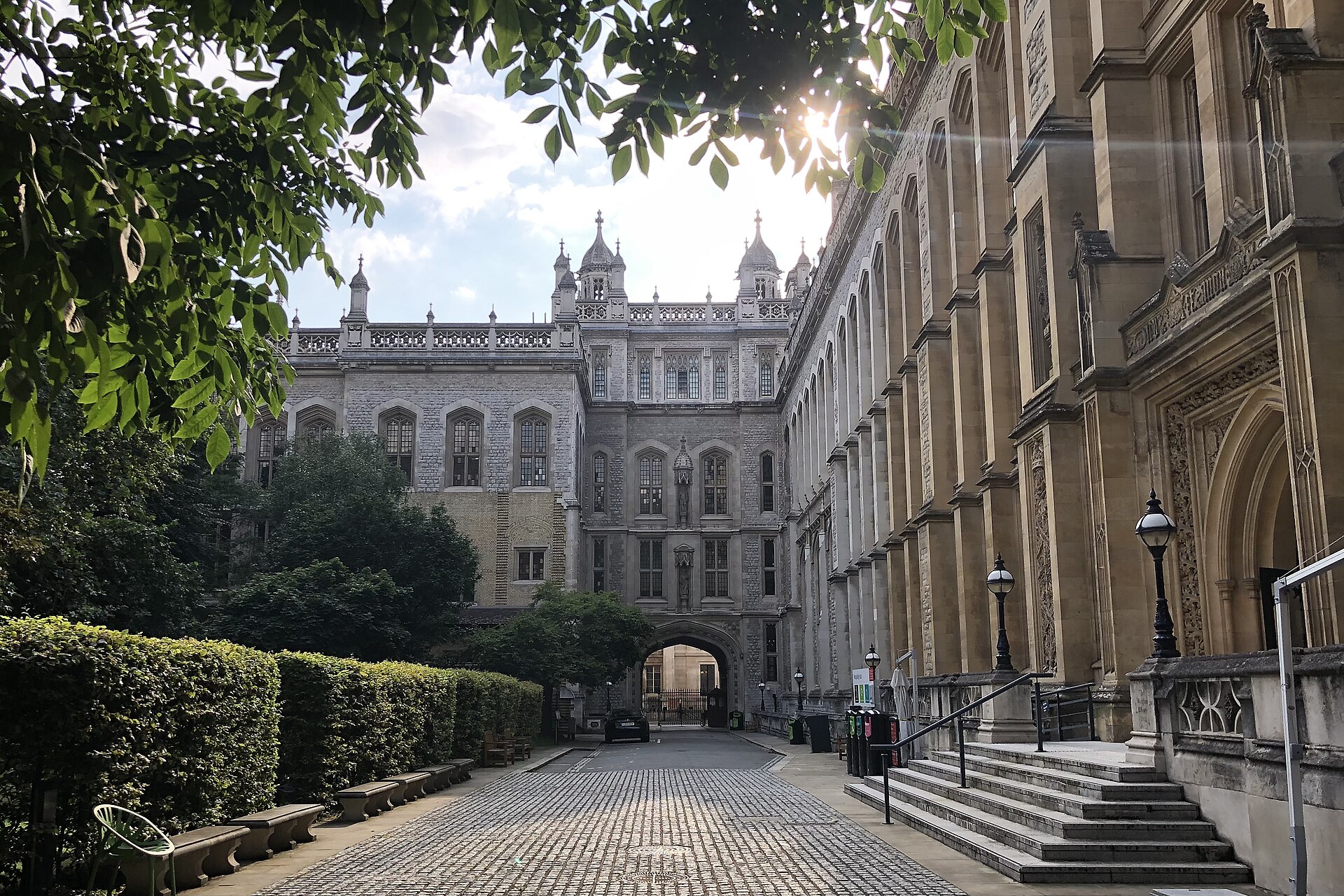
Houghton Street, a short pedestrian street running north from Aldwych, is the school's traditional centre. The Old Building, with its sculpted stone panel above the door, has been the main entrance since the 1920s. Inside are the Old Theatre, used for many of the school's public lectures, and, on an upper floor, the Shaw Library, a quiet room for reading and lunchtime concerts.
At the end of the street, the Centre Building, designed by Rogers Stirk Harbour and Partners, opened in 2019. Its steel-framed tower with outdoor terraces looks over a new open space, LSE Square, which gave the campus something it had never had: a place to sit outside.
The library
The LSE Library, formally the British Library of Political and Economic Science, was founded in 1896, a year after the school itself. It is one of the largest libraries in the world devoted to the social sciences, and it also holds the Women's Library, a major collection on the history of women's lives and campaigns in Britain.
Since the 1970s it has occupied the Lionel Robbins Building on Portugal Street, a former warehouse. Foster and Partners remodelled the interior at the start of this century, cutting a round atrium through the middle with a spiral ramp climbing beneath a glass dome.
The Saw Swee Hock Student Centre
On Sheffield Street, the Saw Swee Hock Student Centre is hard to miss: a faceted, sharply angled building in red brick, with walls that fold and lean to fit an awkward corner site. The Irish architects O'Donnell and Tuomey designed it, and it opened in 2014. It houses the students' union and the everyday services of student life, from a gym and a pub to advice and careers offices.
The Marshall Building and Lincoln's Inn Fields
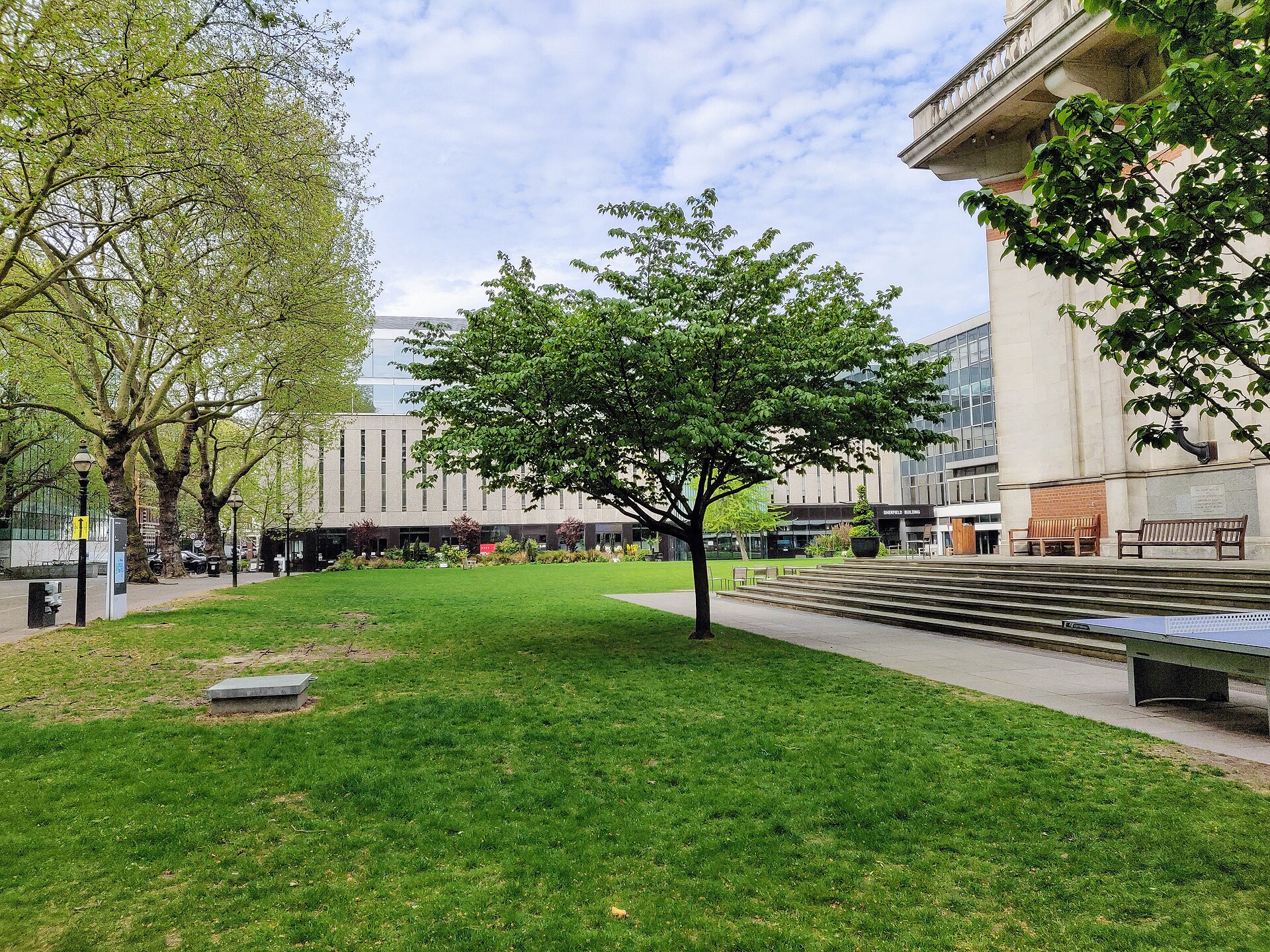
The north side of the campus opens onto Lincoln's Inn Fields, the largest public square in London. On sunny days its lawns fill with students, lawyers and office workers eating lunch.
Two LSE buildings face the square. The Marshall Building, by the Dublin practice Grafton Architects, opened in 2022, with a great concrete-columned hall at ground level, teaching rooms above and sports and music facilities below. A little further along is the New Academic Building, a converted Edwardian office block.
On the square's north side is Sir John Soane's Museum, the eccentric house of the architect, and to the east is Lincoln's Inn itself, one of the four Inns of Court.
The penguin, the globe and other sculptures
LSE has dotted its streets with public art. The best loved is a penguin statue that has become an unofficial mascot. The largest is The World Turned Upside Down, a four-metre globe by the artist Mark Wallinger, installed in 2019 with the south pole at the top.
The official mascot is a beaver, and the student newspaper, founded in 1949, is called The Beaver.
What student life is like
LSE teaches only the social sciences and related fields: economics, politics, law, sociology, anthropology, international relations, history, geography, philosophy, accounting, finance, statistics and more. Postgraduates make up a large share of the student body, and students come from all over the world.
There are no residences on campus. The school's halls are spread around central London, generally a walk or a short bus or Underground ride away, and many students rent privately after their first year. The school's public lecture programme, which regularly brings politicians, economists and writers to campus, is one of the features of student life.
Next-door neighbours include King's College London, whose Strand Campus is across Aldwych, and UCL, about twenty minutes' walk north in Bloomsbury.
Seeing the campus
The streets of the campus are public, so anyone can walk along Houghton Street, through LSE Square and out to Lincoln's Inn Fields, and see the buildings and sculptures from outside. Access to the buildings themselves is generally for students, staff and people attending events. LSE, like most British universities, holds events for prospective students, and many of its public lectures are open to all; arrangements change from year to year, so check the school's official website for what is currently offered and whether booking is needed.
Getting there and around
- Underground: Holborn (Central and Piccadilly lines) and Temple (District and Circle lines) are each about five minutes' walk. Covent Garden and Chancery Lane are a little further.
- Train: Charing Cross is around ten minutes' walk; Waterloo is across the river, a pleasant walk over Waterloo Bridge.
- Bus: many routes stop on Aldwych and Kingsway.
- On foot: this is one of the most walkable parts of London, with Covent Garden, the Strand, the Thames and the British Museum all nearby.
Where families usually base themselves
- Covent Garden and Holborn: right beside the campus, busy and central.
- Bloomsbury: quieter streets and garden squares to the north.
- The South Bank: across Waterloo Bridge, with riverside walks and theatres.
Our guide to where to stay in London compares the main areas, and London in three days helps if you are adding sightseeing to the trip.
Making the most of an hour or two
- Start on Aldwych, walk up Houghton Street to LSE Square, then loop past the library and the Saw Swee Hock Student Centre.
- Finish in Lincoln's Inn Fields, and allow extra time if you want to see the Soane Museum.
- Weekdays in term show the campus at its liveliest; at weekends and in the holidays it is much quieter.
Bloiq is reader-supported. Some links may earn us a commission; it never affects what we write. How we make money.
Cover photo: Shadowssettle, CC BY-SA 4.0, via Wikimedia Commons