Home / Travel / Universities / Netherlands
Leiden University campus tour: the Academy Building, Hortus and canals
A guide to Leiden University for future students: the Academy Building on the Rapenburg, the Hortus Botanicus, the science park, The Hague and student life.
This guide contains affiliate links, marked as such. If you book through them, Bloiq may earn a commission at no extra cost to you.
Leiden University is the oldest university in the Netherlands. William of Orange founded it in February 1575, a few months after the city had held out against a long Spanish siege, and tradition says the university was Leiden's reward. Its motto, Praesidium Libertatis, means "bastion of liberty". Four and a half centuries later the university has no campus in the usual sense: its faculties are spread through a compact old city of canals, bridges and gabled houses, with a science park on one side and a second base in The Hague. This guide shows how it all fits together.
A university spread across a small city
Leiden's historic centre is small enough to cross on foot in twenty minutes, and the university is woven through it.
- The Rapenburg: the grandest canal in the city, with the Academy Building, the botanical garden and several museums.
- Witte Singel: the southern edge of the old town, home to the humanities buildings and the University Library.
- Around the station: the social sciences and the university medical centre.
- Bio Science Park: modern laboratories and lecture halls for the sciences, a short walk or bike ride west of the station.
The Academy Building
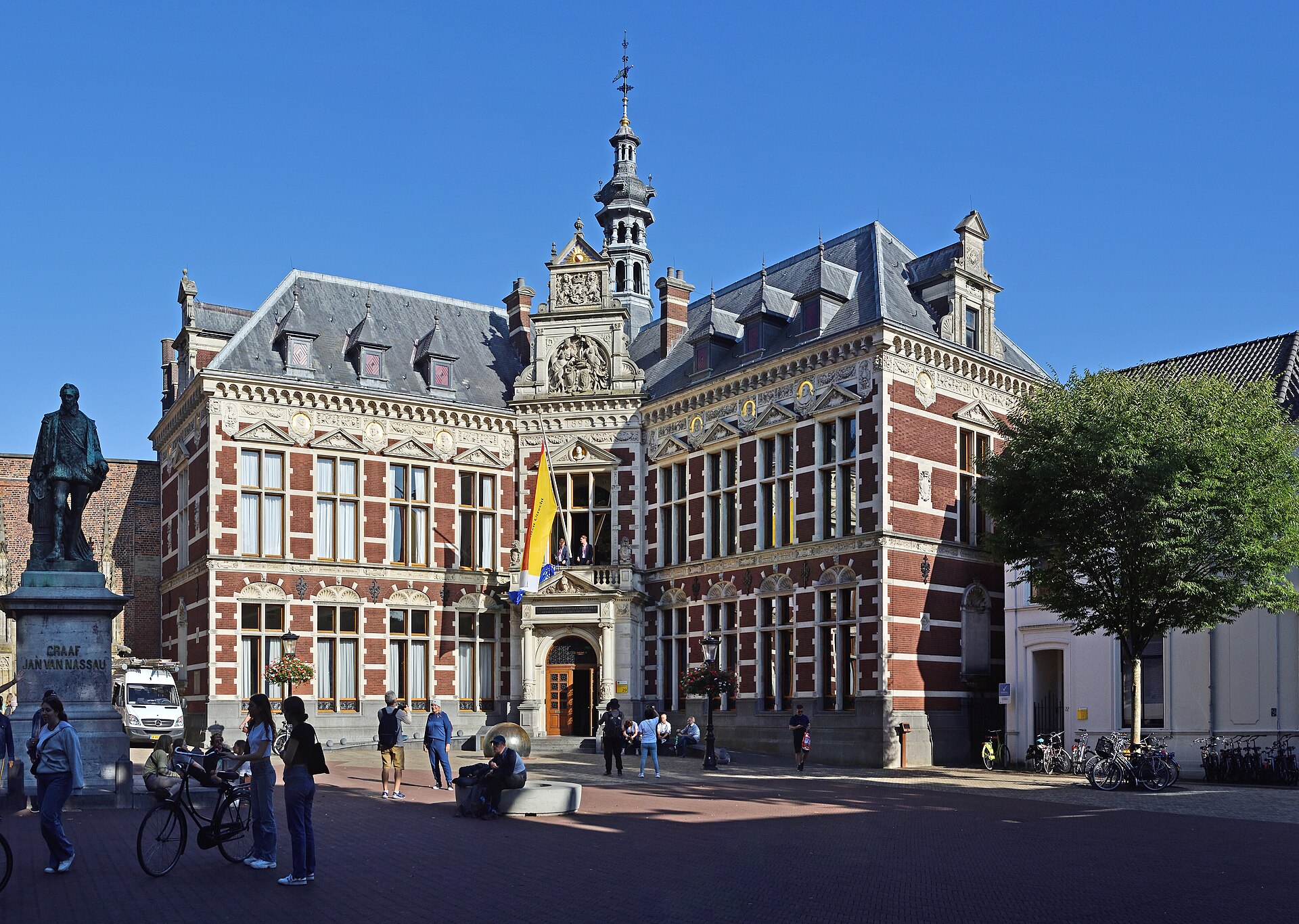
The Academy Building, at Rapenburg 73, is the university's ceremonial heart. It was built as the chapel of a convent, and the university has used it since 1581. Doctoral defences, inaugural lectures and graduation ceremonies still take place here, in rooms hung with portraits of professors from four centuries.
Its most famous corner is tiny. In the sweat room, students once waited nervously for the results of their examinations. For generations, graduates have signed their names on its walls, and the signatures include those of members of the Dutch royal family who studied in Leiden.
The Hortus Botanicus
Behind the Academy Building is the Hortus Botanicus, founded in 1590 and the oldest botanical garden in the Netherlands. The botanist Carolus Clusius became its first director a few years later and planted tulips here, an early step in the Dutch love affair with the flower.
Today the Hortus combines old trees, a Japanese garden and tropical greenhouses, including one with giant water lilies. It is open to the public; check the current opening times and admission arrangements.
The Old Observatory
At the far end of the garden stands the Old Observatory, with its white domes reflected in the canal. Leiden's observatory was founded in 1633, which makes it one of the oldest university observatories in the world, and this building has housed it since the 19th century. The astronomers now work at the science park, and the old building has a visitor centre.
Law, physics and a famous cold laboratory
A few minutes' walk east, the law faculty occupies the Kamerlingh Onnes Building. It was once the university's physics laboratory, where Heike Kamerlingh Onnes first liquefied helium in 1908 and went on to discover superconductivity. His low-temperature research earned him a Nobel Prize. Leiden's physicists of that era included Hendrik Lorentz and Pieter Zeeman, and Albert Einstein was a regular visiting professor.
The Bio Science Park and The Hague
The Faculty of Science is on the Leiden Bio Science Park, on the far side of the railway station, alongside research institutes and biotechnology companies.
The university also has a campus in The Hague, the seat of the Dutch government, about a quarter of an hour away by train. Programmes in fields such as governance, international relations and security are taught there and so is the university's English-language liberal arts college.
Languages of teaching
Many bachelor's programmes are taught in Dutch, and a number are offered in English. Most master's programmes are taught in English. The language of each programme is listed on the university's own website, which is the place to check before applying.
Student life
Leiden is a true student city: students make up a noticeable share of the population, and almost everyone gets around by bicycle. There are no residence halls of the British or American kind. Students rent rooms in shared houses or student complexes, and finding one can take time, so it pays to start early.
Social life revolves around the student associations, some of them well over a century old, which run clubhouses, sports and societies. The city itself adds cafés along the canals, markets on Wednesdays and Saturdays, and more than a hundred poems painted on walls around the centre, in languages from all over the world.
The biggest day of the year is the third of October, when Leiden celebrates the end of the siege in 1574 with a funfair, a parade and the traditional herring, white bread and hutspot, a mash of potatoes, carrots and onions.
Museums worth knowing about
For a small city, Leiden has a remarkable set of museums:
- The National Museum of Antiquities, on the Rapenburg, with Egyptian, Greek and Roman collections.
- Rijksmuseum Boerhaave, the national museum of the history of science and medicine.
- Museum De Lakenhal, the city's museum of art and history. Rembrandt was born in Leiden and enrolled at the university as a boy.
Seeing the university for yourself
Most of the university's historic buildings can be seen from the street, and a walk along the Rapenburg takes in the best of them. The Academy Building is a working ceremonial building and is not always open to visitors. The university holds events for prospective students; dates, formats and booking arrangements change, so check its official website for current information.
Getting there and around
- By train: Leiden Centraal is on the main line through the west of the Netherlands. Schiphol Airport is about a quarter of an hour away by direct train, Amsterdam and Rotterdam each a little over half an hour, and The Hague about a quarter of an hour.
- On foot: the Rapenburg is a fifteen-minute walk from the station through the old centre.
- By bike: rental bikes are easy to find at the station, and cycling is the local way to get about.
Where families usually base themselves
- Leiden's old centre: small hotels and guesthouses, with everything within walking distance.
- Near the station: convenient for the airport and for day trips.
- The Hague or Amsterdam: both are an easy train ride away if you are combining Leiden with a longer stay. Our guide to where to stay in Amsterdam compares its neighbourhoods.
Looking at other Dutch universities too? See our guides to the University of Amsterdam and TU Delft, both less than an hour away by train.
Bloiq is reader-supported. Some links may earn us a commission; it never affects what we write. How we make money.
Cover photo: FrDr, CC BY-SA 4.0, via Wikimedia Commons