Home / Tools & DIY · Product overviews / Additive Manufacturing Products / 3D Printers · More from Creality
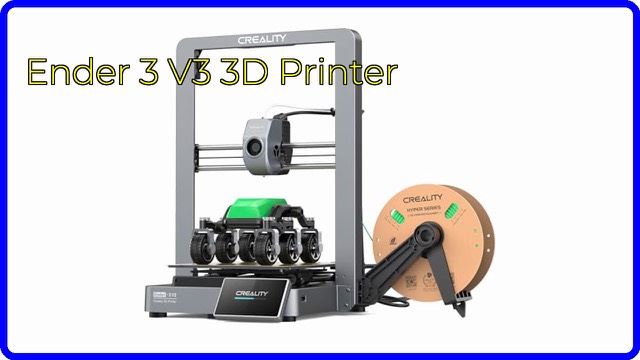
Creality Ender 3 V3 Plus 3D Printer: features, specs and who it suits
A large-format 3D printer with a 300x300x330 mm build volume, Core XZ motion, speeds up to 600 mm/s, auto-leveling and a 300°C hotend.
This page contains an affiliate link, marked as such. If you buy through it, Bloiq may earn a commission at no extra cost to you.
The Creality Ender 3 V3 Plus is a filament 3D printer with a large build volume and a fast motion system. It sits in Creality's Ender line, and the "Plus" refers to the bigger print area. It is aimed at hobbyists and makers who want to print larger parts in one piece or fill the plate with many small ones.
What the build volume means
Creality lists a build volume of 300 x 300 x 330 mm (11.8 x 11.8 x 13.0 inches) and says that is 58% larger than the Ender 3 V3. A larger bed means big items such as helmets, enclosures and display pieces can be printed whole, without splitting and gluing. The trade-off is that a bigger machine needs more desk space, and large prints take longer.
Core XZ motion and speed
The printer uses what Creality calls a Core XZ system. It combines the X and Z axes, so two high-torque motors work together. Creality says this allows speeds up to 600 mm/s and calls it 12 times faster than a regular i3-style printer. Those are maximum figures. In practice, achievable speed depends on the model, filament, layer height and how much acceleration the part can tolerate, and quality usually calls for slower settings than the maximum.
Extruder and hotend
The extruder is a dual-gear direct drive. Direct drive places the feed mechanism close to the hotend, which generally helps with flexible filaments and retraction. The hotend is rated at 60 W and 300°C, which covers common materials such as PLA, PETG and some others, depending on filament requirements.
The nozzle is a tri-metal "Unicorn" design, a steel-tipped copper nozzle with a titanium alloy heatbreak. Creality says it blocks heat creep and can be swapped easily.
Auto-leveling and set-up
Creality says the printer has a CR Touch probe for auto-leveling and a strain sensor for automatic Z offset, which aim to make the first layer reliable. At startup it runs a self-check of the extruder, heated bed, fan and leveling. Those features generally cut down on the manual bed adjustment that earlier hobby printers needed.
Software and firmware
Creality OS is open source, and Creality says it enables advanced functions such as linear advance and input shaping, with an expert mode and root access for fine-tuning. Remote printing is available through the Creality Print slicer and the Creality Cloud app.
Who it suits
It suits hobbyists and makers who want a big print area and faster printing, and people upgrading from an older Ender. It is also a fit for those who like adjusting settings. Anyone who prints only small parts may not need the extra size.
What to check before you buy
- Space: the listing gives about 20 x 10 x 10 inches for the package. Measure your desk for the assembled printer plus room for the bed to move.
- Filaments: check that your materials suit a 300°C hotend.
- Assembly: read the manual to see how much assembly is required.
- Ventilation: hot plastic gives off fumes, so print in a ventilated area and never leave the machine unattended while it is heating.
- Slicer: check the software you'll use and its settings.
- Spares: see which nozzles and parts are easy to replace.
The short version
- A large-format filament 3D printer with a 300 x 300 x 330 mm build volume.
- Core XZ motion with speeds up to 600 mm/s.
- Dual-gear direct extruder and a 60 W, 300°C hotend.
- CR Touch auto-leveling and automatic Z offset.
- Open-source Creality OS and remote printing through Creality's apps.
Bloiq is reader-supported. Some links may earn us a commission; it never affects what we write. How we make money.