Home / Auto · Product overviews / RV Parts & Accessories / Jacks & Stabilizers · More from VEVOR
VEVOR 8000 lb Swivel Trailer Jack: lift range, load capacity and fit
A bolt-on, hand-cranked swivel trailer jack from VEVOR with an 8,000 lb static capacity and a 7.6 to 39.5 inch lift range. What the figures mean and what to check.
This page contains an affiliate link, marked as such. If you buy through it, Bloiq may earn a commission at no extra cost to you.
The VEVOR swivel trailer jack (model 721100) is a hand-cranked jack that bolts to a trailer's tongue. It holds the front of the trailer at a convenient height when it is unhitched, and lets you raise or lower the coupler to line up with a tow ball. VEVOR lists it for RV, horse, utility and yacht trailers.
What the load figures mean
The listing gives two figures. The static capacity of 8,000 lb (about 3,600 kg) is the weight the jack is rated to hold when the trailer is standing still. The dynamic capacity of 5,600 lb (about 2,540 kg) is the lower figure for actually lifting or lowering the load with the crank.
The difference matters in practice. The weight that counts is the tongue weight, which is the downward force the coupler puts on the jack. That is usually a fraction of the trailer's total weight, commonly around 10 to 15 per cent for many trailer types. Compare the tongue weight of your loaded trailer with the dynamic capacity, not just the headline figure.
Lift range and trailer height
VEVOR gives a lifting range of 7.6 to 39.5 inches (roughly 19 to 100 cm), with a 28.5 inch lift in the product title. A wide range is useful if you tow more than one trailer, or if a low trailer and a high-coupler trailer need the same jack. Measure the height from the ground to the underside of your coupler when the trailer is level. The retracted height must be low enough to clear the ground when towing, and the extended height must be tall enough to lift the coupler above your tow ball.
How the swivel design helps
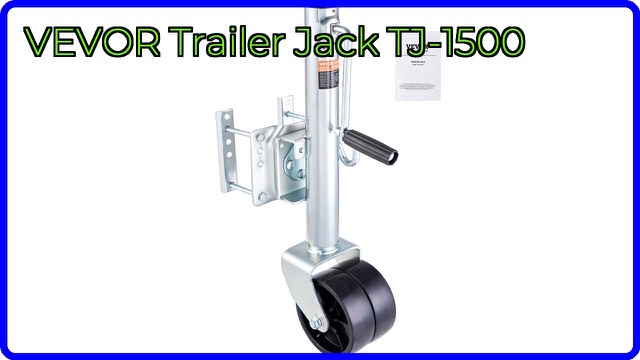
A swivel jack rotates, so once the trailer is hitched you can turn the foot and leg up and out of the way, instead of cranking it to full height. Many owners find this quicker than a fixed jack, and it keeps the leg away from road debris and ground clearance problems. Check that the jack is pinned or locked in the stowed position before you drive, as the manual describes.
Materials and finish
The jack is made of carbon steel with a galvanized, rust-resistant finish, according to VEVOR. Galvanizing is a zinc coating that protects steel from moisture, which is helpful for trailers kept outdoors or used near water. A coating does not make the jack immune to wear, so occasional lubrication of the gears and the screw, and checking for damage, are sensible habits.
Installation and operation
The listing says the jack comes with the parts and assembly instructions, and bolts to the trailer tongue. Operation is manual: you turn the handle to raise or lower the load, and no power is needed, which suits remote campsites and farm use. It measures about 8.1 x 6.1 x 24.7 inches and weighs 28.7 lb, so plan on lifting it into position with a helper or a support.
Who it suits
It suits owners of small to mid-size RV trailers, horse trailers, utility trailers and boat trailers who need a replacement or an upgrade for the tongue jack. It is less suited to very heavy trailers whose tongue weight approaches the dynamic capacity.
What to check before you buy
- Tongue weight: compare it with the dynamic capacity, with room to spare.
- Mounting: confirm that the bolt pattern and the tongue shape (round, square or A-frame) suit the jack's bracket.
- Height: measure the coupler height and check the retracted and extended heights.
- Clearance: check that there is room for the swivel and handle to move.
- Upkeep: look at the manual on lubricating the screw and inspecting the bolts.
The short version
- A bolt-on swivel tongue jack with a hand crank.
- Rated at 8,000 lb static and 5,600 lb dynamic.
- Lift range of 7.6 to 39.5 inches.
- Carbon steel with a galvanized finish.
- About 28.7 lb; check tongue weight, bracket fit and coupler height before choosing.
Bloiq is reader-supported. Some links may earn us a commission; it never affects what we write. How we make money.