Home / Auto · Product overviews / Exterior Accessories / Towing Products & Winches · More from VEVOR
VEVOR 4 in x 30 ft Heavy Duty Truck Straps (10 Pack): specs and uses
VEVOR's 10-pack of 4-inch by 30-foot polyester tie-down straps with flat hooks, rated at a 6,000 lb working load limit. What the strength figures mean and what to check.
This page contains an affiliate link, marked as such. If you buy through it, Bloiq may earn a commission at no extra cost to you.
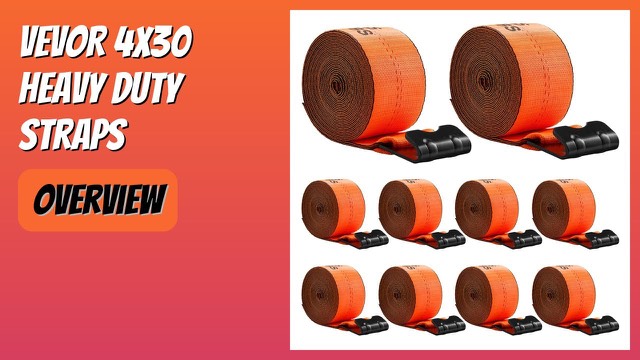
These VEVOR heavy duty truck straps (model PG-08240002) are 4-inch-wide, 30-foot polyester tie-down straps sold in a pack of ten, each with a steel flat hook at one end. They are made for securing loads on flatbeds, trucks and trailers, and VEVOR also lists them for farm work, tree removal and recovering vehicles stuck in sand or mud.
What the two strength figures mean
The listing gives two figures: a working load limit (WLL) of 6,000 lb (2,721 kg) and an assembly break strength of 18,000 lb (8,164 kg). They are not interchangeable. The working load limit is the most you should put on the strap in normal use. The break strength is the force at which a new strap is expected to fail. The gap between them is the safety margin, here three to one.
When securing cargo, the working load limit is the number to plan around, and it is normally applied to the whole assembly: the webbing, the hook and any ratchet or winch you pair with it.
Polyester webbing
VEVOR makes the webbing from blue polyester and says it doesn't absorb water, shrink or stretch. Polyester is a common choice for tie-downs because it tends to keep its length when wet and holds up well in sunlight compared with many other fibres. VEVOR adds that the webbing has a coating and has been heat treated to reach its rated strength and to last longer.
The flat hook
Each strap ends in a black powder-coated steel flat hook. VEVOR describes it as weather resistant and easier to use than a swan-neck hook. You loop it onto a trailer stake pocket or bed rail and secure the other end on the opposite side of the trailer. Flat hooks suit flat anchor points such as stake pockets and rails. They are a poorer fit for round or narrow anchors, so look at what your trailer actually has.
Where the straps are used
VEVOR lists several jobs:
- Holding stacks of lumber, pipe and plywood so they don't shift in transit.
- Short hauls between a port and a distribution centre, or longer regional freight.
- Securing motorcycles and motocross gear.
- Tree saver use, where a wide strap protects bark when pulling.
- Recovering vehicles or heavy objects caught in sand or swamp.
A 30-foot length is long enough to go over tall or wide loads and still reach the anchor point on the far side. A pack of ten lets you spread a load across several straps instead of relying on one or two.
Using straps well
A few points apply to any tie-down strap. Protect the webbing from sharp edges, for example with edge guards or sleeves. Check each strap for cuts, frayed stitching and sun damage before every trip, and retire any that are worn. Don't use tie-downs rated for cargo as lifting slings. Rules for load securement vary by region and by vehicle, so check the requirements that apply to you.
What to check before you buy
- Working load limit: add up the loads you will secure and confirm the straps, hooks and anchor points are rated for them.
- Anchor points: confirm your trailer or truck has stake pockets or rails that suit flat hooks.
- Width and length: 4 inches by 30 feet is wide and long. Check it suits your load and your tensioning hardware.
- Tensioner: the listing doesn't mention a ratchet, so check what you will use to tighten the straps.
- Recovery use: check the manufacturer's guidance before using any strap to pull a vehicle.
- Inspection and storage: keep them dry and out of strong sunlight when not in use.
The short version
- Ten polyester straps, each 4 in x 30 ft, with a steel flat hook.
- Rated at a 6,000 lb working load limit and an 18,000 lb assembly break strength.
- Intended for flatbeds, trucks, trailers, farm work, tree removal and vehicle recovery.
- Plan around the working load limit, not the break strength.
- Inspect before each use and follow local load-securement rules.
Bloiq is reader-supported. Some links may earn us a commission; it never affects what we write. How we make money.